In the quiet grounds of Arnhem Oosterbeek War Cemetery in the Netherlands lie more than 1,750 Allied servicemen, most of whom died during the Battle of Arnhem in September 1944.
Among them are four members of the Royal Australian Air Force: Reginald Austin Davis, Keith Willett, Thomas John Lennie and Bruce Llewellyn Williams.
Their graves provide a tangible Australian connection with one of the best-known battles fought during the liberation of the Netherlands. But Oosterbeek also tells another story: the remarkable way in which successive generations of Dutch people have continued to remember the Allied servicemen buried there.
Four Australians at Oosterbeek
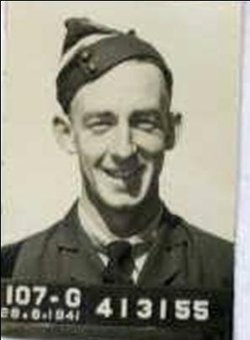
The four Australians lie in two pairs, reflecting the two aircraft in which they lost their lives.
Pilot Officers Reginald Austin Davis and Keith Willett were both members of the RAAF serving with No. 190 Squadron RAF. On 20 September 1944 they were aboard Short Stirling LJ829 on a resupply mission to the airborne forces fighting around Arnhem.
Davis, born at Redfern in Sydney in 1917, had studied economics at the University of Sydney before enlisting in the RAAF in 1941. Willett was born in 1915 and was serving as navigator/bomb aimer.
Their Stirling left RAF Fairford at 3.03 pm carrying supplies for Arnhem. It was shot down near Doorwerth, immediately west of Oosterbeek. All aboard were killed, including Davis and Willett, Canadian and British members of the aircrew and two British Army air despatchers.
Davis and Willett now lie beside one another:
Reginald Austin Davis — Plot 29, Row C, Grave 3
Keith Willett — Plot 29, Row C, Grave 4.
Five days later, two more Australians were lost over Arnhem.
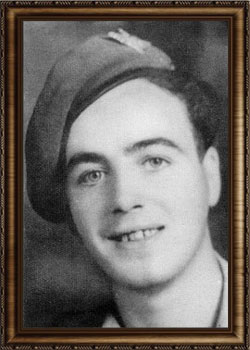
Flight Sergeant Bruce Llewellyn Williams, from Victoria, was the pilot of Mitchell bomber FW194 of No. 98 Squadron RAF. His navigator/bomb aimer was Flying Officer Thomas John Lennie, born at Maryborough, Queensland, who had enlisted in Brisbane in April 1942.
On 25 September their aircraft was attacking German positions around Arnhem when it was intercepted by German fighters. Lennie was killed aboard the Mitchell. Williams ordered the surviving crew to abandon the badly damaged aircraft before parachuting towards Arnhem bridge. He was shot and killed while descending.
A Dutch civilian, Fritz Baars, witnessed what happened. When it was safe, he recovered Williams’s body and buried the young Australian nearby in his parachute. After the war Williams was reinterred beside Lennie at Oosterbeek.
Their graves are:
Thomas John Lennie — Plot 21, Row C, Grave 12
Bruce Llewellyn Williams — Plot 21, Row C, Grave 13.
These four graves complement the story told in DACC’s separate article on the Australian involvement in Operation Market Garden and the Arnhem diorama at the Gold Coast War Museum.
From battlefield to cemetery

After the Battle of Arnhem, Allied dead lay in temporary graves across Arnhem, Oosterbeek and the surrounding countryside. Arnhem Oosterbeek War Cemetery subsequently became their principal Commonwealth burial ground.
Today more than 1,750 Allied servicemen are buried there. The cemetery is maintained by the Commonwealth War Graves Commission and remains the focal point for the annual commemoration of the Battle of Arnhem.
For the families of Davis, Willett, Lennie and Williams, the Netherlands consequently became the permanent resting place of sons who had travelled halfway around the world before joining British squadrons fighting for the liberation of Europe.
But the Dutch community surrounding the cemetery developed its own relationship with these graves.
The Flower Children of Oosterbeek
The tradition began almost immediately after the war.
At the first major commemoration at the cemetery in September 1945, approximately 1,200 local schoolchildren placed flowers on the graves of those killed during the Battle of Arnhem.
The children subsequently became known as the Arnhem or Oosterbeek “Flower Children”.
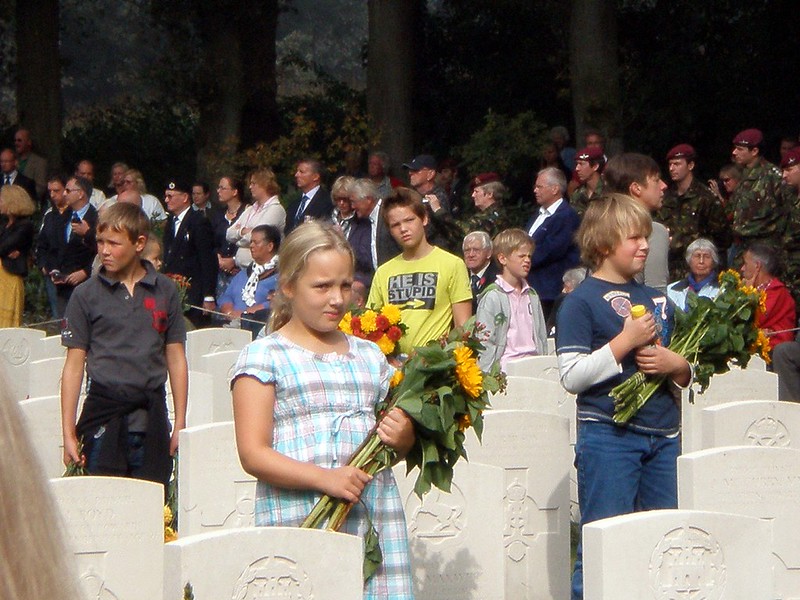
Children laying flowers at the graves in the Arnhem Oosterbeek War Cemetery. Source UK Embassy The Hague
What began with children who had themselves experienced occupation and the fighting around Arnhem became an intergenerational tradition.
More than eighty years later it continues.
At the annual Airborne Memorial Service, held on the first Sunday after 17 September, schoolchildren from the municipality of Renkum traditionally place flowers at the graves. Relatives of those who died, representatives of airborne organisations and thousands of visitors attend the ceremony.
The significance lies not simply in placing flowers on military graves. Children who have no personal memory of the war are being introduced to individual people who died during the liberation of their country.
The four Australian graves are part of that landscape of remembrance.
A Dutch-Australian tradition of remembrance
In the article: “The Dutch who remember: caring for Australian war graves in the Netherlands”, we mention the story on Eindhoven-Woensel General Cemetery, where members of the Adriaensen family have cared for the graves of Australian airmen Farquharson Proctor and Mervyn Lionel Vivian Hass.
Oosterbeek represents a related but somewhat different tradition.
At Eindhoven, individual Dutch families adopted particular Australian graves. At Oosterbeek, remembrance became embedded in the community through generations of local schoolchildren participating in the annual ceremony.
Together they demonstrate something that extends beyond the military history of the Second World War: a Dutch sense of responsibility for servicemen from distant countries who died during the liberation of the Netherlands.
For Australia, the four graves at Oosterbeek give that tradition names.
Reginald Austin Davis, Keith Willett, Thomas John Lennie and Bruce Llewellyn Williams were Australians serving in British squadrons. They died over the Netherlands within five days of each other in September 1944.
More than eighty years later, they remain part of a living Dutch tradition of remembrance.
Sources and further reading
Australian War Memorial – 75th anniversary of Operation Market Garden — overview of Operation Market Garden and Australian involvement, including Bruce Williams, Thomas Lennie and Dutch civilian Fritz Baars.
Australian War Memorial – Bruce Llewellyn Williams, No. 98 Squadron RAF — detailed account of the 25 September 1944 mission over Arnhem, Williams’s death, Fritz Baars and Williams’s eventual burial at Arnhem Oosterbeek War Cemetery.
Commonwealth War Graves Commission – Arnhem Oosterbeek War Cemetery — official CWGC information on the cemetery and those commemorated there.
Airborne Memorial Service Oosterbeek — information on the annual commemoration and the continuing involvement of local schoolchildren in placing flowers on the graves.
ABC News – Dutch families keeping alive the memory of Allied servicemen — covers the Dutch tradition of caring for Allied war graves, including the Arnhem Flower Children and the continuing Australian connection.
Aviation Heritage Museum of Western Australia – Reginald Austin Davis RAAF — biographical and service information on Davis, killed during the Arnhem resupply operation on 20 September 1944 and buried at Oosterbeek.
Virtual War Memorial Australia – Thomas John Lennie RAAF — biographical and service information on the Maryborough-born Queensland airman killed over Arnhem on 25 September 1944.