Seven men survive a forced landing in remote Northern Territory country
On 25 March 1947, Royal Netherlands Navy Douglas C-47 Dakota W-12 made a forced landing in extremely remote country northeast of Katherine in the Northern Territory.
The aircraft, carrying seven Dutch servicemen, had suffered a complete electrical failure during a flight from Sydney to Java. The pilot brought the Dakota down in the first suitable clearing he could find before darkness and worsening weather made a safe landing impossible.
All seven occupants survived without serious injury. Four subsequently undertook a dangerous journey down the Katherine River in an attempt to reach help, while three remained with the aircraft.
The incident became one of the most remarkable Dutch aviation survival stories in postwar Australia.
Royal Netherlands Navy Dakota W-12
The aircraft was a Douglas C-47A-25-DK Dakota operated by the Marine Luchtvaartdienst, the Royal Netherlands Navy Air Service.
Its recorded details were:
- Royal Netherlands Navy registration: W-12, subsequently also recorded as Q-12;
- United States Army Air Forces serial number: 42-93312;
- construction number: 13210; and
- radio call sign: PM-WAB.
The aircraft should not be confused with the Netherlands East Indies Army Air Force Dakota lost off North Stradbroke Island on 26 February 1947. They were separate accidents involving aircraft belonging to different Dutch services.
The forced landing
W-12 was flying from Sydney to Java when it encountered stormy weather over the Northern Territory. Contemporary reports state that its electrical system failed, depriving the crew of normal radio communication and navigational assistance.
Some later accounts attribute the failure to a lightning strike. This is plausible given the weather conditions, but the attached contemporary newspaper reports refer only to an electrical-system failure.
With approximately two hours of fuel remaining, the pilot decided not to continue into deteriorating weather or risk attempting a landing after dark. At approximately dusk, he brought the Dakota down in a clearing about 55 miles northeast of Katherine, near the Katherine River and the Katherine Gorge region.
Before landing, the pilot instructed the other occupants to move to the rear of the aircraft to reduce the risk of injury. The Dakota was badly damaged, but none of the seven men was seriously hurt.
The missing aircraft is located
When W-12 failed to arrive, aircraft began searching the vast area between northern Australian airfields.
The missing Dakota was eventually spotted from the air in swampy country by a passenger aboard a Qantas flying boat. A message laid out on the ground informed the search aircraft that all seven men had survived.
An RAAF aircraft subsequently dropped a portable wireless set. Communication established that three men remained at the wreck while four had already left in an attempt to reach Katherine.
The location was so isolated that an overland rescue party expected to require several days to reach the aircraft.
Four men set out for Katherine
Believing that search aircraft might be looking many miles from the forced-landing site, four members of the party decided to seek help.
The group included the aircraft’s pilot, identified in contemporary reports as Lieutenant van Nifterick, the wireless operator and two Netherlands naval aviation passengers.
They took an inflatable aircraft dinghy and attempted to follow the Katherine River downstream. Progress alternated between travelling by raft and walking along the riverbanks where rocks, rapids or other obstacles made the waterway impassable.
The men crossed exceptionally difficult country characterised by steep escarpments, dense vegetation, swampy ground and grass reportedly reaching ten feet in height.
A desperate shortage of food
The four men carried only limited provisions. Contemporary reports state that for several days they survived on oranges and two tins of condensed milk.
Two dogs had apparently been carried aboard the Dakota. One accompanied the men on their journey and was called Bataan.
As their food ran out, Lieutenant van Nifterick shot the dog. It was cooked over a fire and eaten by the four men. Although disturbing, this detail was widely reported at the time and demonstrates the severity of their predicament.
Reaching Katherine
After approximately six days travelling by raft and on foot, the exhausted men approached Katherine.
Fresh horse tracks suggested that rescuers were searching the area. Sergeant Smyth of the Katherine police had also received information from Aboriginal people and set out by vehicle to look for the missing airmen.
The four Dutchmen heard the vehicle and followed its wheel tracks. They reached safety on 1 April 1947 suffering only abrasions and minor infections.
Initial newspaper reports described their arrival in Katherine as astonishing because the missing aircraft had been located only shortly before and the scale of their journey was not yet fully understood.
The remaining three men stayed with the Dakota. An overland party reached them and they were brought safely to Katherine several days later.
Eddy Emile van Rhoon and the family account
A family recollection identifies Eddy Emile van Rhoon as one of the seven men aboard the aircraft.
Van Rhoon was born at Surakarta in the Netherlands East Indies on 1 July 1917. He served as a flying navigator with the Royal Netherlands Navy Air Service. He was later the father of Australian singer and actor Karel Lawrence van Rhoon, better known as Marty Rhone.
According to the story Eddy passed to his family, he was among those who left the aircraft and travelled towards Katherine. His account included the use of the inflatable dinghy, the crocodile-inhabited river, the group’s uncertainty about its position and the decision to eat the dog when the food ran out.
These details correspond closely with contemporary newspaper reports. Nevertheless, the complete official list of W-12’s seven occupants has not yet been located in the available public sources. Eddy van Rhoon’s presence should therefore be described as a family account until it can be confirmed from the Royal Netherlands Navy accident file or passenger list.
His correct surname is van Rhoon, not “van Kroon”.
Salvaging the Dakota
Unlike the Dakota lost off North Stradbroke Island, W-12 was not abandoned permanently at the crash site.
A recovery party salvaged the aircraft later in 1947. A surviving photograph shows the damaged Dakota under tow near Maranboy during its lengthy journey towards Katherine.
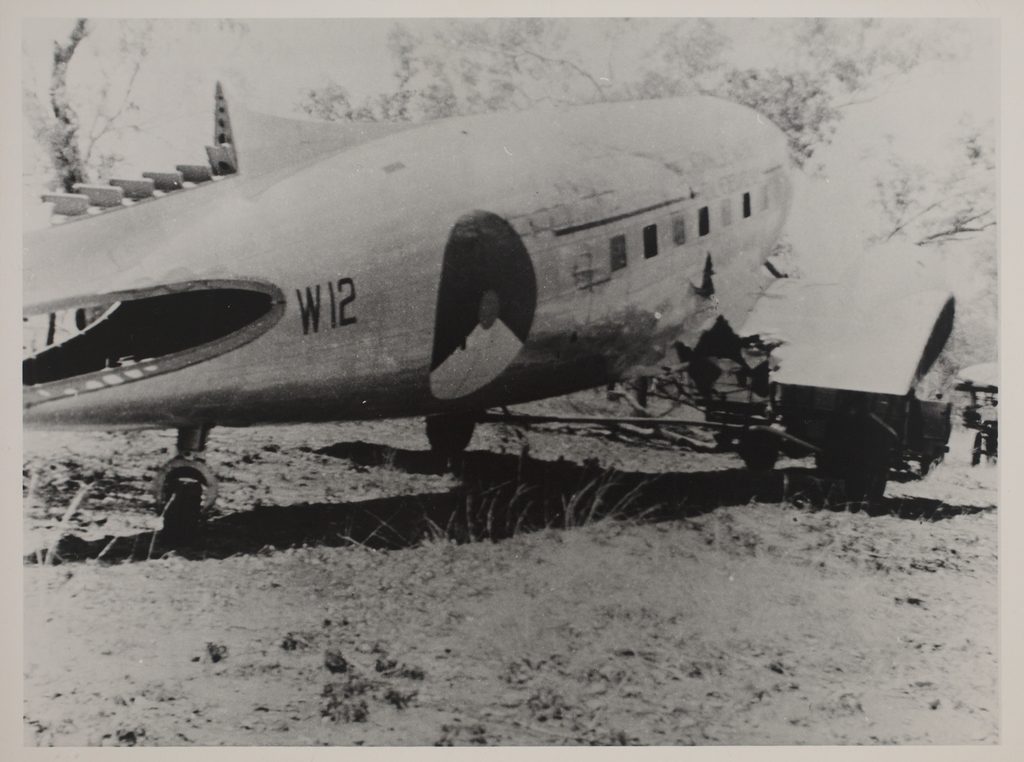
The Dakota was reportedly towed on its wheels behind a truck through Katherine and onwards towards Darwin. Later accounts suggest that it may subsequently have been shipped to the Netherlands, although its final disposal has not yet been conclusively established.
Historical significance
The incident demonstrates the dangers faced by Dutch military aircraft continuing to operate between Australia and the Netherlands East Indies after the Second World War.
It also illustrates the vast practical difficulties involved in search and rescue across northern Australia. Although the aircraft was located from the air, reaching it overland required several days. The survival of all seven occupants resulted from the skill of the pilot, the availability of emergency equipment, aerial searches and the determination of the men themselves.
The family recollection of Eddy van Rhoon provides an important personal dimension to the story. Used alongside contemporary newspapers and official aircraft records, it helps preserve the experiences of the individuals involved while distinguishing family memory from facts that have been independently documented.
Contemporary newspaper reports
The following contemporary newspaper reports provide additional accounts of the crash, the survival of all seven occupants and the difficult journey undertaken by four members of the crew.
- Wrecked Dakota—Dutch crew unhurt, Kalgoorlie Miner, 2 April 1947. This report describes the discovery of the aircraft, the message confirming that its seven occupants were safe, and the departure of four men for Katherine.
- Gruelling six-day journey by raft and foot, Kalgoorlie Miner, 2 April 1947. This report describes the four men’s journey, their limited provisions, the death of the dog Bataan and the pilot’s reasons for making the forced landing.
Related DACC articles
- DACC Air Force Research Portal
- Royal Netherlands Navy flying-boat operations in Australia
- The Dutch at Archerfield Airport, Brisbane
- The ML-KNIL Dakota crash in Moreton Bay
- A Dutch Lockheed crash-lands near Katherine in 1942
Sources and further reading
- Library and Archives Northern Territory—Dutch Dakota under tow near Maranboy
- Nationaal Archief—records concerning the forced landing of Marine Dakota W-12 near Katherine
- IPMS Nederland—Royal Netherlands Navy Douglas C-47 and DC-3 aircraft register
- Geoff Goodall—wartime transport aircraft radio call signs and W-12
- Papers Past—Four crashed Dutch airmen reach safety
Paul Budde, updated October 2026