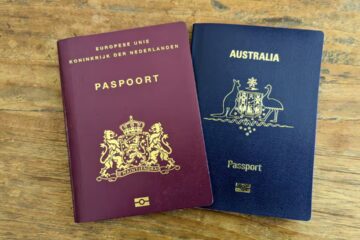
Hendrik Johan “Harry” Burgers lived a life shaped by war, displacement and migration. He served as a radio operator and air gunner during the Japanese invasion of the Netherlands East Indies, survived a forced landing at sea, shot down a Japanese fighter and received the Bronze Cross for bravery.
After escaping to Australia, however, he became the largely forgotten fourth man caught up in the controversial Colombo treason case involving three members of No. 18 (Netherlands East Indies) Squadron RAAF. Unlike the other three airmen, Burgers was not accused of joining their alleged conspiracy. He was prosecuted because he had heard about the proposed flight to Java but had not reported it.
After the war, Harry married Nora Hevel, returned to the Netherlands East Indies and eventually migrated with his family to Australia. They settled in Cowra, New South Wales, where their family story developed another remarkable connection with the former political prisoners of Boven Digul.
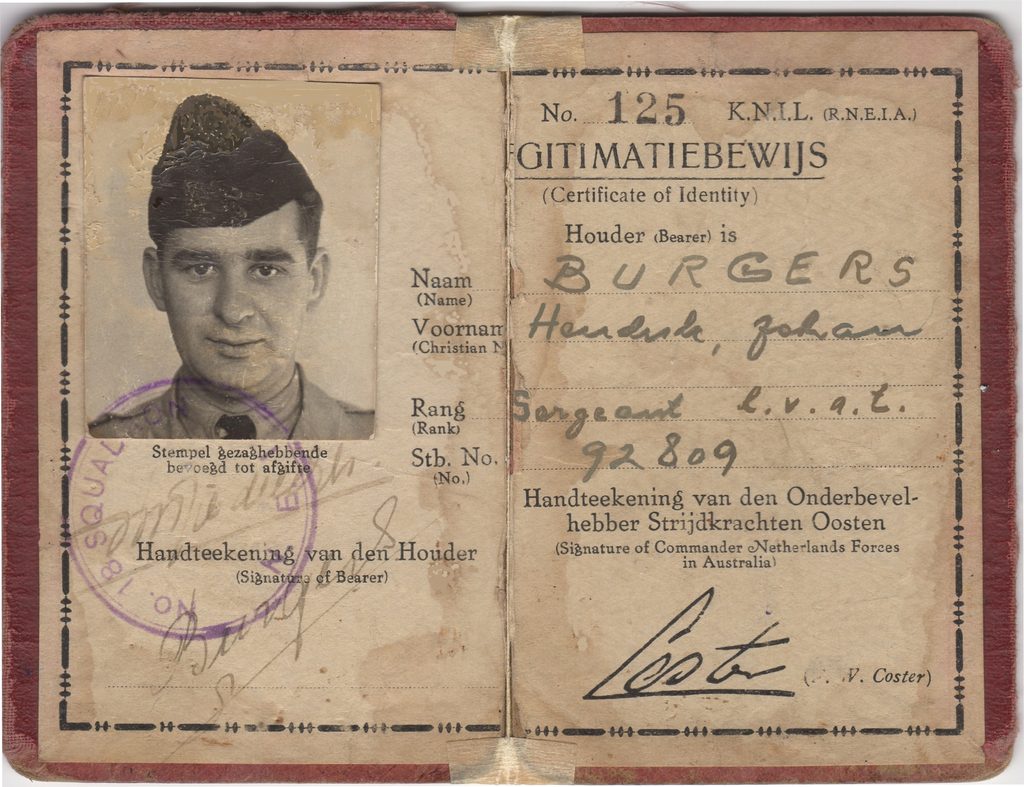
From Nijmegen to the Netherlands East Indies
Hendrik Johan Burgers was born in Nijmegen on 2 November 1918.
According to the judgment in his later court-martial case, he voluntarily entered the Royal Netherlands East Indies Army—KNIL—on 21 June 1937. After basic training with the Colonial Reserve in Nijmegen, he was sent to the Netherlands East Indies.
Burgers initially joined the 3rd Battalion Engineers at Tjimahi, where he trained as a radio operator. In February 1940 he transferred to the Military Aviation branch of the KNIL, the ML-KNIL, at Andir near Bandung. There he qualified as a radio operator and air gunner.
After being promoted to corporal, he was posted to the 3rd Flight Group at Tjililitan, near Batavia.
Flying against the Japanese advance
By early 1942, Japanese forces were advancing rapidly across Southeast Asia.
In January, Burgers participated in reconnaissance flights from Palembang in southern Sumatra, including missions towards Singapore. During one of these operations, the Glenn Martin bomber in which he was serving suffered engine failure and was forced to land in the sea near Billiton Island. Burgers and the other crew members were rescued.
The aircraft commander subsequently reported that Burgers had performed his duties faultlessly throughout the emergency.
Burgers continued flying with a bomber unit conducting operations around Muntok and Palembang. These were extremely dangerous missions against a Japanese force that enjoyed increasing air superiority. Several Dutch aircraft were lost.
According to the account presented by his defence counsel, Burgers once gave another radio operator five bottles of beer to exchange places with him so that he could participate in an operation against the oil installations at Pladju, near Palembang.
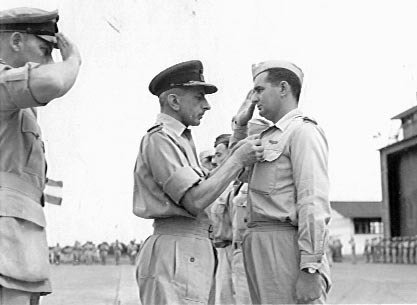
On 19 February 1942, three Dutch Glenn Martin bombers were attacked by Japanese Zero fighters. Burgers, serving as an air gunner, shot down one of the attacking aircraft. His action allowed the bombers to climb towards the protection of cloud cover.
For this act of courage, he was awarded the Bronze Cross. Because of the collapse of the Netherlands East Indies and the disruption of military administration, formal recognition was delayed. The award was confirmed and presented to him at Tjililitan in 1948.
Escape from the Netherlands East Indies
Towards the end of February 1942, Burgers was among the airmen assigned to collect new B-25 Mitchell bombers from British India.
By the time the aircraft were available, Java had fallen and the men could not return. Burgers subsequently escaped to Australia and in May 1942 was posted to the newly formed No. 18 (Netherlands East Indies) Squadron RAAF, where he was promoted to sergeant.
The squadron had been created from Dutch airmen and technical personnel who had escaped the Netherlands East Indies, combined with Australian personnel supplied by the RAAF.
Many of the Dutch airmen were now stranded in Australia while their wives, children and other relatives remained in Japanese-occupied Java. The delayed delivery of aircraft, inactivity, poor living conditions and uncertainty about their families placed the men under severe emotional pressure.
The background to this period is described in the DACC article B-25 bombers ordered by the Dutch ended up with the USAAF.
Approached by Lieutenant Burck
One of the squadron’s pilots, Lieutenant Will Burck, became obsessed with returning to Java. His family had been left behind, and he repeatedly spoke about taking an aircraft and attempting to reach them.
In late October or early November 1942, Burck approached Burgers at the Canberra airfield. He asked Burgers what he thought about the war and whether he would consider returning to Java in an aircraft belonging to the squadron.
Burck explained that he needed a radio operator who could identify Japanese frequencies and contact the Japanese before the aircraft reached Java. This, he believed, would prevent the aircraft from being shot down.
Burgers questioned what would happen after they arrived. He pointed out that the Japanese were unlikely to trust Europeans and would probably place them behind barbed wire.
He also told Burck that locating the appropriate Japanese frequencies and call signs would be extremely difficult. Burgers later explained that he said this partly to discourage Burck and partly because he had no intention of participating.
When Burck raised the matter again, Burgers gave him an unequivocal answer: he did not want to return to Java.
Burgers did not report the conversations. He considered Burck’s proposal so unrealistic that he did not believe it would ever be attempted. He also assumed that an officer would ultimately recognise the foolishness of the idea.
The three arrests
On 10 November 1942, Burck met Sergeants Erich de Lyon and Harry Kelder in a Canberra hotel room. Also present was Sergeant-Major Adriaan Scholte, who was secretly working for Major Simon Spoor of Dutch military intelligence.
During a night of drinking, the men discussed taking a B-25 and returning to Java. Scholte encouraged the discussion and later provided the principal written statement used against them.
Burck, De Lyon and Kelder were arrested. They were subsequently accused of conspiring to commit military treason and desert to the enemy.
Burgers had not attended the hotel meeting and apparently did not know that the other three men had been arrested.
Arrested by Major Spoor
On 29 November 1942, Burgers was summoned to Major Spoor’s office at Dutch military headquarters in Melbourne.
Spoor informed him that he was under arrest for failing to report the proposed conspiracy. Burgers was taken into Australian police custody and later held at Pentridge Prison in Melbourne.
He was subsequently transferred to military detention near Fremantle, where Burck, De Lyon and Kelder were also being held. The four men were then transported aboard the British freighter Tanda to Colombo in Ceylon, now Sri Lanka.
The Dutch authorities had decided to place the airmen under naval jurisdiction. Their court-martial proceedings were held aboard the Dutch submarine depot ship Plancius in Colombo Harbour.
Burgers’ defence
Burgers was tried separately from Burck, De Lyon and Kelder.
His defence did not deny that Burck had approached him. Instead, it argued that Burgers had not appreciated the seriousness of the conversations because the proposal appeared impractical and absurd.
His counsel also pointed out that Burck’s desire to return to Java was widely known within No. 18 Squadron. Numerous airmen, including officers, had heard similar discussions without reporting them. Some senior personnel apparently knew of Burck’s obsession but did not regard it as a genuine operational plan.
The defence argued that it was unjust to single out one relatively junior sergeant when so many others—including officers—had possessed similar information.
It also drew attention to Burgers’ excellent military record. He had served courageously during the Japanese invasion, survived dangerous reconnaissance and bombing operations, and distinguished himself in aerial combat.
The court’s decision
On 22 October 1943, the Dutch Naval Court Martial found Burgers guilty of deliberately failing to inform the proper authority about information whose concealment could damage the military service or the state.
The prosecution had requested eight years’ imprisonment.
The court imposed a substantially lower sentence of twelve months, with the 328 days Burgers had already spent in detention deducted from it.
The judgment rejected the argument that the failure to prosecute other airmen excused Burgers. The court described that as a matter of prosecutorial policy.
Nevertheless, it accepted several mitigating circumstances. Burgers had rejected Burck’s proposal, possessed no firm evidence that an actual attempt would be made, and would have been required to report a former aircraft commander and superior officer.
Most significantly, the court recorded that Burgers had behaved loyally during the war. It therefore declined to strip him of his military rank.
Burgers was never convicted of treason, conspiracy or attempting to desert to the Japanese. His offence was limited to failing to report Burck’s conversations.
The broader case and the controversial role played by Spoor and Scholte are examined in Between duty and desperation: The Colombo treason case within No. 18 (NEI) Squadron.
Marriage and return to the Netherlands East Indies
After the war, Harry returned to the Netherlands.
On 29 December 1945, he married Nora Hevel in Nijmegen. Nora was the daughter of Jan Hevel, who had served as an adjutant at the Boven Digul political prisoners’ camp in Dutch New Guinea.
Their first son, Robert Harry, was born in Nijmegen on 18 October 1946.
The family then returned to the Netherlands East Indies, where Harry was stationed at Tjililitan airbase during the Indonesian struggle for independence. Their second son, Ernie, was born at Tjililitan on 23 June 1949.
Harry eventually left military service with the rank of sergeant-major.
A new life in Cowra
In 1950, Harry and Nora decided to migrate to Australia. They settled at Cowra in New South Wales.
Cowra already occupied a distinctive place in Australian wartime history because of its prisoner-of-war camp and the 1944 Cowra breakout. It also became the final resting place of several former political prisoners from Boven Digul who had been transported to Australia by the Dutch authorities in 1943.
Through Nora’s childhood connection with Boven Digul, the Burgers family developed a special interest in these Indonesian graves. Nora, and later Ernie, helped preserve the memory of the people buried there.
The family’s history therefore connects several important chapters of the Dutch, Indonesian and Australian past: Boven Digul, the Japanese invasion, Dutch military aviation from Australia, the Colombo court-martial affair, the Indonesian struggle for independence and post-war Dutch migration.
This wider family story is told in A fascinating link between the Boven Digul Camp, the 18th NEI Squadron and the Cowra WWII Cemetery.
Courage followed by injustice
Harry Burgers’ story contains a striking contradiction.
In February 1942, he risked his life defending the Netherlands East Indies and shot down an attacking Japanese fighter. Only nine months later, he was arrested because he had failed to report another man’s desperate and unrealistic proposal to return to Java.
He spent almost a year in detention and was transported out of Australia for trial, even though he had rejected Burck’s approach and remained loyal throughout the war.
The court itself acknowledged that loyalty. His Bronze Cross, eventually presented in 1948, provided formal recognition of his courage during the defence of the Netherlands East Indies.
Harry Burgers died at Orange District Hospital on 17 August 1987. He was 68 years old.
His life deserves to be remembered not simply as that of the “fourth man” in the Colombo affair, but as the story of a courageous airman who survived the collapse of the Netherlands East Indies, endured a deeply questionable prosecution and subsequently built a new life with his family in Australia.
Paul Budde, September 2026
Sources and further reading
- Judgment of the Dutch Naval Court Martial in the case of H.J. Burgers, Colombo, 22 October 1943. Document supplied by the Burgers family.
- English translation of the defence presented in the court-martial case of H.J. Burgers. Document supplied by the Burgers family.
- J.C. Bijkerk, De Colombo-tragedie, Van Wijnen, Franeker, 1991.
- Hendrik Johan Burgers — biographical and military record
- Nijmegen recipients of the Bronze Cross
- Doug Hurst, The Fourth Ally: The Dutch Forces in Australia in WWII, 2001.
- O.G. Ward, De Militaire Luchtvaart van het KNIL in de jaren 1942–1945.
- Dr Jack Ford, Allies in a Bind: Australia and the Netherlands East Indies in the Second World War.
- TracesOfWar: Dutch aviation units serving overseas, 1940–1945
Documentation
Harry Burgers judgement
Harry Burgers defence lawyer
Newspaper article in Vrij Nederland 3 October 1991
Extract from the book “The Fourth Ally”