By Edward Duyker
Every now and then, we can all be surprised by what we dig up in the garden, be it a tool, a missing piece of jewellery or a coin. On 26 March 2025, my wife Susan was weeding in our vegetable garden and found a weathered 1-Cent Netherlands East Indies coin, dated 1942. We were both intrigued. It was not a coin either of us had lost or easily recognised.1
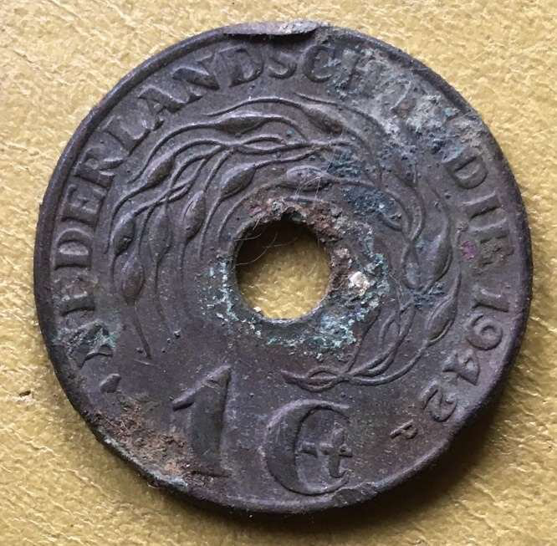
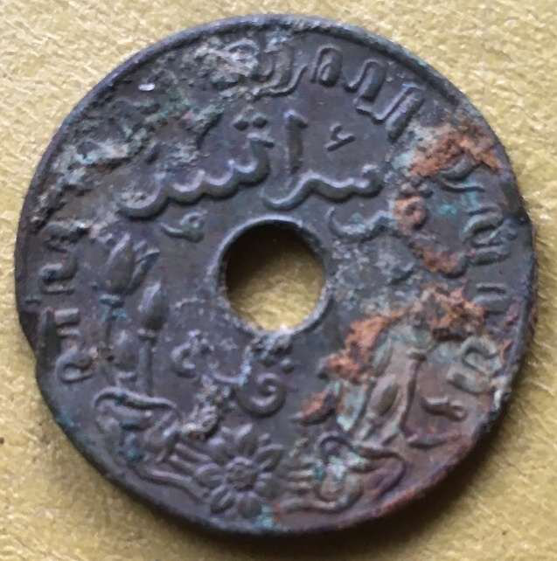
The coin has a hole in the middle. On the obverse it has a rice plant under the Dutch name ‘Nederlandch Indie’ in Latin script. On the reverse it has Arabic and Javanese script denoting ‘One Hundredth Rupiah’. Surprisingly, 100,000 of these Dutch colonial coins (including the one in our garden) were produced by the Philadelphia Mint in 1942 (indicated by the ‘P’ after the date).2 This was at the behest of the Dutch Government in exile, because the metropolitan Netherlands was under German occupation from May 1940. Normally such coins would have been produced by the Royal Dutch Mint in Utrecht with a caduceus or staff of Mercury as a mint mark.
The year the coin was minted was momentous for the inhabitants of the Netherlands East Indies; the Japanese invaded in January 1942 and soon controlled the entire archipelago. Not until 1945 were new Dutch colonial coins minted, but once again in the United States. Could the 1942-coin Susan found, have come to Sylvania during the war? There were many remarkable tales of escape to Australia by Dutch servicemen and civilians, in the immediate wake of the Japanese invasion. About 8,000 Dutch civilians arrived in Broome in the last two weeks of February 1942. Half the Allied aircraft destroyed in Broome during the Japanese raid of March 1942 were Dutch. It is still uncertain how many Dutch civilians were killed during the bombing.3
All Dutch military forces which reached Australia were eventually placed under the command of General Douglas MacArthur. Part of the Hotel Queanbeyan became the headquarters of the Netherlands East Indies Air Force. No. 18 Squadron NEI-RAAF comprised both Dutch and Australian flight and ground crews. No. 120 Squadron NEI comprised Dutch flight crews and Australian ground crews. They were soon operating against the Japanese from the Northern Territory. The Dutch light cruiser Tromp, two submarines, a troop transport, a minesweeper and two merchantmen also escaped to Australia. The Dutch naval contingent numbered 1,353 men and was initially under the command of Admiral Helfrich with his headquarters in Melbourne. The Tromp was later joined by three other Dutch warships, the Jacob van Heemskerk, Van Galen and Tjerk Hiddes, which had been serving with the British Eastern Fleet and undertook convoy escort duties from Fremantle after October 1942.4
It seems very unlikely that a Dutch serviceman dropped the coin in what is now our vegetable garden during the Second World War. Although Susan’s father, William Glenn Wade, purchased the land in 1948, the house was not completed until 1953.5 Nevertheless, many Dutch refugees and demobilised servicemen (some of mixed race) made Australia home after the war. They remain a significant ethnic group in the Sutherland Shire.6 A Dutch tradesman or labourer could conceivably have worked on our house or made a delivery here, though no Dutch surnames appear in surviving construction records.7 A Dutch painter, Joe Broer (a Heathcote resident), did work at ‘Glenn Robin’ between 1988 and 1995, but he never served in the East Indies.8
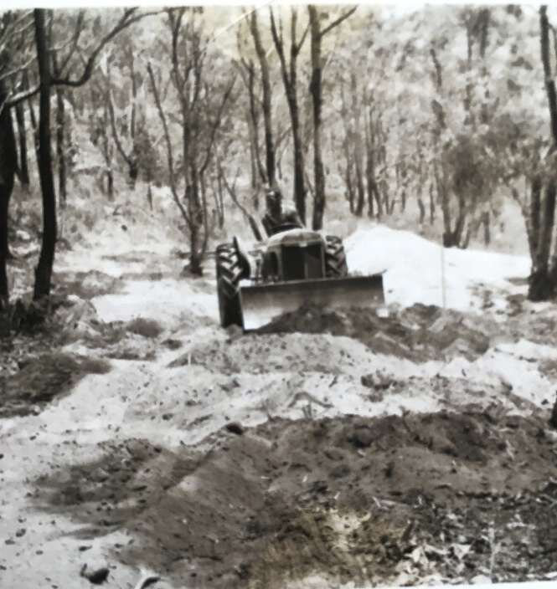
Could we instead connect someone else with the Indonesian Archipelago and this part of Sylvania soon after the war? Many Australians fought in various parts of the formerly Dutch-ruled island chain after the tide turned against the Japanese. We immediately thought of Charles Adams, who was employed by the Wade family as a gardener, handyman and caretaker in Sylvania and then Wallacia until June 1975. He appears in a 16mm film William Glenn Wade took of Queen Elizabeth II passing the Wade property ‘Glenn Robin’ on its then Princes Highway frontage, in Sylvania, in February 1954.9 However, Susan believes he was employed even earlier by her father’s company. After his wife Lola died in Mascot on 10 October 1965, aged 40, Charlie moved to a caravan at ‘Glenn Robin’, along with his red VW Beetle. He lived there until 1968, when he relocated to a farm owned by the Wade family in Wallacia.
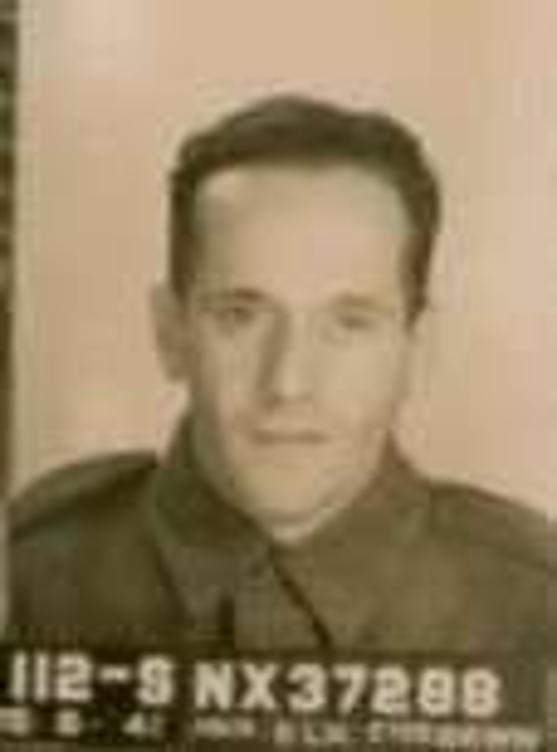
Armed with Charlie’s service number, NX37288, engraved on the back of his World War II decorations which he gave to Susan, rather than his stepson, we were able to access his army records at the National Archives of Australia.10 These records indicate he was born in Auckland, New Zealand, on 24 March 1917. Nevertheless, both his parents were Norfolk Islanders and he grew up on their home island. His father was a direct descendant of the Bounty mutineer Charles Adams and his mother was a direct descendant of the mutineer Matthew Quintal. He also had Tahitian ancestors – the mutineers took Polynesian wives – and this was evident in his dark complexion, eyes and hair.
On 2 December 1939, Charlie Adams joined the Norfolk Island Infantry Detachment (N117044) and served on the island until he travelled to Sydney and joined the Ist Field Infantry Regiment on 25 June 1941. He was initially posted to Ocean Island (now Banaba, Kiribati), but was apparently evacuated aboard the Free French destroyer Le Triomphant, in February 1942, and returned to Australia via New Caledonia. He was back in Sydney, via Brisbane, on St Patrick’s Day 1942, but in late March suffered a fractured right ankle and was not fit for duty until 5 May. Even then, he appears to have received light duties with the Base Postal Unit of the 20th Field Regiment. Charlie was then sent to New Guinea and disembarked in Port Moresby on 12 December 1942. He must have been wounded on 1 April 1943, or perhaps the day before, since he was evacuated to No.2/2 Casualty Clearing Station, but rejoined his unit five days later. He later served with No. 113 Convalescent Depot in New Guinea. While on leave, in Australia, in September 1943, he married his wife Lola who must then have been about 18 years of age. He served in New Guinea until June 1944.
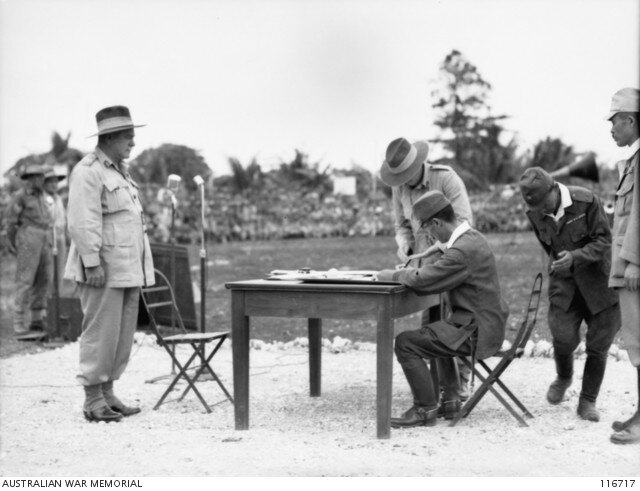
During another period of leave in Sydney, Charlie suffered recurrent bouts of malaria and was twice hospitalised. When he returned to duty, he received driver training in Strathpine, Queensland. Although he completed the course, he was once again hospitalised with malaria in Brisbane. It was from there, on 11 April 1945, that he boarded the Sea Ray for deployment on the island of Morotai in the Netherlands East Indies.11
The Japanese, who still had 190,000 troops on Morotai, under the command of Lieutenant-General Fushataro Teshima, did not surrender until 9 September 1945.12 As a ‘long server’, Charlie was prioritised for his return home. He flew back to Australia a week later, on 16 September, and was discharged on 12 October 1945.
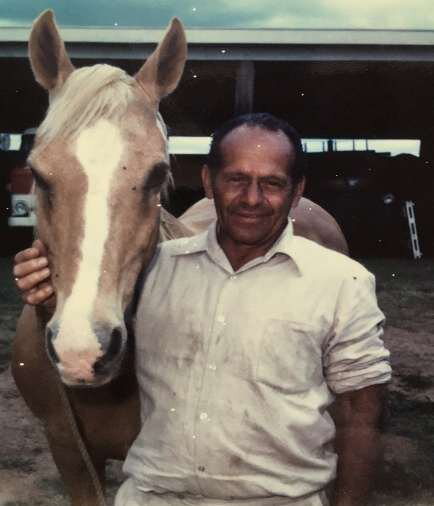
Charles Adams worked for the Wade family until 30 June 1975. He planted the Norfolk Island pine which can still be seen growing on the southern side of ‘Glenn Robin’ in Sylvania. Susan recalls him talking about the mud in New Guinea, Japanese booby traps, and seeing the scars from his war wounds. He retired to Brighton-le-Sands, but was living in Gorokan when he died on 24 February 1983, aged 65.
I never met Charlie. He was invited to our wedding, but it was just four months before his death and he was too ill to attend. We will probably never know if he brought the 1-Cent Netherlands East Indies coin home as a souvenir, or as loose change, and later dropped it in our garden, but it is a tantalising thought. Two of his medals are currently missing.13 Hopefully they are in the attic, not the garden!
First published by Edward Duyker as ‘A Dutch Colonial Coin in the Garden’, in Sutherland Shire Historical Society Bulletin, ISSN 1444-2930, no. 239, May/June 2026, pp. 17–20.
Notes
1. I already possessed a Dutch V.O.C. copper duit from the Netherlands East Indies, but it dates from 1787 and was given to me by one of my brothers.
2. Krause, C. L. et al., World Coins, eighteenth edition, Krause Publications, Iola, Wisconsin, 1991, pp. 1047–8.
3. See Ford, J. M., ‘The First Japanese Air Raid on Broome’, in Sabretache, July-September 1985, pp. 14–18. It deals with the Dutch Catalinas which evacuated refugees from the Netherlands East Indies.
4. See Duyker, E., The Dutch in Australia, AE Press, Melbourne, 1987, chapter 5 contains my account of the Dutch naval forces and NEI airforce squadrons based in Australia. I can also recommend an article by J. M. Ford, ‘The Dutch Navy in the South-West Pacific Area: March 1942–August 1945’, The Navy, October 1985, pp. 31–36. On the Dutch airmen here during WWII, there is also a book by Gordon Wallace entitled Up in Darwin with the Dutch, privately published, Surrey Hills, Vic. 1983.
5. Duyker, E., ‘William Glenn Wade (1911-1983): A Biographical Memoir’, Sutherland Shire Historical Society Quarterly Bulletin, vol. 2, no. 10, May 1995, pp. 209–213.
6. Duyker, E., ‘The Dutch Immigrant Experience: Two Case Studies From the Juliana Village, Miranda’, Sutherland Shire Historical Society Quarterly Bulletin, no. 63, February 1988, pp. 326–9; see also ‘The Dutch in Australia’, Sutherland Shire Historical Society Quarterly Bulletin, November 1988, no. 66, pp. 402–4.
7. See, for example, Duyker, E., ‘Stone Retaining Walls, Sylvania’, Sutherland Shire Historical Society Quarterly Bulletin, vol. 3, no. 2, May 2000, p. 6–7; see also the previously mentioned biographical article on William Glenn Wade.
8. Duyker, E., ‘Joe Broer [obituary]’, Dutch Weekly, 19 January 1996, p. 21.
9. See Duyker, E., ‘Sylvania on Film: Historic 16 mm Footage in the Wade Collection’, Sutherland Shire Historical Society Quarterly Bulletin, no. 60, May 1987, p. 281. This list, however, is not comprehensive.
10. National Archives of Australia, Service Record, Adams, Charles B883, NX37288.
11. Ibid.
12. Long, G. T., Australia in the War of 1939–1945: Series One: Army: Volume VII: The Final Campaigns, Australian War Memorial, Canberra, 1963, pp. 553–4.
13. His service record indicates that he was awarded the 1939/45 Star, Pacific Star, 1939–45 War Medal and Australian Service Medal.