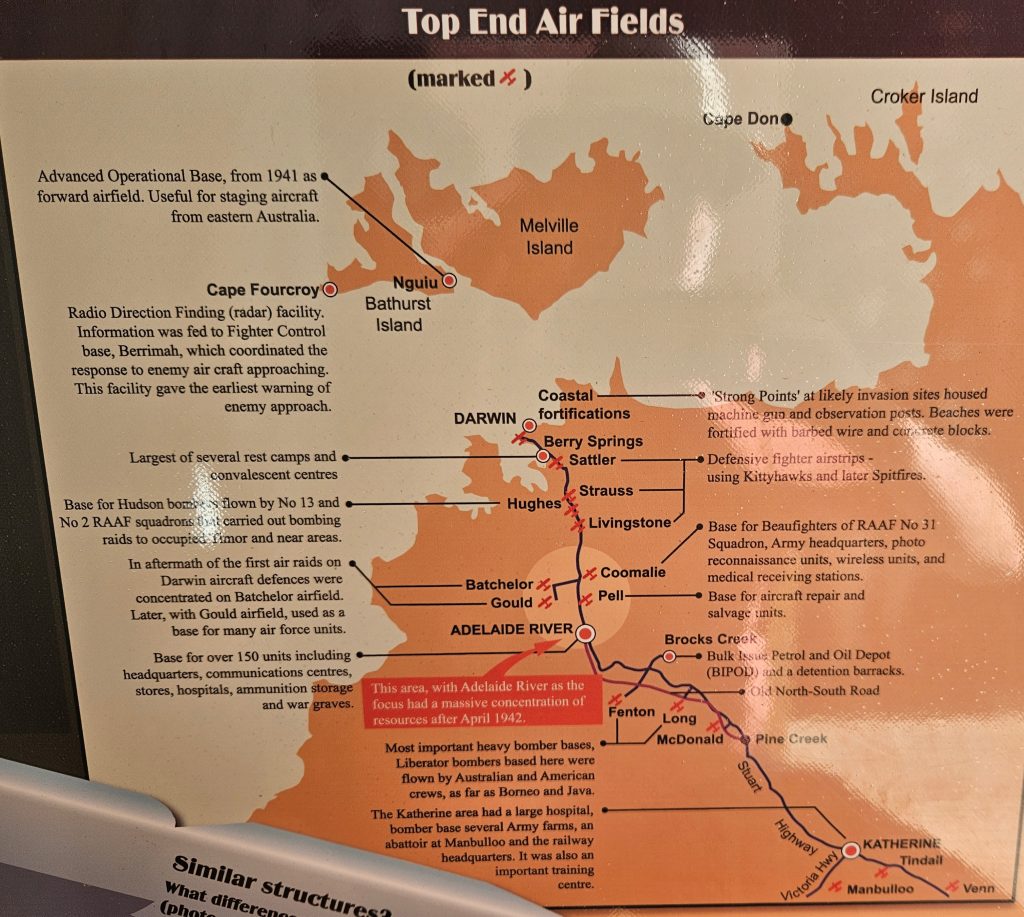
Pell Airfield in the Northern Territory formed part of the network of bases that supported Dutch–Australian air operations from the Top End during the Second World War.
Although No. 18 (Netherlands East Indies) Squadron RAAF was principally based at nearby Batchelor, its B-25 Mitchell bombers could use Pell for maintenance, repairs, emergency landings and dispersal. Pell’s specialist repair and salvage facilities made it an important supporting airfield within the wider Allied aviation network south of Darwin.
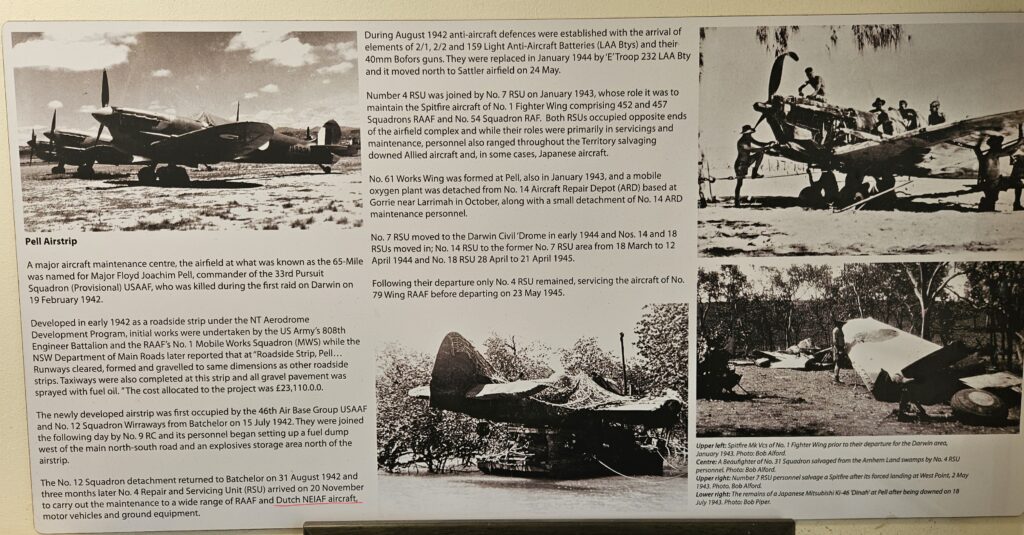
An airfield built for repair and servicing
Pell Airfield was situated southeast of Batchelor, near the Stuart Highway and the settlement of Adelaide River. Unlike several airfields built primarily as operational bomber or fighter bases, Pell was developed particularly as an aircraft repair, servicing and salvage facility.
Its runway was suitable for medium bombers, while taxiways, aircraft dispersal bays, workshops, camps and technical facilities supported the maintenance units based there.
A number of RAAF repair and salvage units served at Pell, including:
- No. 4 Repair and Salvage Unit, subsequently renamed No. 4 Repair and Servicing Unit;
- No. 7 Repair and Salvage Unit;
- No. 14 Repair and Salvage Unit; and
- No. 18 Repair and Salvage Unit.
These units recovered damaged aircraft from remote locations, repaired operational aircraft and salvaged reusable parts from machines that could not be returned to service.
No. 4 Repair and Salvage Unit arrived at Pell in late 1942 and remained there until 1945. Its personnel serviced numerous types of Allied aircraft and undertook difficult recovery missions throughout the Top End.
Named after Major Floyd Pell
The airfield was named in honour of Major Floyd Joaquin Pell of the United States Army Air Corps.
On 19 February 1942, Pell was leading American P-40 Kittyhawk fighters that had returned to Darwin after bad weather prevented their intended flight to Koepang in Timor. The aircraft arrived back as the first major Japanese attack on Darwin began.
Major Pell managed to take off during the attack, but his aircraft was struck by a Japanese fighter. He attempted to escape by parachute at very low altitude, but the parachute did not have sufficient time to open. He was killed in the fall.
Pell was posthumously awarded the United States Distinguished Service Cross. Both the wartime airfield and an associated military camp were named in his honour.
Supporting No. 18 Squadron
No. 18 Squadron operated B-25 Mitchell bombers from Batchelor against Japanese airfields, shipping and military installations throughout the eastern Netherlands East Indies.
The intensity and range of these operations placed considerable demands on the aircraft. Mitchells frequently returned with battle damage, mechanical problems or very little fuel. Access to specialist maintenance facilities at Pell and other nearby airfields was therefore essential.
Pell also provided an alternative landing ground when Batchelor was congested, affected by weather or unsuitable for a damaged aircraft. Gould Airfield performed a related support and maintenance role.
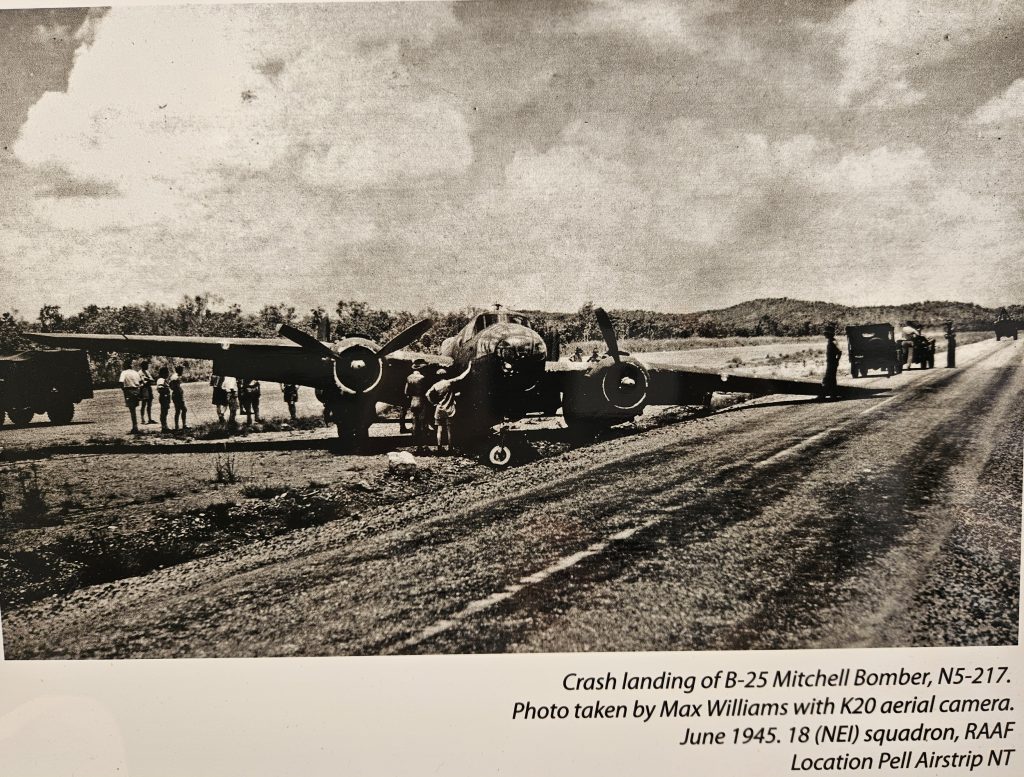
Emergency landing of B-25 N5-217
On 9 February 1945, a No. 18 Squadron B-25 Mitchell made an emergency landing at Pell after its undercarriage failed to lower completely.
A contemporary account recorded:
“A few exciting moments were experienced when a NEI pilot landed a B-25 with his undercarriage partially down. The pilot made a splendid approach and a remarkably good landing, with only slight damage to the aircraft and no injuries of any description to the crew.”
Later aircraft chronologies identify the Mitchell as N5-217. Until its identity and crew can be confirmed directly from the squadron’s operational record, this identification should be treated as provisional.
The aircraft did not “crash” in the usual sense. It completed a controlled emergency landing, suffered only limited damage and caused no injuries. The incident demonstrates both the skill of the crew and the practical value of Pell’s repair facilities.
Surviving heritage
Parts of Pell’s wartime infrastructure remain visible. The surviving No. 4 Repair and Salvage Unit engineering workshop and main camp area are included on the Northern Territory Heritage Register.
These remains are valuable evidence of the extensive technical organisation required to keep Allied aircraft operating under difficult tropical conditions. They also help explain how front-line units such as No. 18 Squadron depended upon a much larger network of engineers, mechanics, salvage teams, transport personnel and support facilities.
Although Pell was not the squadron’s principal operational base, it formed an important part of the Dutch–Australian aviation presence in northern Australia.
Related DACC articles
- WWII airfields in the Top End used by the Dutch
- The Dutch at Batchelor Airport in the Northern Territory
- WWII Gould Airfield used by the Dutch for maintenance
- No. 18 (Netherlands East Indies) Squadron moves to McDonald Airfield, 1942–1943
- The 18 Netherlands East Indies Squadron RAAF
- DACC Research Portal—Dutch and Netherlands East Indies Air Forces in Australia during World War II
Sources and further reading
- Northern Territory tourism—WWII Pell Airstrip Camp A and No. 4 Repair and Salvage Unit workshop
- Northern Territory Place Names Register—Pell Landing Ground
- Territory Stories—Floyd Joaquin Pell
- Territory Stories—No. 4 Repair and Salvage Unit
- Oz at War—military units at Pell Airfield
- Australian War Memorial—No. 18 (Netherlands East Indies) Squadron