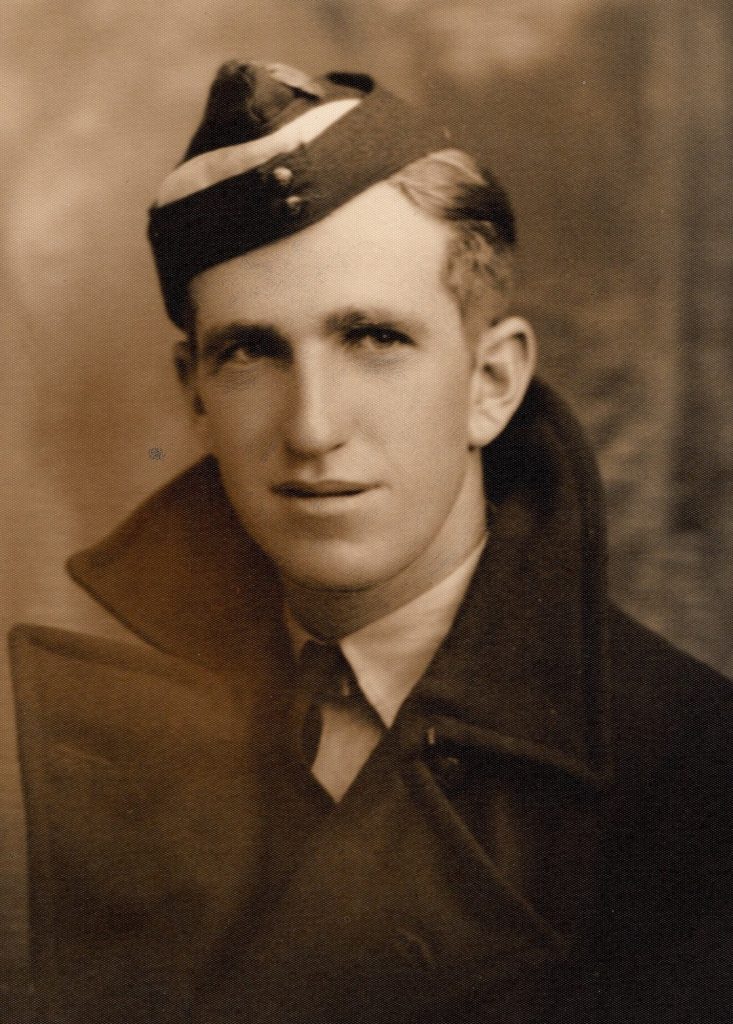
Flight Sergeant Jeffery David “Jeff” Crosbie was one of the Australian airmen who served alongside Dutch and Indonesian personnel in No. 18 (Netherlands East Indies) Squadron RAAF.
A tail gunner in the squadron’s B-25 Mitchell bombers, he participated in reconnaissance patrols and bombing operations against Japanese targets in the Netherlands East Indies. On 30 May 1944, only four months after joining the squadron, Jeff and the five Netherlands East Indies members of his crew were killed when their aircraft crashed during a skip-bombing exercise near Bare Sand Island in the Northern Territory.
He was 21 years old.
Jeff graduated in December 1943. His final report described him as being of “very good character” and a “proficient air gunner.”
During his final leave in Western Australia, Jeff made an unexpected visit to his sister Belle. When she asked why he had returned so soon after seeing her, he reportedly answered that what he was about to do would be dangerous and that he might not return.
Joining No. 18 Squadron
Jeff reported to No. 1 Embarkation Depot in Canberra on 19 January 1944. He was selected for service with No. 18 Squadron, which was then operating B-25 Mitchell bombers from Batchelor in the Northern Territory.
The squadron was a combined Netherlands East Indies–Australian formation. Its pilots and many navigators, bombardiers and other operational personnel came from the Netherlands East Indies, while the RAAF supplied Australian air gunners, technical personnel and much of the ground organisation.
Jeff travelled north by air and reported to the squadron’s aircrew headquarters at Batchelor on 22 January 1944. He was accommodated in an American-style six-man tent in the area occupied by the squadron’s officers and aircrew.
Batchelor was a busy operational base shared by Dutch, Indonesian, Australian and American personnel. Aircraft were continually arriving, departing, being serviced, armed and tested. Living conditions were basic, with intense heat, seasonal rain, insects and limited recreational facilities.
The work of a B-25 tail gunner
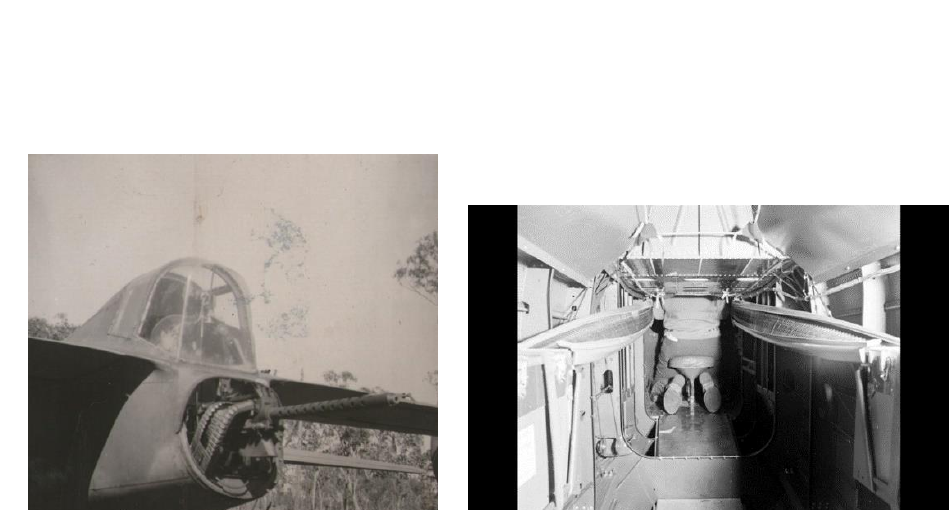
The tail-gunner’s compartment in a B-25 Mitchell was extremely confined. The gunner often had to remain kneeling in position for several hours while the aircraft crossed hostile territory.
The compartment was barely protected from the wind and had no heating. In addition to heavy flying clothing, the gunner carried a life jacket, pistol and ammunition, emergency rations, fishing equipment, jungle knife, mosquito net and parachute.
The gunner’s duties were not limited to defending the aircraft. From his position at the rear, he also observed the results of bombing attacks and reported where the bombs had fallen and what damage appeared to have been caused.
y May 1944, Jeff had been permanently assigned to the crew of B-25D Mitchell N5-176. The Netherlands East Indies members of the crew had trained and travelled together before Jeff joined them:
- Captain Albert Anton Visser, pilot;
- Robert Bousche;
- Johan Frederik Burghard;
- Robert Fruin; and
- Liem You Hien.
Jeff was the crew’s Australian tail gunner.
Their first operation together took place on 11 May, when they attacked Japanese barracks at Penfui. On 27 May they participated in a six-hour bombing operation against Soe. Two days later they undertook bombing and fire-control practice.
The loss of N5-176
On the morning of 30 May 1944, four No. 18 Squadron B-25s were ordered to conduct skip-bombing training at Range L near Bare Sand Island in Bynoe Harbour, west of Darwin.
Skip bombing was a low-level anti-shipping technique. An aircraft approached its target at approximately mast height and released a bomb intended to bounce or “skip” across the water before striking the side of a ship.
The participating aircraft were:
- N5-188;
- N5-185;
- N5-176; and
- N5-171.
N5-176 carried three 250-pound bombs. During the exercise, it was paired with N5-188. The two aircraft completed three bombing runs, including one dry run without releasing a bomb.
During the fourth run, N5-176 followed N5-188 at a greater distance and on a slightly different course. A bomb released by the leading aircraft exploded in the water, producing a large column of water and debris.
The column struck the port wing of N5-176 and tore it from the aircraft. Witnesses in the other Mitchells saw N5-176 turn upside down and crash into shallow water near the south-western corner of the sandbank.
The remaining aircraft circled the area but saw no survivors. A light aircraft later landed on the beach, where its occupants found debris but no members of the crew.
All six men were presumed killed:
- Albert Anton Visser, born in Surabaya in 1916;
- Robert Bousche, born in Semarang in 1922;
- Liem You Hien, born in Cilacap in 1920;
- Johan Frederik Burghard, born in Dampit in 1916;
- Robert Fruin, born in Medan in 1921; and
- Jeffery David Crosbie, born in Midland, Western Australia, in 1922.
Service and remembrance
During his four months with No. 18 Squadron, Jeff completed approximately 68 hours and 30 minutes of daylight operational flying, 48 hours and 15 minutes of night operations and a further 46 hours of non-operational flying.
His service illustrates the important role played by Australians within what is often described simply as a Dutch squadron. Australians served as air gunners, wireless operators, bombardiers, photographers, technical personnel and ground staff. They shared the dangers of combat operations and training with their Dutch and Indonesian colleagues.
Jeff’s body was never recovered. His family preserved his documents, photographs, medals and the memory of his brief but demanding service with No. 18 Squadron.
Family tribute to Jeffery David Crosbie
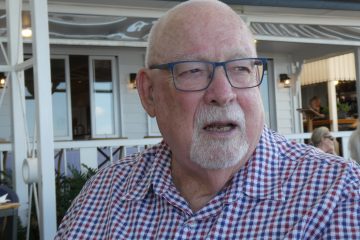
The following illustrated tribute was prepared by Jeff’s nephews Ralph Duttson and Bill Crosbie. Drawing upon his Army and RAAF service records, flying logbook, family photographs, correspondence and family recollections, it provides a much fuller account of his early life, training, operational missions and death.
The document also preserves details of daily life at Batchelor, the difficult working conditions experienced by B-25 tail gunners and the names of the other five members of the N5-176 crew. It should be retained in full as an important family and historical record.
Historical significance
Jeff Crosbie’s story represents the Australian contribution to No. 18 Squadron at a personal level.
The squadron was the product of Dutch, Indonesian, Australian and American cooperation, but that cooperation depended upon individuals learning to work and fly together despite differences in language, nationality, military administration and previous experience.
The loss of N5-176 also demonstrates that training for low-level operations could be as dangerous as combat. Jeff and his five crewmates died while preparing for missions against Japanese shipping—the type of operation for which No. 18 Squadron had become particularly effective.
Remembering the entire crew ensures that the history records not only an Australian air gunner but the multinational team with whom he served and died.
Related DACC articles
- No. 18 (Netherlands East Indies) Squadron RAAF
- The Dutch at Batchelor Airport in the Northern Territory
- No. 18 and No. 120 Squadrons during the Western Australian Emergency
- Dutch artefacts of No. 18 Squadron at the Aviation Museum in Darwin
- DACC Air Force Research Portal