Joan Butler grew up in a Dutch migrant family on a farm in Western Australia. During the Second World War, she worked as a Land Girl before joining the Women’s Corps of the Royal Netherlands East Indies Army. At Camp Columbia in Brisbane, she trained as a soldier and worked as a switchboard operator, driver and supply clerk.
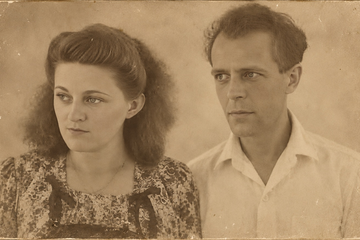
Her service also changed her personal life. At Camp Columbia she met Dutch airman Otto van Embden. They became engaged in March 1945 and married in Brisbane five months later.
This article is based principally on Joan’s own recollections, recorded in notes supplied in 2004 and in further material she prepared for Dr Nonja Peters in 2022. Douglas Hurst incorporated Joan’s earlier information into his history of the Women’s Corps.
A Dutch farming family in Western Australia
Joan’s parents had migrated from Goes in Zeeland to Western Australia during the 1920s. She grew up speaking their Zeeuwse dialect rather than standard Dutch.
Before joining the VK-KNIL, Joan contributed to Australia’s wartime effort as a Land Girl. Life on her family’s farm required considerable practical skill. She milked cows, picked fruit, managed a team of eight horses, rounded up sheep with the family’s border collie and undertook numerous other farm duties.
She also completed a dressmaking course by correspondence, an undertaking made more difficult because the farm had no telephone through which she could ask questions.
Recruitment in Perth
A friend, Dina Freese, told Joan that Dutch officials would be visiting Perth to explain the newly established Women’s Auxiliary Corps.
On 17 May 1944, Lieutenant Colonel de Stoppelaar, representing the army, and Lieutenant Commander de Groot, representing the navy, addressed interested Dutch women at the Palace Hotel in Perth. The Netherlands consulate helped organise the meeting.
In a letter dated 13 June 1944, de Stoppelaar sent Joan the necessary application and medical examination forms from the Netherlands East Indies offices at Temple Court, 422 Collins Street, Melbourne.
Joan was accepted. Her movement order, dated 20 July 1944, instructed her to travel with Dina Knol-Freese and Johanna Mol and report to Camp Columbia in Brisbane by 15 August.
A report in The West Australian on 24 July 1944 named Joan Butler among five Western Australian women who had applied to join the new corps and passed their medical examinations. The others were C. J. Leeman, J. M. Mol, Berendina Annagena “Dien” Freese and Hazel Whitton. The report also revealed the varied backgrounds of the recruits, several of whom had close personal connections with the Netherlands East Indies.
Across Australia to Camp Columbia
Joan, Dina and Johanna travelled east by train across the Nullarbor. Joan remembered that the journey seemed endless.
They stopped in Melbourne, where they were measured for their uniforms and caps. They then reported to Sub-Lieutenant Bieger, who issued second-class railway tickets for the remainder of their journey to Brisbane.
Before leaving Western Australia, Joan had received a letter from Camp Columbia’s commandant confirming that the women would be met at Brisbane station on 15 August and wishing them een goede reis—a good journey.
On reporting to the commandant’s office, Joan received an unforgettable welcome. Lieutenant Colonel de Stoppelaar told the three recruits that he had never seen such healthy girls. Joan, the youngest of the group, attributed this to her active life on the family farm.
Learning to become a soldier
Joan received the VK-KNIL service number VK 43.
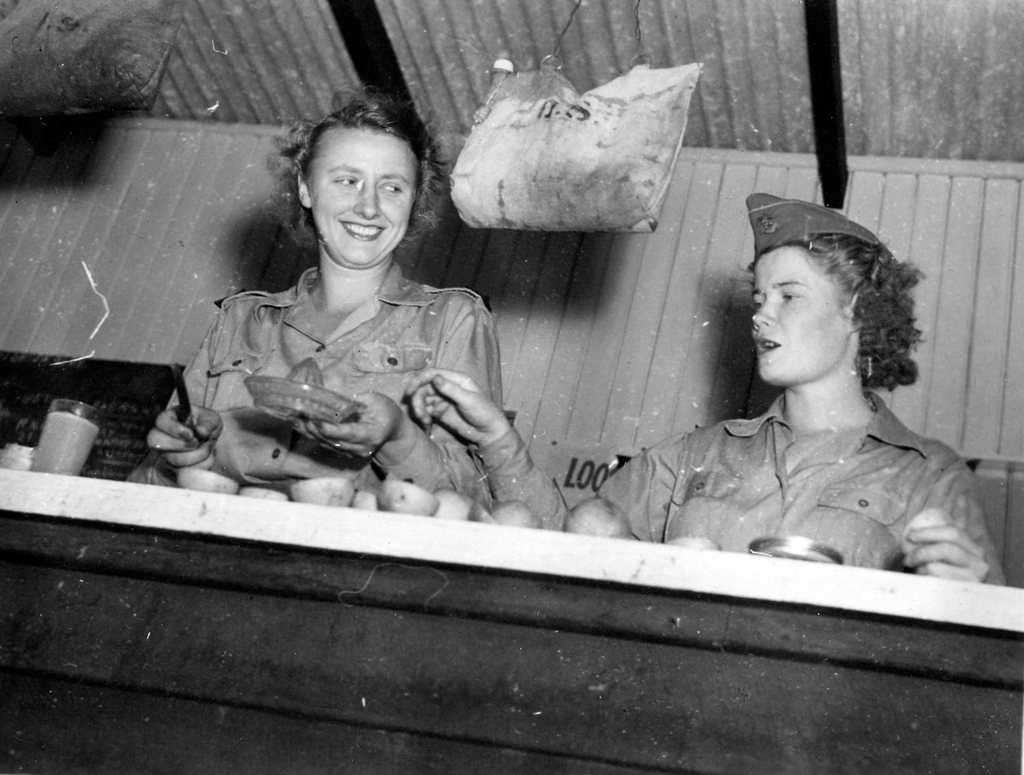
She initially had her own room in Camp Columbia’s C Area, where the women’s quarters were separated from the remainder of the camp by barbed wire. Her neighbour was Mrs Spoor, the wife of Colonel Simon Spoor. Joan later moved into the barracks and shared a room with another woman—her slapie.
The transition from farm life to military service involved a great deal of learning. Joan attended the army school and received lessons in Malay and Dutch.
Standard Dutch proved surprisingly challenging. Her parents had come from Zeeland and spoke Zeeuws at home, so she had to become accustomed to receiving military instructions in formal Dutch.
The women learned marching, forming ranks, standing to attention, numbering off and responding to commands. All orders were given in Dutch.
After several months, Joan was promoted to corporal.
Switchboard, motor pool and supply work
Joan’s first assignment at Camp Columbia was operating the switchboard. She later moved to the motor pool, where the VK-KNIL women received driving instruction from members of the United States Women’s Army Corps (WAC).
This direct contact between Dutch and American servicewomen is an important part of the women’s history at Camp Columbia.
Joan subsequently worked in the Supply Department, opposite Lieutenant Colonel de Stoppelaar’s office. She maintained records of military equipment and clothing.
Her varied duties made use of the adaptability she had developed through farm work. She moved readily between communications, driving and administrative responsibilities.
Daily life at Camp Columbia
Joan remembered eating in the camp’s enormous mess halls. Physical training was conducted by former Dutch boxing champion Bep van Klaveren, who also operated the camp’s PX store.
When the women were not working or attending lessons, they could watch films screened outdoors. Joan considered their uniforms very smart: olive drab during cooler weather and khaki in summer.
On one occasion, the VK-KNIL women were invited to an American women’s army camp to demonstrate their marching. The American commanding officer was impressed by the standard they had achieved after such a short period of training.
During their free time, the women sometimes visited Surfers Paradise or dined at Lennon’s Hotel in Brisbane. A shuttle bus operated between Camp Columbia and Brisbane City Hall.
They also visited a Methodist church popular with American servicemen and attended the Dutch Club, where they met airmen, sailors, officers, soldiers, civilian employees and Netherlands Indies Civil Administration personnel.
Brisbane families sometimes invited the women into their homes. These connections could develop into lasting friendships. Joan’s civilian colleague in the Supply Department, Jean Ayling, remained her friend for more than 42 years.
Meeting Otto van Embden
Camp Columbia brought together Dutch people who had reached Australia from many parts of the world. Among them was Lieutenant Otto van Embden.
Otto was a Dutch Jewish airman who had escaped from the Netherlands shortly before the German occupation. His family also succeeded in reaching England, leaving their possessions and former life behind.
Otto trained at the Royal Netherlands Military Flying School at Jackson, Mississippi. He later served as a navigator-bombardier with No. 18 Netherlands East Indies RAAF Squadron, flying operations from Australia, including from Batchelor south of Darwin.
Joan recalled that romance was “in the air” among the many young service personnel at Camp Columbia. Otto stood out and made his intentions clear.
They became engaged on 15 March 1945 and married in Brisbane on 2 August 1945.
Their relationship was one of many created by the unusual wartime concentration of Dutch and Australian military personnel in Brisbane. As Joan’s story illustrates, a young woman from a Western Australian farm and a young man from Amsterdam met and married in a place neither might have visited in peacetime.
Joan and Otto remained married until his death on 7 March 1981, after almost 36 years together.
Other women at Camp Columbia
Joan remembered that the origins of the VK-KNIL women changed as the war progressed.
The earliest members included Dutch women already living or studying in Australia. Others had left the Netherlands East Indies before the Japanese invasion. Later arrivals included women recruited in Canada, the United States, the Dutch Caribbean and Suriname, as well as women who had escaped from the occupied Netherlands.
Some stayed at Camp Columbia only briefly before being posted elsewhere. Nurses were sent to hospitals and recently recaptured territories, while other women reportedly worked as parachute packers in Dutch-controlled New Guinea.
Joan specifically remembered women including Mia La Bree, Hazel Whitton, Yvette Bartlema and Helen Sisage. Her barracks companion was Wendela Kiewiet de Jonge, whose brothers Coen and Joost served as pilots with No. 18 Netherlands East Indies Squadron.
On 18 September 1945, Captain Janet Meerburg issued a movement order transferring the VK-KNIL women then at Camp Columbia to the Netherlands East Indies. Joan retained a copy containing the names, ranks and service numbers of the women covered by the order.
Joan’s surviving copy is an especially valuable record of the Camp Columbia contingent because it identifies the women by name, rank and service number.
Remembering her service
Joan later observed that the Australian beginnings of the VK-KNIL received relatively little attention in histories concentrating on women recruited in the Netherlands after the war.
Her recollections help correct that imbalance. They document recruitment in Western Australia, the journey across the continent, women’s accommodation at Camp Columbia, military and language training, work assignments, recreation and contact with American servicewomen.
They also record how women with very different backgrounds adapted to military service. Joan moved from demanding agricultural work to communications, transport and supply duties and attained the rank of corporal within several months.
Looking back, she wrote:
“I gained no medals but believe I did my duty.”
Sources and acknowledgement
This article is based primarily on Joan van Embden-Butler’s own written recollections, including notes supplied on 14 May 2004 and further personal material prepared for Dr Nonja Peters in 2022.
Douglas Hurst incorporated Joan’s earlier recollections into his article “The Women Corps”, together with information supplied by Ineke Thysse and other sources. His work helped preserve and place these personal accounts within the wider history of the VK-KNIL.
The original recollections, supporting newspaper material and Douglas Hurst’s account are preserved in the Camp Columbia Heritage Association article about the Women’s Corps.
This personal story forms part of the VK-KNIL Research Portal – Dutch women in military service from Australia to Indonesia.