Rebuilding a military presence after the fall of the Netherlands East Indies
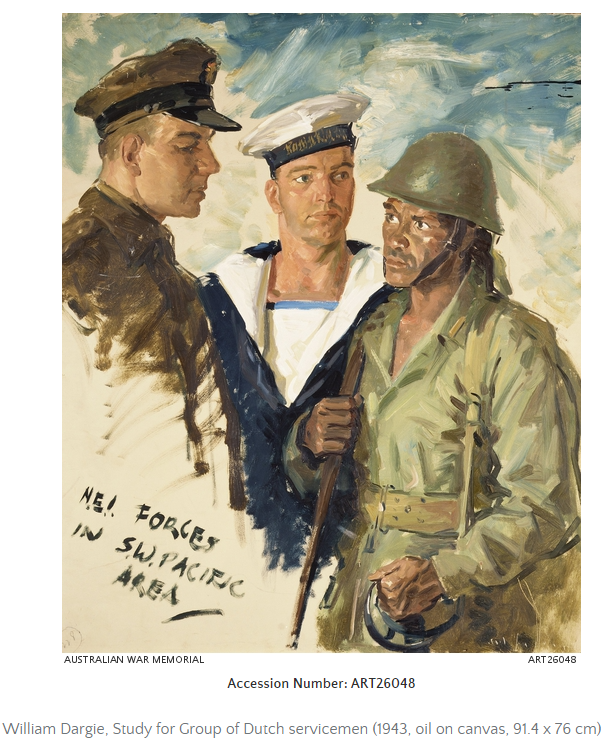
The Japanese conquest of the Netherlands East Indies in early 1942 destroyed much of the Dutch colonial military organisation in Southeast Asia. Most personnel of the Royal Netherlands East Indies Army were killed, captured or isolated in occupied territory. Ships, aircraft, military personnel, government officials and civilians who escaped were dispersed between Australia, Ceylon, India and other Allied-controlled territories.
Australia became the principal base for rebuilding the Dutch and Netherlands East Indies military presence in the Southwest Pacific. From here, army, air-force, naval, intelligence and administrative organisations were gradually re-established.
These forces were never exclusively Dutch. They included Dutch, Indo-European and Indonesian personnel, as well as Australians serving in joint units or providing logistical, technical and administrative support.
Command and Allied cooperation
The military command arrangements were complicated. The Netherlands Government-in-Exile operated from London, while the Netherlands East Indies administration and surviving military organisations had to be reconstructed overseas.
Lieutenant Admiral Conrad Helfrich, based in Ceylon, became Commander of Netherlands Forces in the East. Major-General Ludolph van Oyen, commander of the Military Aviation Service of the Royal Netherlands East Indies Army, played a leading role in reorganising Dutch forces and aviation personnel in Australia and the United States.
Following the establishment of the Southwest Pacific Area in April 1942, Dutch and Netherlands East Indies forces operating from Australia came within the wider Allied command headed by General Douglas MacArthur. They retained their national administration but depended upon Allied operational planning, transport, bases, equipment and supplies.
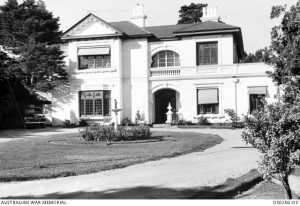
Dutch headquarters initially operated principally from Melbourne. In 1944, important military and administrative organisations moved to Camp Columbia at Wacol in Brisbane. This placed them closer to MacArthur’s headquarters and the forward operational areas in New Guinea and the Netherlands East Indies.
See: The Headquarters of the Dutch East Indies Armed Forces in Melbourne and Brisbane
Royal Netherlands East Indies Army
Only a relatively small proportion of the Royal Netherlands East Indies Army—the Koninklijk Nederlands-Indisch Leger or KNIL—escaped to Australia in 1942. Much of the army had surrendered on Java or remained behind in other parts of the archipelago.
The personnel who reached Australia included officers, technical and administrative staff, soldiers evacuated from eastern parts of the Netherlands East Indies, and men later recruited or transferred from other locations.
KNIL headquarters and support organisations were established in Melbourne. As the war progressed, additional facilities were created in Queensland and New South Wales. Camp Victory at Casino became an important Dutch and Netherlands East Indies military centre, while Camp Columbia in Brisbane became the principal headquarters during the final phase of the war.
Planning focused on supporting Allied operations and preparing personnel to return to liberated parts of the Netherlands East Indies. The Dutch also developed the Netherlands Indies Civil Administration to restore civil administration in territories recovered from Japan.
The army included personnel from many ethnic and cultural backgrounds. Indonesian, Moluccan, Timorese, Papuan, Indo-European and European personnel all contributed to the Dutch-led war effort. Their different experiences and later political positions cannot be represented simply as a uniform Dutch story.
Women also joined the Women’s Corps of the Royal Netherlands East Indies Army, the VK-KNIL. Women recruited in Australia trained for administrative, communications, transport, medical and other supporting roles.
See:
- Dutch at WWII Camp Columbia, Brisbane, 1944–1947
- The Netherlands Indies Civil Administration—established in Brisbane
Military aviation
Personnel and aircraft of the Military Aviation Service of the Royal Netherlands East Indies Army—the ML-KNIL—regrouped in Australia after the Japanese conquest.
Dutch flying students initially continued their training at Australian bases before most were transferred to the Royal Netherlands Military Flying School in Jackson, Mississippi. Graduates later returned to Australia and served in Dutch and joint Dutch–Australian units.
No. 18 (Netherlands East Indies) Squadron RAAF operated B-25 Mitchell bombers from northern Australia. No. 120 (Netherlands East Indies) Squadron RAAF operated P-40 Kittyhawk fighters from Merauke in southern Netherlands New Guinea. Dutch military transport services were centred principally at Archerfield in Brisbane and ultimately became No. 19 Transport Squadron.
The Royal Netherlands Navy Air Service maintained a separate presence involving Dornier and Catalina flying boats.
The Air Force story is covered in detail in the:
Dutch and Netherlands East Indies Air Forces in Australia during World War II – Research Portal
Royal Netherlands Navy
The Royal Netherlands Navy suffered heavy losses during the Japanese invasion and the Battle of the Java Sea. Surviving warships, submarines, auxiliary vessels and naval personnel regrouped principally in Australia and Ceylon.
In Australia, Dutch naval headquarters were established in Melbourne, with supporting organisations in Sydney, Brisbane, Fremantle and other ports. Fremantle became an especially important submarine base because of its location on the Indian Ocean and its access to operational areas north of Australia.
Rear Admiral Fokko Willem Coster became Commander of Netherlands Naval Forces in Australia and the senior Dutch naval representative within the Allied command arrangements. He was succeeded in 1943 by Pieter Koenraad.
Dutch submarines and surface vessels operated with the Allies, while Australian and British liaison personnel assisted with communications and coordination. Dutch naval personnel also supported harbour services, maintenance, shipping control and intelligence activities.
The Marine Luchtvaartdienst, or Royal Netherlands Navy Air Service, operated separately from the ML-KNIL. Its surviving flying boats participated in reconnaissance, transport and special missions from Australian and Indian Ocean bases.
See:
Merchant shipping
The Dutch merchant fleet was not a branch of the armed forces, but it made one of the Netherlands’ most important contributions to the Allied war effort.
Ships of the Koninklijke Paketvaart Maatschappij and other Dutch companies escaped from the Netherlands East Indies or were already outside Japanese-controlled waters. Many were placed under Allied shipping control and carried troops, vehicles, fuel, ammunition, food and other supplies.
Dutch and Indonesian seafarers served aboard these vessels, often under dangerous conditions. Their ships supported operations in Papua and New Guinea and maintained vital transport connections throughout the Southwest Pacific.
Because this contribution was extensive and organisationally distinct from the armed forces, it is covered separately in the:
Dutch Merchant Fleet and the Allied war effort in Australia – Research Portal
Intelligence and special operations
The Netherlands Forces Intelligence Service—NEFIS—was established in Australia following the collapse of the Netherlands East Indies.
NEFIS collected and analysed information about Japanese-occupied territories, interrogated evacuees and former prisoners, prepared maps and reports, and cooperated with Australian and American intelligence organisations. Dutch and Indonesian agents were sent on dangerous missions into Timor, New Guinea, the Moluccas and other occupied areas.
NEFIS initially operated from Melbourne and later became associated with Camp Columbia in Brisbane. Its work formed an important part of the Allied intelligence and special-operations network in the Southwest Pacific.
See: NEFIS Research Portal—Dutch and Indonesian intelligence in Australia during WWII
Camp Columbia and preparations for the return
By 1944, Camp Columbia at Brisbane had become the principal concentration point for the Netherlands East Indies administration and many supporting military organisations in Australia.
From Brisbane, Dutch authorities prepared for the return to territories being liberated by the Allies. Camp Columbia accommodated military headquarters, administrative bodies, intelligence personnel, communications units, the VK-KNIL and other support organisations.
These preparations took place amid growing political uncertainty. Dutch authorities hoped to restore their administration, while the Indonesian independence movement was becoming increasingly organised and determined to end colonial rule.
From wartime cooperation to postwar conflict
The Japanese surrender in August 1945 did not bring an orderly return to the prewar situation.
The Republic of Indonesia proclaimed independence on 17 August 1945. Dutch forces lacked the personnel and transport needed to reoccupy the archipelago immediately, while British and Australian forces initially accepted responsibility for Japanese surrender and the release of prisoners in different areas.
At the same time, Australian maritime unions refused to load or service many Dutch ships carrying military supplies to Indonesia. This industrial campaign became known as the Black Armada and reflected strong Australian union support for Indonesian independence.
Dutch military and administrative organisations gradually left Australia between 1945 and 1947. Their departure marked the end of one phase of Dutch–Australian wartime cooperation and the beginning of a far more difficult period in relations involving Australia, the Netherlands and the emerging Indonesian Republic.
A complex shared history
The Netherlands and Netherlands East Indies military presence in Australia was never a single organisation with a simple command structure.
It brought together the KNIL, ML-KNIL, Royal Netherlands Navy, naval aviation, transport services, intelligence organisations, civil administrators, merchant shipping and supporting Australian units. It also involved people of Dutch, Indonesian, Indo-European and Australian backgrounds whose experiences and political outlooks were not always the same.
Despite limited personnel and resources, these organisations made important contributions to the Allied war effort. Their activities in Melbourne, Brisbane, Sydney, Fremantle, Canberra, Casino and northern Australia created an extensive wartime relationship between Australia, the Netherlands and the Netherlands East Indies.
Sources and further research
- National Archives of Australia document—Netherlands Forces in Australia, 1945
- Australia, the Netherlands and the Netherlands East Indies during the Second World War: guide to the DACC research series
- Australian War Memorial—Allies in adversity: Australia and the Dutch in the Pacific War
- Jack Ford, Allies in a Bind: Australia and the Netherlands East Indies in the Second World War, Australian–Netherlands Ex-Servicemen and Women’s Association, 1996; Central Queensland University Press, 2001.
Documents on the Dutch Forces in Australia
Various declassified documents from the National Archives of Australia on the Dutch Forces in Australia, researched by Ruby Todorovski, University of Queensland
Links to other declassified WWII Australian Documents re the Netherlands East Indies
Military Command
After the surrender of the Dutch military in the Netherlands East Indies to the Japanese in March 1942, the Dutch military command ceased to exist in the region. Many Dutch military personnel were taken prisoner by the Japanese, while others went into hiding or joined the resistance. However, some were able to flee to Australia and to Ceylon.
Australia had no military industry of any significance to properly supply its military, let alone to assist the Dutch during its war with the Japanese. This led to diplomatic frustrations between both countries in the early days of the arrival of NEI government officials. The Netherlands expected more military resources from Australia than they were able to provide. With America taking over the leadership of the war effort in the South Pacific, significant military resources arrived from the US. This only changed when in the following month (April 18) the Dutch and the Australian military were placed under the command of Douglas MacArthur, Supreme Commander of Allied Forces in the Southwest Pacific Area (SWPA), supplies now also started be become available from the US.
This was a result of the formation of the Pacific War Council in Washington, on 14 April 1942, with President Franklin D. Roosevelt and representatives from Britain, China, Australia, the Netherlands, New Zealand, and Canada. Representatives from India and the Philippines were later added. The council never had any direct operational control, and any decisions it made were referred to the US-UK Combined Chiefs of Staff, which was also in Washington. The Asian region stood under British control and the Pacific under American . There was a significant number of senior Dutch civil and military personnel at the Dutch Embassy in Washington to liaison with the Pacific War Council.
After the first level of chaos of the totally unprepared evacuation from key personal to Australia had settled down. NEICANZ began to rebuild the Dutch civil and military presence in the region. However, within weeks the decisions was made to split the civil and military activities.
While the Dutch were now under American Command, the Dutch Government remained adamant to keep as much as possible the Dutch presence in place as that would add to their legitimacy to recolonize NEI after the war.
The following are the key military commanders in Australia that had to maximise the contribution of the limited Dutch resource to the war effort.
Lieutenant Admiral Conrad Emil Lambert Helfrich who was send to Ceylon, just a few weeks prior to the surrender of the NEI, became the Commander in Chief of all of the Dutch and NEI forces in the Far East. Based in Ceylon that was far away from Australia were the largest part of the Dutch Forces were concentrated. Helfrich asked to be stationed in Australia but that was refused by the Dutch Government in London, who also wanted to stay close to the Brits. The Dutch Government wanted have a foot each in both the American and the British camp, this however was problematic with the small force that it had .
With NEI spreading out over 5000 kilometers some ships had escaped into the Indian Ocean and grouped in Ceylon. While others arrived in Australia. The Dutch Government was split about where to deploy their very limited military resources in the end they decided to keep it split between the British Command in Ceylon and the American Command in Australia. Helfrich reported to General Sir Archibald Wavell the British Commander of the South East Asia Command (SEAC). All of this complicated the communications issues for Helfrich as well as the Dutch decision making process.
Major-General Ludolph Hendrik van Oyen served as the commander of the ML-KNIL. During his time as commander, he was able to expand the view of the Japanese advance at the beginning of World War II. He played a significant role in the defense of the Dutch East Indies during the early stages of the war. He was among the last the flee from Java and became the Commander of all of the Dutch Forces in Australia (reporting to Helfrich) who had arrived in Australia and were now scattered all over the country including the planes, ships and personnel. He was placed under the overall command of General MacArthur. As would be the case during the war, the command structures were often complex and personal egos and county politics all played a role in this.
For unknown reason van Oyen himself as well as other senior personnel moved to the USA in April 1942 to set up the Dutch Military Flying School on Jackson, Mississippi. This left a gaping hole in the military top who were need for the active war effort. It was not until November 1943 before van Oyen came back to Australia and resumed his position as the Commander of all Dutch Forces in Australia.
At Archerfield Airport was an important group stationed to take possession of new American B-25 bombers and they were under the command of Major B.J. Fiedelij.
For other key military commanders see: The Headquarters of the Dutch East Indies Armed Forces (HK-KNIL) in Melbourne and Brisbane.
The Royal Netherlands East Indies Army Air Force
The – in Dutch – Militaire Luchtvaart van het Koninklijk Nederlands-Indisch Leger, ML-KNIL was an entirely separate organisation from the Royal Netherlands Air Force. Like the NEI Army (KNIL) they resorted under the Minister of War at the Dutch Government-in-Exile in London. The Command structure as mentioned above applied to them.
Flying School
At a relative early stage it was decided to evacuate the flying school and the 300 students plus staff and families from Tasikmalaja (south east of Bandung) to Australia. In all 450 people boarded the MS Boissevain on February 14. They re-established at the RAAF Airfields of their flying schools at Mallala and Parafield, near Adelaide. The students of the Naval Aviation Service settled at Rathmines on Lake Macquarie. A further dozen single-engine flying boats were also brought to Australia.
The school would be one of the major contributions from the Dutch to the war efforts. Hundreds of pilots and flight-engineers were trained here and than brought to Australia to be deployed in the various squadrons. ( The Camp Columbia Heritage Association does have information on Willy de Eerens who was trained in Jackson, was stationed at Camp Columbia and tragically died in a plane accident in 1944).
See also: The evacuation of the Netherlands East Indies Flying Schools to Australia
Planes sold to the Allied Force (Americans)
It was only in the last days before the surrender that other military planes and their crews who were able to flee arrived in Australia (most without their families and their ground staff colleagues).
Once evacuated to Australia they were scattered around the country over the next few weeks the military command was busy organising the chaos and the planes were directed to bases at Bundaberg, Brisbane and Canberra.
A few weeks before the Fall of NEI a detachment of the Air Force was send to Archerfield Airport in Brisbane to collect B-25 bombers that were ordered by the Dutch Government. However, the first of these planes arrived after the Fall of NEI. The staff in Archerfield was trapped. They were not allowed to fly back to NEI to pick up their families.
The civil aviation company Koninklijke Nederlandsch-Indische Luchtvaart Maatschappij – KNILM (Royal Netherlands Indies Airways) was already during the previous few month used by the Air Force and the military crew at Archerfield witness the arrival of the KNILM planes that eventuated with families and even household goods.
After the Fall all military and KNILM planes were handover to the Allied Forces, who were in desperate need of them for the defence of Australia and to stop further advances of the Japanese. This resulted in an already devastated NEI crew sitting idle for weeks on end. So it is not difficult to guess how bad the atmosphere was among these people.
18 NEI Squadron RAAF
Once more planes that were ordered by the Dutch started to arrive from America, the idea was born to establish a Dutch fighting squadron. Most of these planes went to the Americans. Eventually five B-25 bombers were allocated to the Dutch, these had to be shared among the 200 plus crew, so still a lot of sitting-around time. As Archerfield became to crowded, the Dutch were moved to Canberra where the 18 NEI Squadron RAAF was established on 4 April 1942.
Once operative they moved to McDonald, an airstrip in the bush, south of Darwin. The facilities here either din’t exist or were very primitive. They basically had to build an airbase from scratch. But finally after more than a year they now could be part of the action.
Royal Dutch Navy (Koninklijke Marine)
Unlike the NEI Army and Air Force, the Navy that operated in NEI, was part of the Royal Dutch Navy. They resorted under the Minister for the Navy at the Dutch Government-in-Exile in London.
Once evacuated to Australia, the Naval Headquarters was established in Melbourne with subsidiary naval establishments in Sydney and Freemantle. The latter became the base of 15 NEI submarines. Many were lost at the start of the war, others participated in successful attacks on Japanese vessels.
About two third of all of the ships of KM were in NEI at the time of the breakout of the war here. So they were a formidable force and they were very important for the war effort of the Allied Forces.
Following the sinking of his ship during the Battle of the Java Sea , Rear Admiral Fokko Willem Coster had managed to escape and make his way to Australia. Helfrich appointed him as the Commander of the Dutch Naval Forces in Australia.
He also became the Dutch representative in SWPA in Australia. In his book Allies in bind: Australia and the Netherlands East Indies relations during World War Two, Dr. Jack Ford stated that by 10 June 1942, Coster’s command totaled 1,353 personnel comprising 207 officers, four midshipmen, 18 warrant officers, 241 non-commissioned officers, 144 corporals and 739 ratings/other ranks.
In May 1943 Coster retired and his position was taken over by Acting Rear Admiral Pieter Koenraad.
Several measures were implemented to enhance oversight, administration, and coordination between the Koninklijke Marine (KM) and Royal Australian Navy (RAN). Given that the majority of Dutch naval personnel were stationed in Fremantle, Western Australia, Commander Gustaaf Berg was appointed as the senior Dutch naval officer in the region from July 1942. The KM established its local headquarters by acquiring an entire floor in the Colonial Mutual Life building on St. Georges Terrace in Perth. Additionally, every major Australian port had a designated Dutch naval officer responsible for overseeing Dutch naval and merchant ships that arrived.
To ensure the efficient operation of Dutch warships from Australian ports, larger KM warships carried a British Naval Liaison Officer (BNLO) and a small team of signalmen, radio operators, and coders. For Dutch warships arriving from Europe or the Indian Ocean, an RN liaison team was initially present, but this was later replaced by RAN personnel.
The Navy Airforce
After the chaotic evacuation and the dramatic destruction of many Dutch flying boats during the attack on Broome, the Navy Airforce concentrated its flying boats and personnel on Ceylon and became part of the 321 (Netherlands) Squadron RAF and was mainly involved in activities Under British command in South East Asia. One D0-24 flying boat was kept to cooperate with NEFIS and involved in intelligence missions in Dutch New Guinea and Timor. This was later extended with two more PBY-5 flying boats. Their flights generally moved up the east coast often stopping in Brisbane and Cairns before arriving in Merauke, the main town in unoccupied Dutch New Guinea. This detachment was further increased during 1945 and at that time they operated from the Qantas Airways facility at Rose Bay, Sydney. Other flyting boast were in May 1944 added to the 18 Squadron in Batchelor, Northern Territory.
The Merchant Navy
A significant contribution to the naval activities was the Dutch Merchant Fleet, one of the largest in the world and they played a crucial role in the transport of troops and material for the Allied (mainly US) forces in the Southwest Pacific. They operated from the Naval Control os Shipping (NCOS) with of fives in Sydney, Melbourne, Freemantle (this port had the largest concentration of Dutch ships), Brisbane and Townsville.
After the war the Dutch Navy could not immediately return to Indonesia. The Dutch didn’t have enough forces available to take over command from the Japanese, this was done by the British in their section and the Australians in the Pacific section. The Indonesian independence movement used this vacuum and this became a very violent period known ad Bersiap, where European and Chinese people were killed. This also forced many of the 100.000 women and children who were imprisoned in the Japanese camps to stay there. Furthermore back in Australia the Unions where boycotting Dutch transport to Indonesia- known as the Black Armada – as they supported the Independence movement.
Another problem were the mines that were laid by the Japanase. KM bought 8 oceangoing minesweepers from the RAN to help clearing these mines.
Most ships went to Indonesia in the first half of 1946. The Dutch depended for nearly 100% on supplies for Indonesia from Australia and the Black Armada made that very difficult. The head office in Melbourne closed in November 1946. However, Navy liaison officers were appointed and stayed in Australia. The last Navy ships left Australia in mid 1947.