During the Second World War, northern Australia became a crucial operational base for Allied air forces defending the continent and supporting offensive operations into the Netherlands East Indies. Among the aircraft deployed in this theatre was a Dutch-operated North American B-25 Mitchell bomber, serial N5-156, whose dramatic loss in October 1943 remains one of the lesser-known episodes of Dutch–Australian wartime cooperation.
Dutch air power in exile
After the Japanese invasion of the Netherlands East Indies in early 1942, Dutch airmen regrouped in Australia. Here they formed No. 18 (Netherlands East Indies) Squadron RAAF, which operated within the Royal Australian Air Force structure. The squadron flew American-built B-25 Mitchell medium bombers, undertaking reconnaissance, bombing, and training missions in support of Allied operations across northern Australia and the Indonesian archipelago.
Aircraft N5-156 was one of these bombers. Built in Kansas City and originally delivered to the United States Army Air Forces, it was later transferred to the Dutch forces and repainted in Netherlands East Indies Air Force markings before entering service with the joint Dutch-RAAF unit.
The fatal night mission
On the night of 21 October 1943, N5-156 undertook a practice bombing flight in the Darwin area. During the exercise, a photo-flash bomb or flare exploded aboard the aircraft and started a rapidly spreading fire.
Sergeant Engels was the pilot. Sergeant-Major Cornelis Antonius Hendrikus Keesmaat, a mechanic with No. 18 Squadron, had reportedly asked to accompany the non-operational flight. The other crew members escaped by parachute, but Keesmaat was killed when the aircraft crashed east of Hughes Field, in bushland south-east of Darwin.
Accounts differ concerning precisely why Keesmaat did not survive. One records that his parachute caught fire, while another suggests that he may not have had access to a parachute. The available evidence does not support the earlier identification of Keesmaat as the pilot attempting a controlled landing.
Keesmaat was initially buried at Adelaide River cemetery, NT, Australia, his remains were later exhumed and re-interred in the Dutch war cemetery at Menteng Pulo in Jakarta — a poignant reminder of the transnational nature of the Dutch wartime experience.
A remarkably intact wreck site
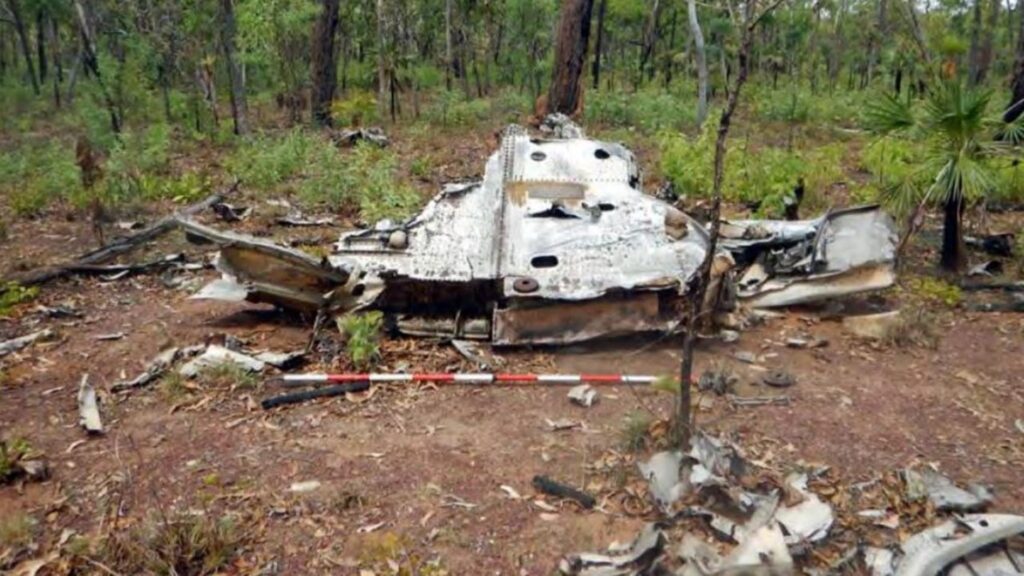
The crash site of N5-156 lies in the Noonamah Ridge area, where aircraft debris remains scattered across a wide area. Archaeological investigations have noted the site’s exceptional integrity compared with other wartime aircraft wrecks in the Northern Territory.
Survey findings describe concertinaed wing structures consistent with a high-speed impact, as well as burnt components that confirm the onboard fire reported in historical records. Numerous smaller artefacts — including machine-gun ammunition — also remain in situ, providing valuable evidence for reconstructing the final moments of the aircraft.
Researchers have emphasised that, although not a war grave, the site represents a significant testament to the sacrifices made by Dutch and Australian airmen defending northern Australia from Japanese attack.
Heritage debates and modern significance
The wreck site has been the subject of heritage nominations in recent years. It was formally nominated for inclusion on the Northern Territory Heritage Register in 2018, provisionally declared a heritage place in 2021, and considered one of the most intact aircraft wrecks of its type in the region.
However, in March 2025, the responsible minister ultimately refused full heritage listing — a decision that sparked debate about the preservation of wartime archaeological sites and the recognition of shared Dutch–Australian military history.
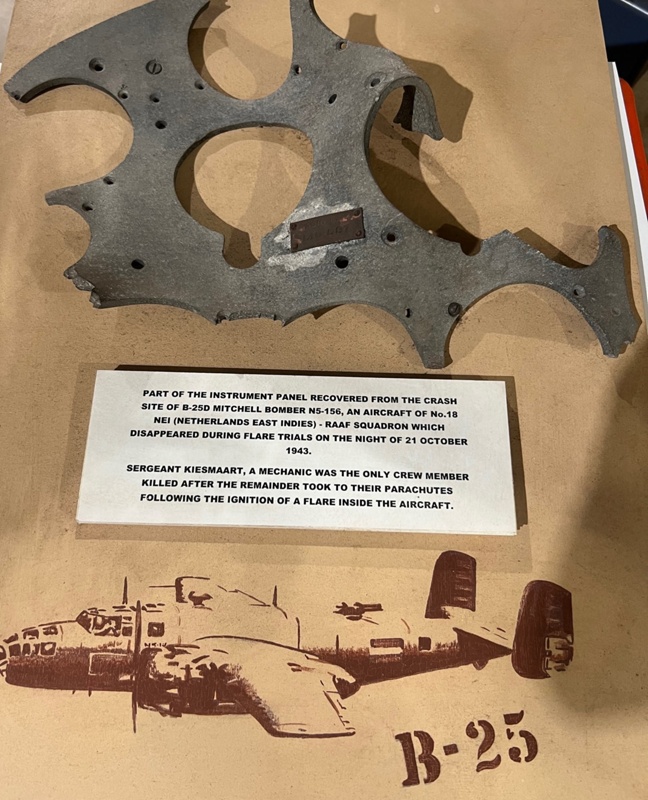
Part of the instrument panel is on display at the Darwin Aviation Museum.
Remembering a shared wartime past
Today, the remains of bomber N5-156 continue to lie in the Northern Territory bush, largely unknown outside specialist historical and archaeological circles. Yet the story of the aircraft — and of Sergeant Keesmaat — symbolises the broader Allied struggle in which Dutch forces, operating from Australian soil, contributed significantly to the defence of the region and the eventual liberation of Southeast Asia.
As efforts continue to document and interpret wartime heritage sites across Australia, the wreck of N5-156 stands as a powerful physical reminder of this cooperation — and of the human cost of the air war fought over northern Australia more than eighty years ago.
The accident is also reported in: De Militaire Luchtvaart van het KNIL in de jaren 1942-1945 by O.G. Ward
This article forms part of the DACC Air Force Research Portal, which brings together DACC research concerning Dutch and Netherlands East Indies aviation personnel, aircraft, squadrons and operations from Australia during the Second World War.