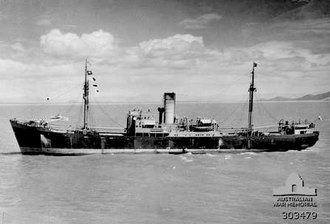
The Dutch-operated cargo ship Karsik played a distinctive role in the Allied campaign in Papua. In December 1942 she became the first large vessel to reach Oro Bay, carrying Australian Stuart tanks that were urgently needed at the Battle of Buna.
The voyage demonstrated that a viable maritime supply route could be established between Milne Bay and the Buna front. Its importance therefore extended beyond the tanks themselves: Karsik helped open the route subsequently used by Operation Lilliput, through which Dutch merchant ships delivered thousands of troops and tens of thousands of tons of supplies.
Karsik later participated in Operation Accountant, carrying American troops from Australia to New Guinea. Her history connects Dutch, Indonesian, Australian and American participation in the Pacific War.
A German ship taken over by the Dutch
Karsik was not originally a KPM vessel. She was built as Soneck for the German shipping company Deutsche Dampfschifffahrts-Gesellschaft Hansa. Constructed by Deutsche Schiff- und Maschinenbau at Wesermünde, she entered service in 1938.[1]
The cargo steamer was powered by a triple-expansion engine assisted by an exhaust-steam turbine and had a service speed of approximately 12 knots.[2]
When Germany invaded the Netherlands on 10 May 1940, Soneck was in the Netherlands East Indies. The Dutch authorities seized the vessel, renamed her Karsik and placed her under KPM management.[3]
She was initially employed as a train ferry at Batavia. Her relatively modern construction and cargo-handling capacity later made her particularly valuable to the Allied transport system.
From the Netherlands East Indies to Australia
Karsik escaped the Japanese conquest of the Netherlands East Indies and was among the ships that reached Australian waters. She became part of the group of Dutch-controlled vessels made available to the United States Army in Australia on 26 March 1942.[4]
Like the other KPM-operated ships, Karsik remained under Dutch authority and retained her existing officers and crew. Operationally, however, she was employed according to Allied military requirements.
The United States Army designated her X-20 within its local transport fleet.[5] Her officers were Dutch, while much of the ship’s day-to-day operation depended upon Indonesian seafarers from the Netherlands East Indies.
The supply crisis at Buna
Australian and American troops began their offensive against the Japanese positions at Buna and Gona in November 1942. Supplying the battlefield was exceptionally difficult.
The overland route across the Owen Stanley Range could not carry the quantities of ammunition, food, engineering equipment and heavy weapons required by a sustained military operation. Aircraft brought supplies to forward airfields, but their carrying capacity was limited and weather frequently interrupted operations.
Oro Bay, approximately 24 kilometres from Buna, offered a possible maritime supply base. Reefs, narrow approaches and incomplete charts, however, made it difficult for conventional transports to enter safely.
Australian survey vessels, particularly Paluma, examined the approaches and marked a route through the reefs. By December 1942 the Allies believed that a relatively large merchant ship might be able to reach Oro Bay.[6]
Karsik was selected to test the route.
Operation Karsik
On the night of 11–12 December 1942, Karsik entered Oro Bay under escort by the Australian corvette HMAS Lithgow. She was the first large merchant vessel to reach the anchorage.[7]
Her cargo included four Australian M3 Stuart light tanks. After Karsik arrived, the tanks were transferred to barges. The barges were then towed along the coast and the tanks landed near the Buna battlefield.[8]
The operation was a considerable navigational and logistical achievement. Karsik had demonstrated that a substantial cargo vessel could pass through the approaches to Oro Bay and discharge heavy military equipment close to the fighting front.
United States Army historian Lida Mayo observed that the successful arrival of a large ship may have been even more important than the tanks themselves. It showed that a dependable maritime supply route to the Buna area could be created.[9]
The mission became known as Operation Karsik.
Operation Tramsik
The success of the first voyage led the Allies to organise a second tank delivery within days. This was designated Operation Tramsik — a name constructed from “transport” and “Karsik”.
Karsik returned as part of the second movement, accompanied in the operation by the KPM vessel Japara. Another four Stuart tanks were carried forward for the Australian forces.[10]
Sources give slightly different dates for Karsik’s return voyage, placing it between 14 and 16 December. Jack Ford identifies the second movement as Convoy Tramsik on 16 December, while other operational summaries date Karsik’s return to 14 December.[11] What is clear is that the two deliveries took place only days apart and immediately preceded the opening of the regular Operation Lilliput service.
The tanks were operated by the Australian 2/6th Armoured Regiment. Conditions around Buna were far removed from those for which armoured vehicles had been designed. Swamps, jungle, kunai grass, mud and concealed Japanese positions severely restricted movement and visibility.
Despite these limitations, the tanks gave Australian infantry mobile firepower against Japanese fortified positions. Their arrival contributed to Australian advances on 18 and 19 December and helped restore confidence among troops who had encountered determined resistance and suffered heavy casualties.[12]
Karsik had not delivered a decisive weapon capable of winning the battle by itself. She had, however, brought equipment to Buna that could not realistically have been transported across the mountains or delivered by air.
Opening the way for Operation Lilliput
The two tank voyages were the immediate predecessors of Operation Lilliput. On 18 December 1942, Japara departed Milne Bay under escort by HMAS Lithgow on the first voyage of the regular supply service to Oro Bay.[13]
Over the following six months, Operation Lilliput transported 3,802 reinforcements and approximately 60,000 tons of supplies from Milne Bay to Oro Bay. Nineteen Dutch merchant ships participated in the operation, supported by Australian naval escorts.[14]
Karsik continued to work on this route. She carried troops, vehicles, weapons, fuel, engineering equipment and general supplies into the forward area.
The ship’s first arrival at Oro Bay had therefore marked an important transition. Before December 1942, the Allies struggled to deliver heavy equipment and large quantities of supplies to the Buna front. After the route was established, Oro Bay developed into an important forward supply base for subsequent operations along the New Guinea coast.
Operation Accountant
Karsik also participated in Operation Accountant in February and March 1943. Together with Bontekoe and Van Heemskerk, she transported approximately 3,200 troops of the United States 162nd Infantry Regiment from Australia to Oro Bay.[15]
The operation was conducted between 21 February and 4 March. It occurred alongside Operation Lilliput but differed in purpose: Accountant was a specific troop movement from Australia, whereas Lilliput maintained the supply and reinforcement service between Milne Bay and Oro Bay.[16]
The arrival of the 162nd Infantry Regiment strengthened the United States 41st Infantry Division in New Guinea and supported preparations for further Allied operations following the conclusion of the Buna–Gona campaign.
Karsik’s participation in both operations illustrates how the same small group of Dutch-controlled vessels was repeatedly employed for different military requirements. The ships moved between Australian ports, principal bases and exposed forward anchorages according to rapidly changing operational priorities.
Ships and crews under pressure
Karsik survived the Japanese air attacks that destroyed ’s Jacob, Bantam and Van Heemskerk during the first months of 1943. She was present at Oro Bay when ’s Jacob was attacked and sunk on 18 March, but escaped damage.[17]
Operating the ship remained dangerous. Japanese aircraft repeatedly attacked shipping at Milne Bay and Oro Bay, while the forward ports lacked adequate firefighting, repair and salvage facilities.
The successful voyages depended upon Karsik’s Dutch officers and Indonesian crew. Their knowledge of tropical navigation and small ports, acquired during commercial service in the Netherlands East Indies, became an important Allied resource.
Recognising Karsik simply as a “Dutch ship” can obscure this multinational dimension. The vessel was under Dutch control and managed by the KPM, but much of the demanding and dangerous work aboard her was performed by Indonesian seafarers.
Postwar service
Unlike several other KPM vessels used in the New Guinea campaign, Karsik survived the war. She returned to commercial operations and remained under KPM management until 1963.[18]
After being sold and renamed, she continued operating under Panamanian registration. On 17 June 1967 she struck a reef near Jeddah in the Red Sea and was wrecked.[19]
The significance of Karsik
Karsik’s December 1942 voyages occupy a distinctive place in the history of the KPM fleet. She did more than deliver eight tanks. She proved that a large merchant vessel could reach Oro Bay and thereby helped establish the maritime supply route upon which Operation Lilliput was based.
The tanks she carried provided direct assistance to Australian troops at Buna. Her later participation in Operation Accountant supported the deployment of an American regiment from Australia to New Guinea.
Karsik consequently brought together several elements of the Allied war effort: a German-built ship seized by the Dutch, managed by the KPM, sailed by Dutch and Indonesian personnel, escorted by Australian warships and employed to transport Australian and American forces.
Her story demonstrates why the surviving merchant fleet of the Netherlands East Indies became one of the most valuable transport resources available to the Allies in the Southwest Pacific.
Endnotes
[1] Lloyd’s Register of Shipping, entry for Soneck; Deutsche Dampfschifffahrts-Gesellschaft Hansa, vessel history for D/S Soneck. The ship was built by Deutsche Schiff- und Maschinenbau AG, Seebeckwerft, Wesermünde, and entered service in 1938.
[2] Lloyd’s Register of Shipping. The machinery consisted of a three-cylinder triple-expansion engine assisted by a low-pressure exhaust-steam turbine driving the same shaft.
[3] Australian War Memorial, “Karsik and Tramsik: Operation Lilliput”; Deutsche Dampfschifffahrts-Gesellschaft Hansa, vessel history for Soneck.
[4] James R. Masterson, U.S. Army Transportation in the Southwest Pacific Area, 1941–1947 (Washington: Transportation Unit, Historical Division, Special Staff, United States Army, 1949), pp. 321–323.
[5] Masterson, U.S. Army Transportation in the Southwest Pacific Area, appendix 30 and discussion of the United States Army local fleet.
[6] G. Hermon Gill, Royal Australian Navy 1942–1945, Australia in the War of 1939–1945, Series 2, vol. II (Canberra: Australian War Memorial, 1968), pp. 244–245.
[7] Australian War Memorial, “Karsik and Tramsik: Operation Lilliput”; Gill, Royal Australian Navy 1942–1945, pp. 244–245.
[8] Lida Mayo, The Ordnance Department: On Beachhead and Battlefront, United States Army in World War II, The Technical Services (Washington: Office of the Chief of Military History, 1968), p. 82.
[9] Mayo, The Ordnance Department: On Beachhead and Battlefront, p. 82.
[10] Jonathan Ford, “The Netherlands Merchant Navy in the Pacific War,” Journal of Australian Naval History, vol. 6, no. 1 (2009), pp. 88–89; Australian War Memorial, “Karsik and Tramsik: Operation Lilliput.”
[11] Ford, “The Netherlands Merchant Navy in the Pacific War,” pp. 88–89; Gill, Royal Australian Navy 1942–1945, pp. 244–245; Masterson, U.S. Army Transportation in the Southwest Pacific Area, pp. 588–589.
[12] Ford, “The Netherlands Merchant Navy in the Pacific War,” pp. 88–89; Mayo, The Ordnance Department: On Beachhead and Battlefront, discussion of armoured operations at Buna.
[13] Gill, Royal Australian Navy 1942–1945, pp. 244–245.
[14] Gill, Royal Australian Navy 1942–1945, pp. 268–283.
[15] Ford, “The Netherlands Merchant Navy in the Pacific War,” p. 89; Masterson, U.S. Army Transportation in the Southwest Pacific Area.
[16] Ford, “The Netherlands Merchant Navy in the Pacific War,” p. 89.
[17] Ford, “The Netherlands Merchant Navy in the Pacific War,” p. 88.
[18] KPM fleet records; Lloyd’s Register of Shipping.
[19] Lloyd’s Register of Shipping and contemporary casualty records for the vessel’s loss on 17 June 1967.