When Dick was nineteen, he was seized by the German authorities and transported to Germany. According to the account he later gave to Glenda Korporaal, he was initially taken to the Dachau concentration camp. He recalled harsh treatment during his detention, including an incident in which a guard broke his teeth.
Dick later returned to Dachau with his Australian wife, Linda, and retained brochures from their visit.
After Dachau, Dick was transferred to a village he remembered as Endorf. He was subsequently accommodated in barracks in Munich and compelled to undertake maintenance work at railway facilities in eastern Munich until the closing stages of the war.
A recently located Dutch archival document provides additional information about this period. It records Dirk van Teulingen as staying at an unspecified location from 2 February until 1 May 1945 and classifies him as a compulsory labourer under the German Arbeitseinsatz system. These dates may relate to his work at the railway facilities in eastern Munich following his earlier detention at Dachau.
At present, no documentary record has been located confirming Dick’s formal registration as a prisoner in the main Dachau concentration camp. Concentration-camp imprisonment and compulsory civilian labour were different administrative categories, although people could pass through several forms of detention and forced labour during the chaotic final months of the war.
Dick’s statement that he was initially taken to Dachau should therefore be presented as his personal testimony. The surviving documentary evidence independently confirms his compulsory labour in Germany but does not yet establish the complete sequence of his arrest, detention and transfers.
Liberation and return to the Netherlands
Dick was working at the railway facilities in Munich when the war ended in May 1945. He then began the difficult journey back to the Netherlands, reportedly travelling part of the way by obtaining rides on Allied military vehicles.
Like many displaced people returning from Germany, he was treated with DDT because of lice and the risk of disease. Returning home did not immediately bring an end to the disruption caused by the war. The Netherlands had suffered occupation, hunger, destruction and serious economic dislocation.
Dick nevertheless resumed and completed his interrupted apprenticeship as a fitter and turner.
Service in the Royal Netherlands Navy
According to an account published by the Geelong Advertiser, Dick volunteered for the Royal Netherlands Navy shortly after completing his apprenticeship. He served as an engineer and travelled to places including Malta, Colombo and Singapore.
His naval service gave him experience beyond the Netherlands and further developed the maritime and engineering skills that would later take him to Australia.
The Dutch dredging project in Australia
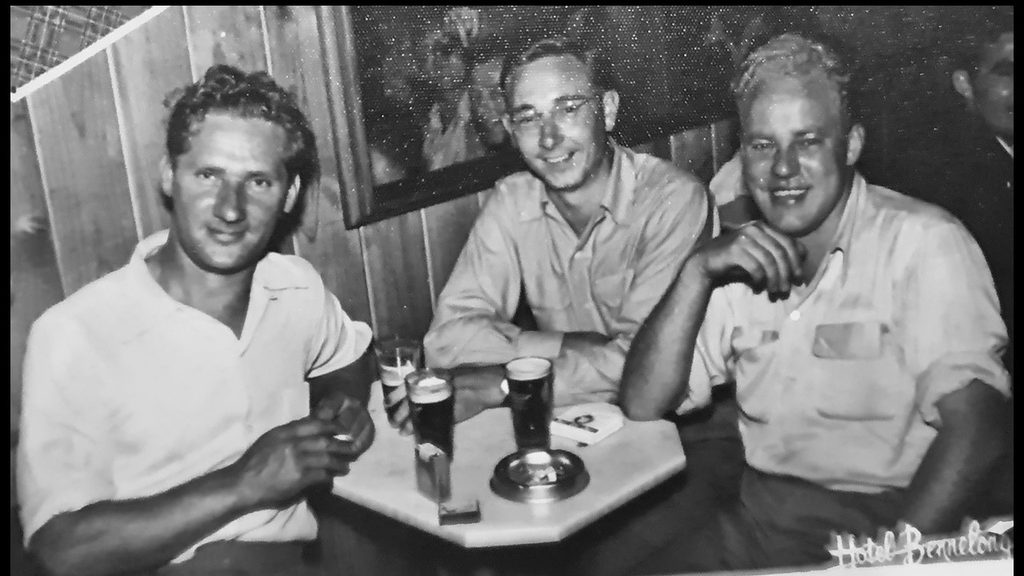
In 1950, Dick joined a group of Dutch workers recruited for an Australian dredging project. The men were employed by Australian Dredging and General Works and came primarily from Sliedrecht and its maritime industries.
They travelled to Australia on two KLM flights, arriving in June and July 1950. Their skills were required for dredging and harbour works around Williamstown and elsewhere in Australia. Dick travelled on the second KLM flight, which departed Amsterdam on 22 July 1950 with Sydney recorded as its Australian destination. The surviving seating plan lists “Mr D. van Teulingen” in seat F3 (see below).
The original employment arrangement was intended to last for approximately two years. For some of the men, however, the project became the beginning of permanent settlement in Australia.
Dick carefully retained copies of the seating plans for the two KLM flights. As the years passed, he reportedly crossed out the names of colleagues as they died. The documents became a poignant record of the group of young Dutch workers who had travelled together to begin a new chapter in Australia.
Meeting Linda in Williamstown
While living and working in Williamstown, Dick met Linda, a nurse at Williamstown Hospital. Linda was a friend and colleague of Glenda Korporaal’s mother, who was also a nurse at the hospital and married another of the Dutch dredging workers.
Dick and Linda married and established their life in Australia. By 2025, they had celebrated their 72nd wedding anniversary.
They had three children, seven grandchildren and six great-grandchildren. Their daughter Martine later described her father as a man of quiet pride and a strong work ethic. She remembered family camping and caravanning holidays and said that he never seemed to take a sick day.
Dick and Linda eventually lived in Torquay. He became a keen supporter of the Geelong Cats and, in his later years, enjoyed following sport on television.
From temporary worker to Australian family man
Dick’s story illustrates how an industrial employment project contributed to permanent Dutch settlement in post-war Australia.
He did not necessarily leave the Netherlands with a definite intention of remaining in Australia. Like the other dredging workers, he initially came under a temporary employment arrangement. Work, personal relationships and the opportunities available in Australia subsequently influenced his decision to stay.
The marriage of Dutch workers to local women—including nurses from Williamstown Hospital—transformed what had begun as a commercial dredging project into a lasting migration story.
Dick’s experiences were probably shared by several of his colleagues. Younger and relatively unattached workers had opportunities to establish new lives and families in Australia, while some older workers with established families may have returned to the Netherlands.
His final years and legacy
Dick celebrated his 100th birthday in July 2025, surrounded by family and friends. The milestone was reported by the Geelong Advertiser in an article entitled “From war prisoner to family man”.
He died in July 2026, having reached the remarkable age of 100. He was reportedly the last surviving member of the original group of Dutch dredging workers who arrived in Melbourne in 1950.
His life stretched from a childhood in the Netherlands and the trauma of wartime deportation to engineering work, migration, marriage and more than seven decades of family life in Australia.
Continuing the research
The Dutch Australian Cultural Centre is working with Glenda Korporaal, descendants of the dredging workers and the Historische Vereniging Sliedrecht to identify the men who came to Australia in 1950 and record their stories.
Further research is particularly needed into:
- the identity and location of the village he remembered as Endorf;
- his forced labour at the railway facilities in eastern Munich;
- his naval service;
- the Australian dredging projects on which he worked; and
- the experiences of the other Dutch workers who travelled to Australia with him.
Further documentation may help establish the complete route of Dick’s transfers through Germany and identify the precise locations where he was held and required to work.
The DACC welcomes information from members of the Van Teulingen family and other people who knew Dick or Linda.
Acknowledgements and sources
This article draws upon Dick van Teulingen’s recollections as recorded by journalist and author Glenda Korporaal; information supplied by Kees van der Sluijs and researchers associated with the Historische Vereniging Sliedrecht; a Dutch archival record concerning Dick’s compulsory labour; and the following published sources:
Glenda Korporaal – “Reflections of a migrant’s daughter”
Geelong Advertiser, “Torquay WWII veteran Dirk van Teulingen turns 100”, 7 July 2025.
DACC – “From Sliedrecht to Williamstown: Dutch dredging workers in post-war Australia”
For the wider history and related company, project and personal stories, see the Dutch dredging in Australia – Research Portal.
The DACC is grateful to Glenda Korporaal for sharing her interviews, recollections and photographs, and to the researchers in Sliedrecht who are helping reconstruct this Dutch-Australian migration story.