Frank Zindler is a Dutch migrant and artist who is primarily known for having married Maria (Ria) Scholte, the 50,000th Dutch migrant to Australia.
Early years in Indonesia and Australia
Frank was born in Java in the Dutch East Indies (now Indonesia) on 20 May 1932. He grew up in the Indies, where his father Jacob Hendrik Zindler (known as Jaap) was a professional photographer. During the Japanese Occupation of Indonesia in the Second World War Jaap was a Japanese prisoner-of-war. His wife Janke Anke Nederhoed and their three children – Frank and his brothers Robert and Max – were imprisoned in the Tjihapit civilian internment camp in Bandung. After the end of the war the family was evacuated to Australia in January 1946. They passed through migration camps at Wacol and Brisbane before being transferred to Melbourne. During this time Frank was one of 35 Dutch boys who volunteered to load cargo onto the SS Tasman in Port Melbourne. At the time, Australian dockworkers refused to load Dutch ships as part of the Black Armada blockade.
Eventually, however, the family was broken up: Jaap returned to Indonesia and Janke and the children travelled to the Netherlands. The marriage between Frank’s parents did not last.
In 1953, less than ten years since he had left Australia as a wartime evacuee, Frank returned as a Dutch migrant on the Johan van Oldenbarnevelt. He arrived in Melbourne in November that year aged twenty-one, joining his brother Robert, who had emigrated in 1952.
Marriage to Ria Scholte
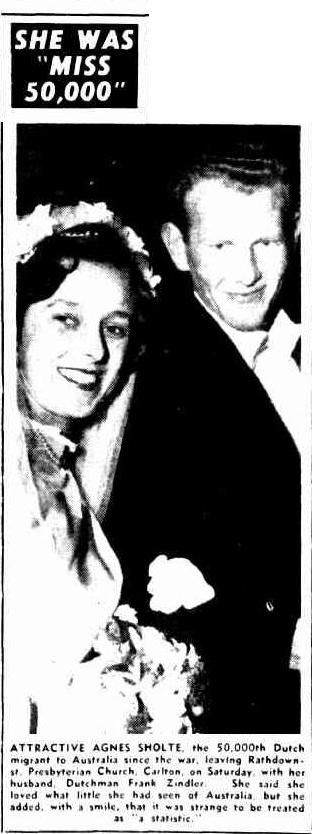
At the time of his emigration Frank was newly engaged to Maria (Ria) Scholte, a young woman who in 1954 would become the 50,000th Dutch migrant to Australia. After Frank emigrated the couple spent nine months apart on opposite sides of the world before Ria joined Frank in Melbourne. Ria’s status as the 50,000th migrant generated not insignificant media coverage of the couple, and their wedding in Carlton on 10 July 1954 was covered by the local newspapers.
In Melbourne Frank worked as a draughtsman and architect, spending twelve years at Garnet Alsop & Partners. He studied architecture at RMIT University and became a Fellow of the Royal Australian Institute of Architecture. While working towards his degree Frank drew illustrations of Melbourne houses built in the Victorian style, partly to finance his studies.
Living in two countries
In 1957, only four years after he had arrived in Australia, Frank and Ria returned to the Netherlands. They felt homesick for their relatives and had difficulty adjusting to life in Australia. Back in the Netherlands, Frank worked as a construction supervisor for a time and in August 1959 he and Ria welcomed a baby girl into their little family. However, the economic downturn meant that Frank lost his job and the family decided to return to Australia, where they thought job prospects were better.
Back in Melbourne, Frank got a job with his former employer and Ria picked up hairdressing again after a short stint as stay-at-home mum. The family lived at different addresses in Melbourne as Frank and Ria bought and fixed up run-down properties before selling them at a profit. However, the couple felt they did not fit into Australian society and decided to return to the Netherlands again, in time for their daughter to start high school there.
The family bought a house in Naarden in the country’s Gooi region. Frank continued his architectural career for a further twenty-five years, working for NKI Group from 1971 to 1996. Frank travelled a lot while working for this company: he was responsible for airport check-in desks that the company produced for airports from Schiphol Amsterdam to Singapore, Kuala Lumpur and beyond.
At the end of 1992 Frank’s wife Ria was diagnosed with a brain tumor. She passed away only a few months later in early 1993. After Ria’s death Frank remarried to a woman named Annelies Heijnen.
Love for art
In his retirement Frank picked up his love for painting and art. He pursued water colour painting and became a member of the Aquarelinstituut van België (Belgian Institute of Water Colour Painting). His works have been exhibited in Galerie Alafran in Diepenheim and sold to private collectors. While the subjects of his artworks varied, he sometimes painted scenes of Australian life while in the Netherlands.
The information in the last part of this article is abstracted from two Dutch Courier articles by Ann Schipperheyn (below). With thanks to Ada Cable-De Graaff for suppling these articles.
Selected additional sources
- ‘Interest in Dutch Migrant’, The Age, 3 July 1954, p.8 via TROVE
- ‘Busy Days for Maria’, The Beaudesert Times, 10 September 1954, p.8 via TROVE
- ‘50,000th Migrant Married’, The Northern Miner, 26 August 1954, p.2 via TROVE
- Emigration card record of F. Zindler
- Frank Zindler Watercolours on Facebook
- Frank Zindler’s profile at Galerie AlaFran
- Frank Zindler’s profile on LinkedIn
- ‘Galerie AlaFran presenteert vanaf 27 maart 2010 een nieuwe expositie’, Molennieuws vol.5 no.1 (April 2010), p.8.
- Transcript of Robert Zindler’s interview questionnaire for Nonja Peters
- FindAGrave listing for Jacob Hendrik (Jaap) Zindler
- The Nederlands Fotomuseum’s collection contains photos of/by Jaap Zindler in Indonesia. Likewise, there are records associated with Jaap in the OnsLand database.