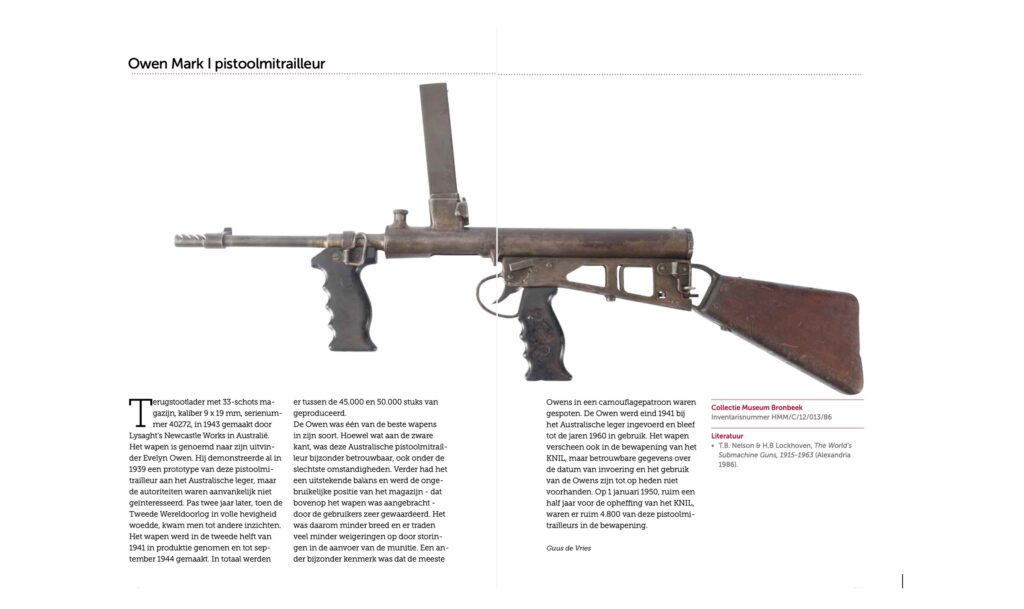
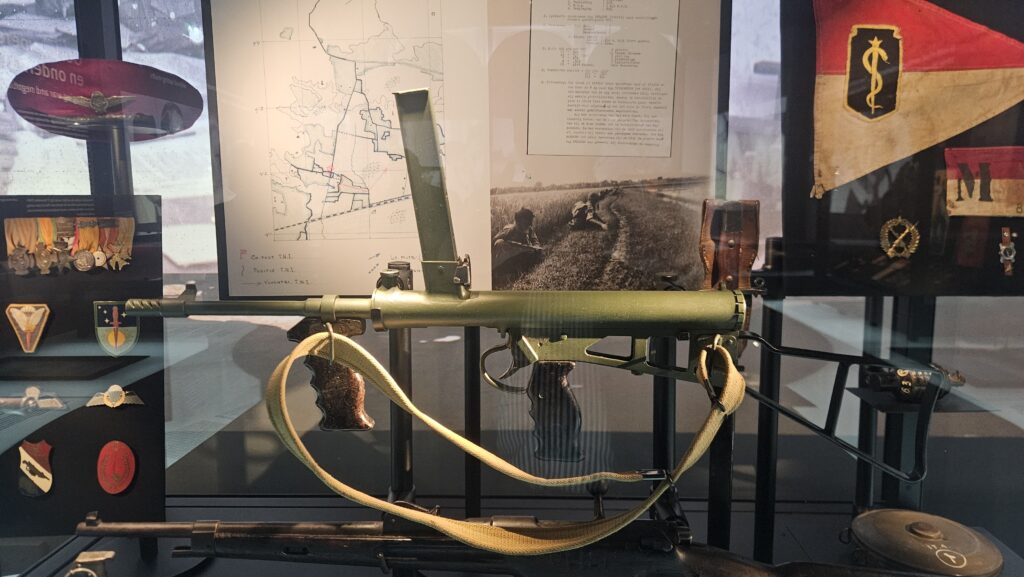
Among the many fascinating objects in the collection of the Bronbeek Museum is an Australian-made Owen Mark I submachine gun. At first glance it appears to be simply another weapon of the Second World War. Yet this remarkable firearm tells a much larger story—one of Australian innovation, Dutch-Australian military cooperation and the rebuilding of the Royal Netherlands East Indies Army (KNIL) after the fall of the Netherlands East Indies.
Few Australians realise that one of Australia’s greatest wartime military inventions also became one of the principal submachine guns of the KNIL. By 1 January 1950, just six months before the KNIL was dissolved, more than 4,800 Australian-made Owen guns were still in Dutch military service.
The Owen gun therefore represents far more than Australian military history. It also symbolises one of the many practical ways in which Australia supported the Dutch war effort during and after the Second World War.
An Australian invention
The weapon is named after its inventor, Evelyn Owen, a young Australian who first demonstrated a prototype submachine gun to the Australian Army in 1939. At the time the military showed little interest in the design. Only after Japan entered the war and Australia suddenly faced the prospect of invasion did attitudes change.
Development resumed in earnest and by the end of 1941 the Owen gun had entered Australian Army service. It would go on to become one of the most successful submachine guns of the Second World War. Between 45,000 and 50,000 examples were manufactured, including this Owen Mark I, serial number 40272, produced in 1943 by Lysaght’s Newcastle Works in New South Wales.
Although somewhat heavier than many contemporary weapons, the Owen possessed qualities that made it ideally suited to jungle warfare. It was exceptionally reliable under the harsh conditions of the Southwest Pacific. Mud, sand, rain and tropical humidity had little effect on its operation. Soldiers particularly appreciated its excellent balance and the unusual top-mounted magazine, which proved highly practical in combat. Many Owens were also painted in camouflage patterns before being issued.
Australian troops quickly came to regard the Owen as one of the finest submachine guns of the war, and it remained in Australian military service until the 1960s.
The Dutch connection
The Bronbeek display highlights a less well-known chapter in the Owen gun’s history.
The Owen was also issued to the Royal Netherlands East Indies Army (KNIL). Although reliable records have yet to establish precisely when the weapon entered Dutch service, its presence within the KNIL is well documented. Surviving records show that on 1 January 1950 there were more than 4,800 Owen submachine guns in Dutch military service.
This is a remarkable figure. It demonstrates that the Owen was not an occasional substitute or emergency weapon, but had become one of the standard submachine guns of the KNIL during the final years of its existence.
Australia as the Dutch wartime arsenal
The story of the Owen gun cannot be separated from Australia’s role during the Second World War.
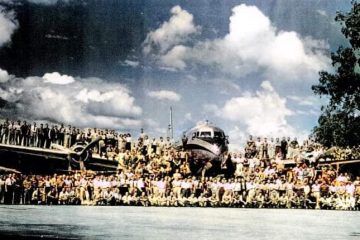
Following the Japanese conquest of the Netherlands East Indies in early 1942, Australia became the principal base for Dutch military and government organisations operating in exile. Camp Columbia near Brisbane housed the Netherlands East Indies Government-in-Exile together with military headquarters and intelligence organisations such as NEFIS. Dutch naval units operated from Australian ports, Dutch airmen trained alongside Australians, and Dutch soldiers prepared for the eventual liberation of their homeland.
As Dutch forces were rebuilt in Australia, they increasingly relied on Australian industry for equipment and supplies. The Owen gun became one of the most tangible examples of this cooperation.
Manufactured in Newcastle, New South Wales, the weapon was supplied to Dutch forces fighting alongside their Australian and American allies. It became part of the practical military partnership that developed between the two nations during the war.
Designed for the Pacific
The Owen’s success reflected the very different nature of the Pacific War.
European-designed weapons often struggled in tropical conditions. Fine sand, heavy rain, dense jungle and constant humidity created severe maintenance problems. The Owen was specifically adapted to these conditions. Its simple but robust design gave it an outstanding reputation for reliability where it mattered most—in the jungles of New Guinea and throughout the islands of the Southwest Pacific.
Those same qualities made it equally valuable for Dutch troops operating in the tropical environment of the Netherlands East Indies.
More than a weapon
The Owen gun displayed at Bronbeek therefore represents much more than an Australian military innovation.
It illustrates the close military relationship that developed between Australia and the Netherlands during the Second World War. Australian factories supplied equipment, Australian training establishments prepared Dutch personnel, Australian ports became bases for Dutch naval operations, and Australian industry helped re-equip Dutch forces after the loss of the Netherlands East Indies.
Like many wartime objects, the Owen gun tells a story that extends far beyond its mechanical function. It speaks of Allied cooperation, shared resources and common purpose.
Manufactured in New South Wales, carried by Australian soldiers in New Guinea, and later adopted by the KNIL, the Owen gun became one of the tangible products of the Dutch-Australian wartime alliance.
Today the example preserved at the Bronbeek Museum serves as a reminder that the partnership between Australia and the Netherlands was built not only through diplomacy and strategy, but also through the practical cooperation that equipped Allied soldiers for the difficult campaigns of the Pacific War.
In that sense, the Owen gun stands as one of the most distinctive Australian contributions to the military history of the Netherlands East Indies.
The text below is from Guus de Vries published in: Mark Loderichs (red.), Catalogus Museum Bronbeek. Het verhaal van Indïë (Amersfoort 2015), 400-401.