Charleville, in western Queensland, is widely remembered for its importance to American aviation during the Second World War. Less well known is its connection with the Netherlands East Indies through the Dutch airline KNILM (Koninklijke Nederlandsch-Indische Luchtvaart Maatschappij).
Before the Pacific War, Charleville served as an inland stopping point on the air route between the Netherlands East Indies and Sydney. In early 1942 it became part of an evacuation corridor used by Dutch aircraft escaping the Japanese advance. Later that year, the rare Dutch Douglas DC-5 Wakago made its final landing near the town.
KNILM’s prewar Australian service
KNILM inaugurated a regular service between Batavia and Sydney in July 1938. Its aircraft travelled through the Netherlands East Indies and northern Australia before crossing inland Queensland on their way to Sydney.
The precise stopping pattern changed as KNILM introduced different aircraft and revised its timetable. Charleville’s position on the inland route and its established aviation facilities made it an important stopping and overnight point between northern Australia and Sydney.
Shell, KNILM and aviation fuel
Refuelling facilities were essential to Charleville’s place on the KNILM route. Earlier DACC research identified Shell as a supplier of aviation fuel to KNILM and associated the company’s inland fuel network with operations at Charleville.
This would add another Dutch corporate dimension to the town’s aviation history: KNILM connected Charleville with the Netherlands East Indies, while the Royal Dutch Shell group helped sustain international aviation through its Australian fuel-distribution network.
Shell’s presence in Australia was already well established by this period. However, further primary documentation is still required to establish the precise ownership and operation of the Charleville aviation-fuel facilities and the terms under which fuel was supplied to KNILM.
See also: The history of Shell in Australia—since 1901.
Brisbane omitted from the revised route
A contemporary report published in the Brisbane Telegraph in June 1938 provides particularly valuable evidence of Charleville’s planned role.
The newspaper reported that Brisbane had been omitted as a port of call following plans to use slower Douglas DC-3 aircraft. Avoiding the detour through Brisbane would allow KNILM to maintain a two-day Sydney–Batavia service.
The revised timetable provided for stops at Cloncurry and Charleville on the Darwin–Sydney section. Cloncurry was to be the overnight stop for aircraft travelling north from Sydney, while Charleville would accommodate passengers travelling south from Darwin.
KNILM representative Mr Mijnlieff spoke to the newspaper from Charleville, where he was arranging passenger accommodation. His presence demonstrates that the town was being prepared as an operational and passenger stop, rather than merely being used as an occasional refuelling point.
Document below
“Brisbane Omitted on Overseas Air Service,” Brisbane Telegraph, June 1938. The report records KNILM’s plans to use Charleville as an overnight stop on its Australia–Netherlands East Indies service.
Charleville and the 1942 evacuation
Japan’s advance through Southeast Asia transformed the civil air route into an emergency evacuation corridor.
Beginning in February 1942, KNILM aircraft carried airline employees and their families, Netherlands East Indies government officials, military personnel, government records, technical equipment and other important material from Java to Australia.
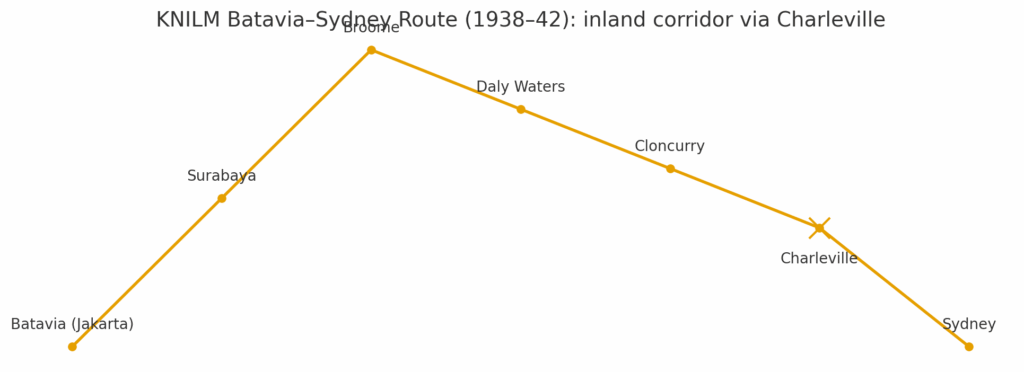
During the major movement beginning on 19 February, KNILM aircraft reportedly departed Batavia and Surabaya at intervals during the night. Flights followed different routes according to operational conditions, but one important route continued from Broome through Daly Waters, Cloncurry and Charleville before reaching Sydney.
After unloading their passengers and cargo, some aircraft returned north to undertake further evacuation flights while Java remained accessible. This created a temporary pendulum service between Australia and the threatened Netherlands East Indies.
Approximately 200 KNILM employees and family members were reportedly evacuated during the initial operation, with additional personnel following later. Many ground staff and their families could not be evacuated and were subsequently interned by the Japanese.
Eleven KNILM aircraft ultimately escaped to Australia. Charleville therefore became one link in an air bridge carrying evacuees, government records, technical personnel and aircraft away from the Japanese advance.
The Dutch DC-5 Wakago at Charleville
One Dutch-linked aircraft is conclusively documented at Charleville. The rare Douglas DC-5 Wakago had escaped from Java in March 1942 and subsequently entered Allied transport service in Australia.
On 6 November 1942, Wakago departed Charleville carrying approximately 20 American servicemen bound for Brisbane. After a newly installed engine failed, the crew diverted to an emergency landing ground near Lurnea Siding, approximately 30 miles east of Charleville.
The aircraft landed successfully, but during its landing run it struck a large anthill. The impact caused serious structural damage and ended the aircraft’s flying career. No serious injuries were sustained, and the crew and passengers were returned to Charleville.
A small piece of aluminium recovered near the crash site is now preserved at the WWII Secret Base Museum in Charleville. It provides a tangible connection with this Dutch–Australian–American wartime story.
The aircraft’s complete history is told in From Java to Charleville: the extraordinary wartime journey of the Douglas DC-5 “Wakago”.
Part of the wider Allied aviation network
During the war, Charleville developed into an important United States Army Air Forces aircraft reception and maintenance centre. Aircraft arriving in Australia passed through the airfield for assembly, servicing, modification or redistribution.
Dutch aircraft and personnel were meanwhile dispersed among numerous Australian locations. Some former KNILM aircraft entered American service, while KNILM pilots, flight engineers, wireless operators and technical personnel later contributed to Dutch and Allied transport operations.
No Netherlands East Indies squadron was permanently based at Charleville. The town’s importance to the Dutch aviation story instead arose from its role as:
- a stopping and overnight point on the prewar KNILM service;
- part of the 1942 evacuation route from Java;
- a connection between northern Australia, inland Queensland and Sydney;
- the departure point for the final flight of the Dutch DC-5 Wakago; and
- one location within the wider Allied aviation network established across Australia.
During the war, Charleville developed into an important United States Army Air Forces aircraft reception and maintenance centre. Aircraft arriving in Australia passed through the airfield for assembly, servicing, modification and redistribution.
Aircraft originally ordered and paid for by the Netherlands East Indies—including B-25 Mitchell bombers—were transferred to American control after arriving too late to be delivered to Java. Charleville’s aircraft reception role makes it possible that some Dutch-ordered aircraft passed through the airfield, but no individual B-25 movement through Charleville has yet been confirmed.
The Dutch-linked Douglas DC-5 Wakago, however, is conclusively documented at Charleville. Other former KNILM aircraft were dispersed among Australian bases and absorbed into the Allied transport system.
Surviving Dutch aircrew meanwhile regrouped elsewhere in Australia. This process led to the formation of No. 18 (Netherlands East Indies) Squadron RAAF in April 1942 and, later, the Netherlands East Indies military transport organisation. Charleville was not a permanent base for these Dutch units, but it formed part of the larger Australian aviation network upon which they depended.
Aftermath and legacy
Charleville’s place in this history should nevertheless not be overlooked. For several critical years, it was a junction on the air route between Java and Sydney. It received KNILM passengers before the war, formed part of the evacuation corridor in 1942 and became the departure point for the final flight of the Dutch DC-5 Wakago.
As Dutch aviation operations were reorganised in Australia, Charleville’s importance as a KNILM staging point declined. Sydney became the principal gathering place for the surviving civil airline administration and personnel. Senior KNILM employees and some family members assembled at the Australian Hotel, while aircraft were directed to Sydney, Archerfield and other centres for maintenance, military duties or transfer to American control.
KNILM had effectively ceased operating as an independent Australian airline during 1942. Its aircraft and personnel were dispersed among Allied organisations, although the company continued to exist legally and later attempted to resume civil operations after the war.
Related DACC articles
- KNILM and its Australian connection
- From Java to Charleville: the extraordinary wartime journey of the Douglas DC-5 “Wakago”
- The Java–Broome evacuation route, February and March 1942
- Netherlands East Indies military air transport services in Australia, 1942–1947
- The Dutch at Archerfield Airport, Brisbane
- DACC Air Force Research Portal
Sources and further reading
- Brisbane Telegraph, “Brisbane Omitted on Overseas Air Service,” June 1938; reproduced in the downloadable DACC document above.
- G.J. Hagens, De KNILM vloog door, Haarlem: Bakenes, 1972.
- 36 Squadron News Bulletin, Issue 13, July 1993—Peter Dunn’s Oz at War.
- WWII Secret Base Museum, Charleville.