Frederik “Fred” Pelder was a Dutch military pilot whose extraordinary escape from Java, service with No. 18 (Netherlands East Indies) Squadron RAAF and later commemoration in South Australia connect several important chapters of Dutch–Australian wartime history.
His nickname, “Pulk,” was painted on the B-25 Mitchell N5-131 operated by No. 18 Squadron. Decades later, another B-25 was brought to Australia and restored in the markings of N5-131 as a tribute to Pelder and all the Dutch, Indonesian and Australian personnel who served with the squadron.
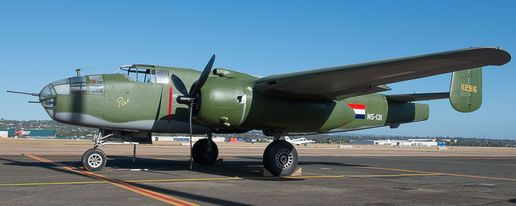
The preserved aircraft is not the original wartime N5-131. It is an American B-25J, serial number 44-31508, now presented in the historically significant markings of “Pulk.”
Frederik “Pulk” Pelder
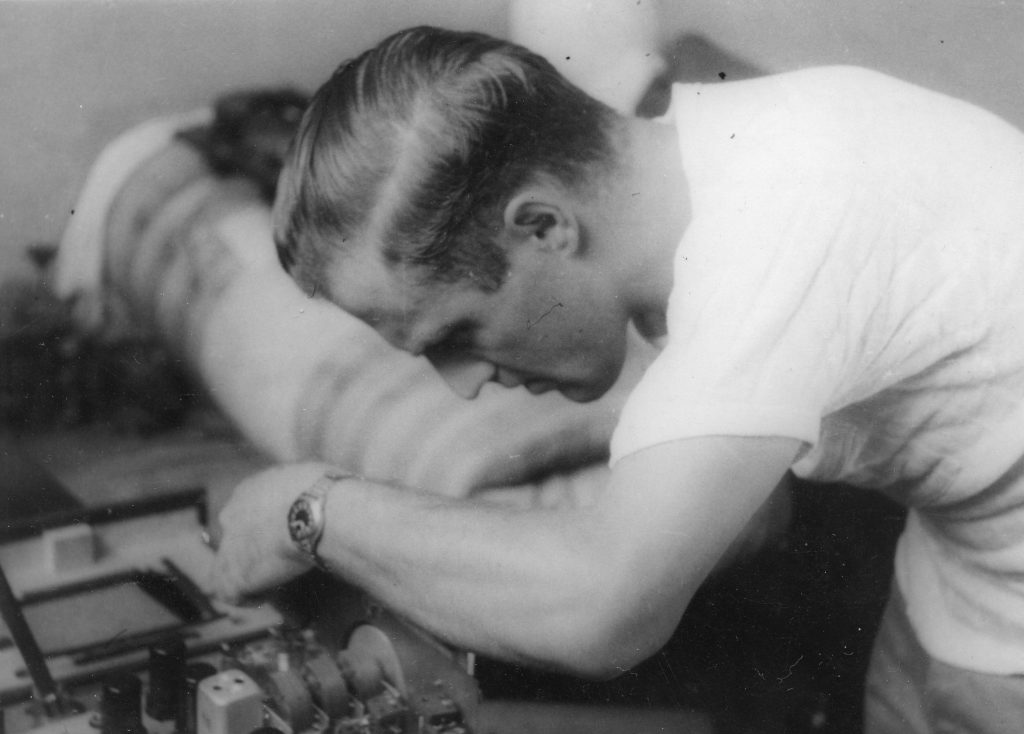
Frederik Pelder was born in The Hague on 19 January 1918. Before the Pacific War, he trained as a pilot with the Military Aviation Service of the Royal Netherlands East Indies Army—the ML-KNIL—and flew Brewster Buffalo fighters.
The nickname “Pulk” dated from his school years in the Netherlands. According to family accounts, it was given to him by his friend and fellow aviator Fridjof Olsen because Pelder was continually tinkering with mechanical equipment, including cars, motorcycles and radios, in an effort to improve their performance.
His practical mechanical abilities would prove crucial during the final days of the Netherlands East Indies campaign.
The escape from Java
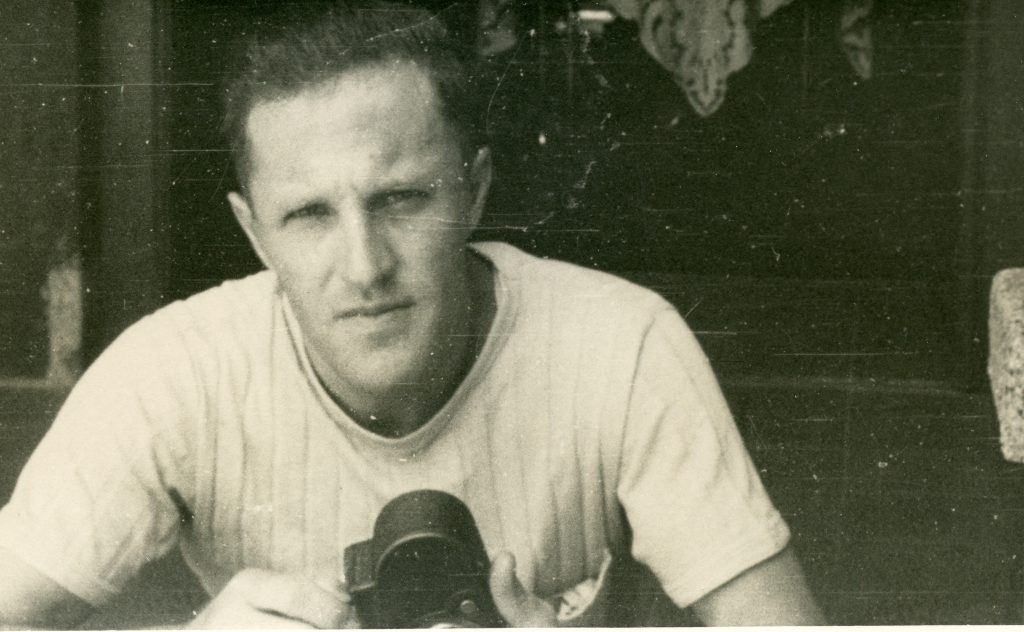
When the Netherlands East Indies forces capitulated on 9 March 1942, Pelder was recovering in hospital. Rather than surrender, he decided to find a way out of Java and continue the war.
At Pameungpeuk airfield on Java’s southern coast, Pelder encountered several abandoned and badly damaged Lockheed 12 aircraft. He had trained on the type and believed that one could be made airworthy.
Pelder joined four other Allied servicemen:
- Pilot Officer Mendizabal, a Canadian;
- Sergeant Stuart Munroe, an Australian;
- Alan Martin, an Australian; and
- Doug Jones, a New Zealander.
Working with extremely limited tools and materials, the five men reconstructed one aircraft, reportedly Lockheed 12 identification L-201. The work included attaching a replacement tail section. Coins were bent and used as improvised screwdrivers, while wire, bamboo and other available materials helped make the aircraft serviceable.
The repaired Lockheed’s normal range was insufficient for a flight across the Indian Ocean. The men therefore loaded additional fuel in improvised containers, described in some accounts as wine casks. A hose was connected to the main fuel system, and the men took turns manually pumping fuel into the aircraft’s tanks during the flight.
On 9 March 1942, they departed Pameungpeuk and flew towards northern Sumatra. After landing at a small dispersal airfield near Lho Nga, south of Kota Radja—present-day Banda Aceh—they refuelled and departed shortly before Japanese aircraft attacked the area.
They then set out across the Indian Ocean for Ceylon, now Sri Lanka. Their navigational resources were extremely limited and reportedly included an ordinary school atlas. The over-water flight lasted approximately ten hours.
As the aircraft approached Ceylon, Pelder fired two signal flares in an attempt to show that it was friendly. By extraordinary coincidence, the signal corresponded with the correct recognition code for that day, allowing the aircraft to approach and land without being fired upon.
Pelder and his companions had escaped Java and carried valuable information with them, reportedly including a current version of secret KNIL military codes. The repaired Lockheed was subsequently taken into Royal Air Force service as LV762.
From Ceylon to Australia
While in Ceylon, Pelder was reunited with his friend Fridjof Olsen, who had been serving with the Royal Air Force. After a period in British India, both men eventually travelled to Australia and joined No. 18 (Netherlands East Indies) Squadron RAAF.
The squadron had been established in Canberra in April 1942 as a combined Dutch–Australian formation. Its pilots and many of its other operational personnel came from the Netherlands East Indies, while the RAAF supplied substantial numbers of Australian aircrew and ground personnel.
On 30 August 1942, Pelder was among six new officers sworn in at Canberra Airport. The ceremony was conducted by the squadron’s commanding officer, Major B.J. Fiedeldij.
After completing his B-25 conversion and operational training, Pelder served with the squadron as it moved to northern Australia and began operations against Japanese positions and shipping in the occupied Netherlands East Indies.
The original B-25 N5-131 “Pulk”
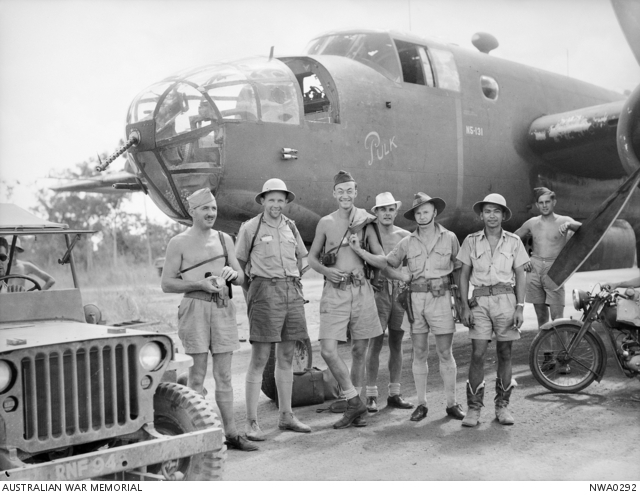
The name “Pulk” was painted below the cockpit of B-25C Mitchell N5-131. The aircraft was one of the early Mitchells allocated to No. 18 Squadron and became closely associated with Fred Pelder.
From bases in the Northern Territory, No. 18 Squadron’s Mitchells flew bombing, reconnaissance and anti-shipping missions against Japanese targets across the Netherlands East Indies. The crews were multinational, commonly combining Dutch or Netherlands East Indies pilots with Australian wireless operators and air gunners.
An Australian War Memorial photograph taken on 4 May 1943 shows personnel and aircrew standing in front of N5-131 after returning from a raid against Japanese forces.
The original N5-131 did not survive to become the aircraft now preserved in South Australia.
Pelder’s later service
Pelder remained with the ML-KNIL through the remainder of the war and during the turbulent postwar period in the Netherlands East Indies. He continued serving until the transfer of sovereignty to Indonesia in 1949.
He then returned to the Netherlands with his wife and their first child. Pelder continued his aviation career and eventually retired with the rank of lieutenant colonel pilot-observer in the Royal Netherlands Air Force.
He died in The Hague on 19 September 2000, aged 82. He was survived by his wife and five children.
Pelder’s Australian family connection
Fred Pelder’s wartime years in Australia also produced an unexpected personal connection.
While stationed in Australia, he formed a relationship with Brisbane woman Ruth Leah. After an engagement of approximately six months, they married at Holy Trinity Anglican Church in Woolloongabba. Pelder became close to Ruth’s family and stayed at their Brisbane home when his duties permitted.
The relationship did not continue after the war, and Pelder later returned to the Netherlands East Indies. For many years, his later family knew little about this part of his life.
Decades later, Ruth’s daughters, Robyn Turner Rodgers and Deborah Turner, discovered information about Pelder and contacted his son, Fred Pelder Jr. This brought the Australian and Dutch families together. Fred Jr and his wife Mathilde subsequently visited Ruth, who was then 88 years old.
The complete family account is preserved in the related DACC article A very personal WWII story from Ruth Leah.
A different B-25 comes to Australia
The B-25 now carrying the “Pulk” name in South Australia is North American B-25J Mitchell serial number 44-31508. It was completed in the United States during 1945 and was never part of No. 18 Squadron.
After leaving American military service, the aircraft passed through several private owners. In 1967 it was modified as an aerial camera platform and flown to Europe for use during production of the film Battle of Britain. Its camera installation enabled aerial sequences to be filmed from the air.
The aircraft later returned to the United States and was restored to flying condition. During different stages of its civilian history it carried the names “Chapter XI” and “Lucky Lady.”
By 1999 it had been withdrawn from flying and was stored in deteriorating condition at Franklin, Virginia. It was missing an engine, and parts of its structure had suffered from years of exposure.
Reevers Warbirds acquired the remaining aircraft in 2015 and transported it to Parafield Airport in South Australia.
Restored as a tribute to No. 18 Squadron
Reevers Warbirds restored the B-25 to static-display condition and painted it to represent the original No. 18 Squadron B-25C N5-131 “Pulk.”
Although the surviving aircraft is a later B-25J rather than the original B-25C, the restoration recreates the Dutch flag markings, N5-131 identification and “Pulk” name carried by Pelder’s wartime aircraft.
She returned to the USA and restored to flight using the name Chapter XI, the lucky lady (that applies on some of the pictures of the plane at that time) was applied for an old spice commercial, but that name was never officially used that name.
The restored B-25 was publicly unveiled at Parafield Airport in April 2017. Fred Pelder Jr participated in the commemoration and helped return the name “Pulk” to the aircraft.
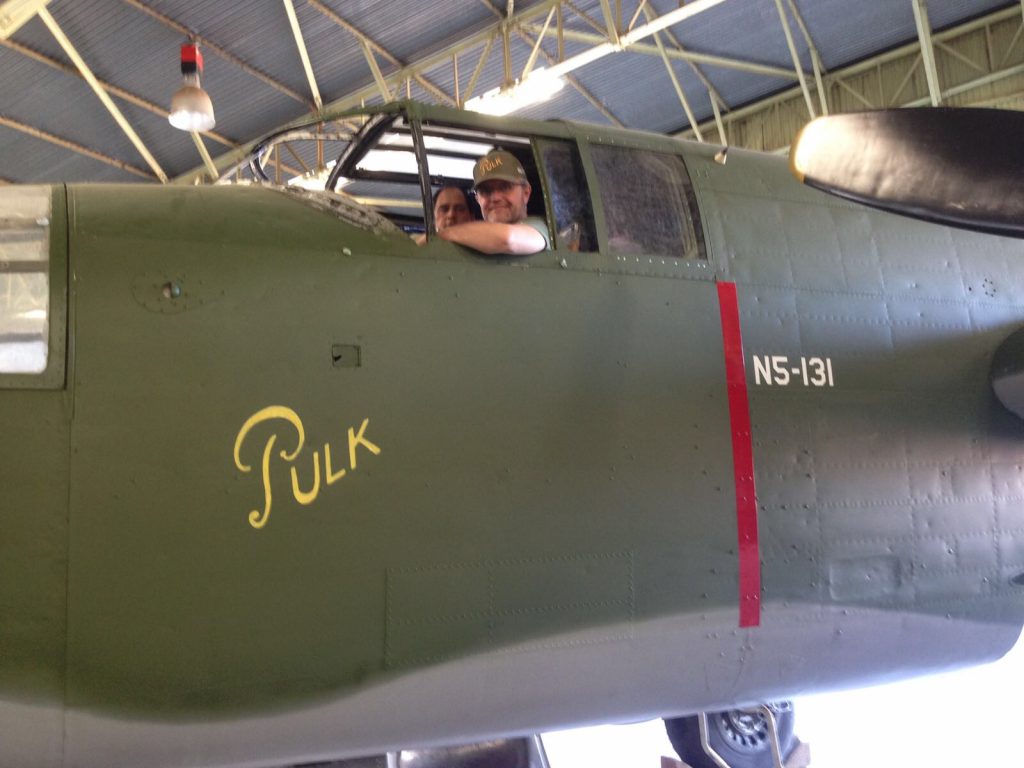
No. 18 Squadron veteran Hans de Vries also attended the event and sat once again in the cockpit of a B-25. The gathering became an important commemoration of the personnel of No. 18 Squadron, whose service in the Pacific had received comparatively little recognition in the Netherlands after the war.
Medals presented to the Pelder family
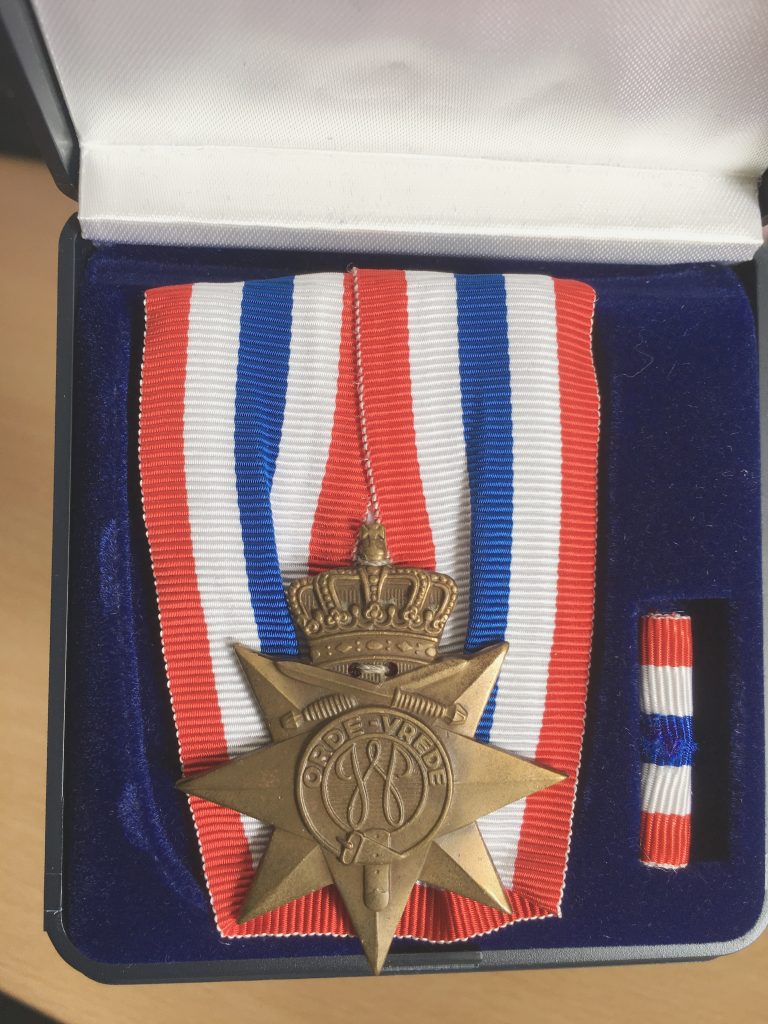
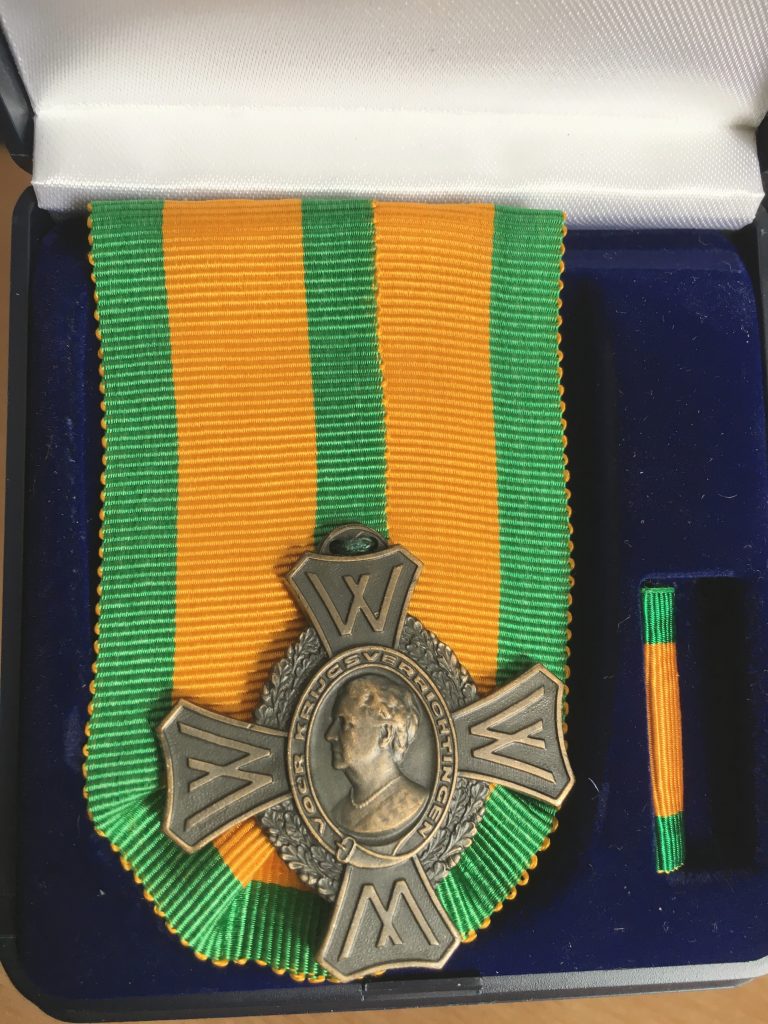
During the commemoration at Parafield Airport in April 2017, the Dutch military attaché formally presented Fred Pelder Jr with two Dutch decorations in recognition of his father’s service: the Oorlogsherinneringskruis, commemorating his service during the Second World War, and the Ereteken voor Orde en Vrede, recognising his postwar service in the Netherlands East Indies.
The presentation provided belated recognition of Pelder’s wartime and postwar military career and formed part of the wider tribute to the personnel of No. 18 Squadron.
Fred Pelder’s account of the escape
The following downloadable document contains Fred Pelder’s account of his remarkable escape from Java in March 1942. It provides additional information about the damaged Lockheed aircraft, the improvised repairs, the multinational group that escaped with him and their hazardous flight through Sumatra to Ceylon.
Restoration to flying condition
After the aircraft was restored for static display, structural inspections indicated that a return to flying condition might be possible. Work commenced on sections of the wing centre structure and planning included replacement fuel and oil tanks, pumps, filters, plumbing and other essential systems.
Restoring a large historic aircraft to airworthy condition is a complex and expensive undertaking. The project should therefore be described as an intended restoration to flight unless Reevers Warbirds provides confirmation that the aircraft has subsequently achieved airworthy status.
Whatever its eventual flying status, the aircraft already has considerable commemorative importance. It provides a physical focus for remembering the approximately 90 Dutch and 25 Australian personnel who died while serving with No. 18 Squadron.
Historical significance
Fred Pelder’s story connects three forms of survival and remembrance.
His escape from Java demonstrates the ingenuity and determination of Allied personnel who refused to surrender. His subsequent service with No. 18 Squadron forms part of the shared Dutch–Australian air war conducted from northern Australia. The restored B-25 at Parafield shows how that history continues to be commemorated by veterans, descendants, aviation specialists and museums.
The aircraft now carrying the name “Pulk” is not the original N5-131, but its value lies in what it represents: Fred Pelder, the multinational crews of No. 18 Squadron and a chapter of Australian and Netherlands East Indies history that was nearly forgotten.
Related DACC articles
- No. 18 (Netherlands East Indies) Squadron RAAF
- A very personal WWII story from Ruth Leah
- The Dutch at Batchelor Airport in the Northern Territory
- Dutch artefacts of No. 18 Squadron at the Aviation Museum in Darwin
- DACC Air Force Research Portal