Part 3 of a four-part series examining the rapid growth of relations between Australia and the Netherlands East Indies immediately before the Japanese invasion.
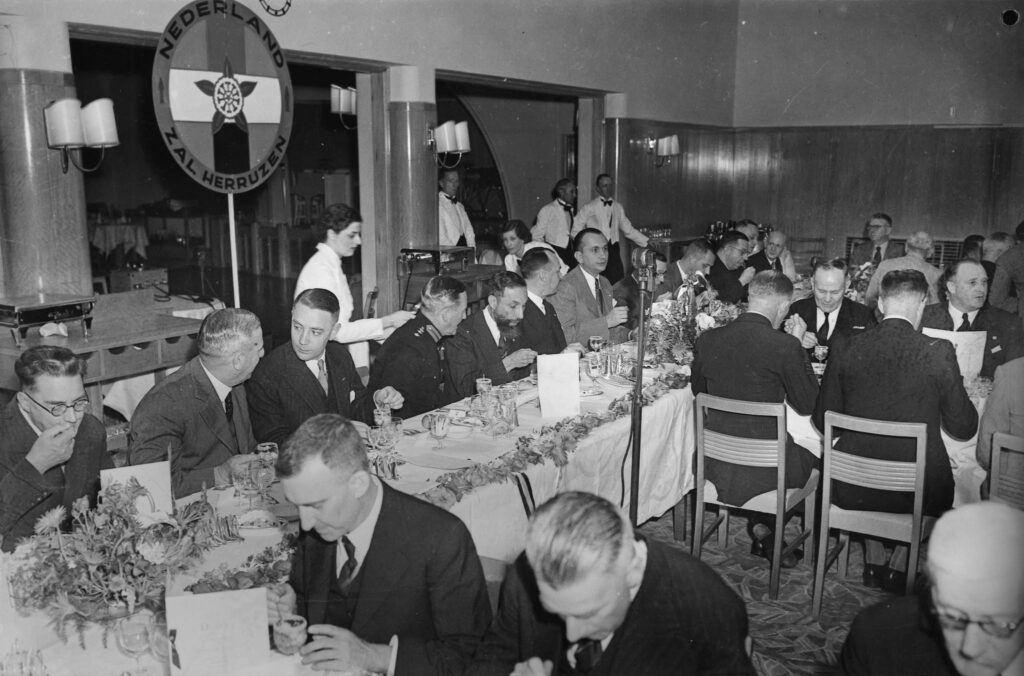
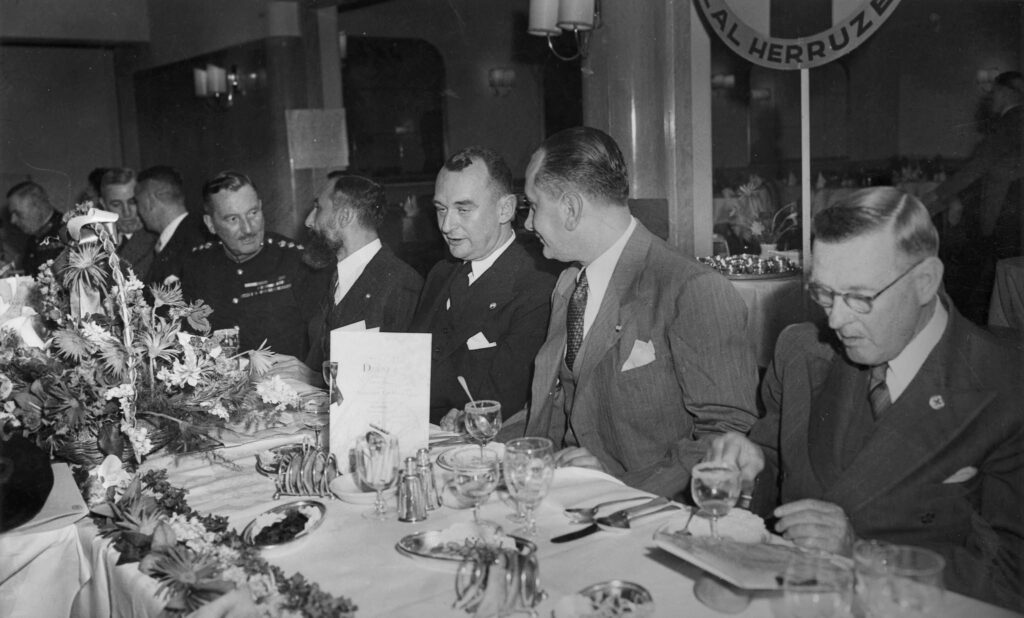
On 6 October 1941, members of a Netherlands East Indies Press Delegation were welcomed to Brisbane at a dinner at Lennon’s Hotel in George Street. The photographs of the occasion show Australian journalists, government representatives, military officers and visitors from the NEI gathered beneath a large Netherlands emblem carrying the wartime motto Nederland Zal Herrijzen—“The Netherlands Shall Rise Again”.
The dinner formed part of a Commonwealth Government-sponsored tour intended to show the visitors Australia’s military preparations, munitions production and industrial capacity. However, the delegation represented more than a newspaper study tour. It was part of the intensive exchange of Australian and NEI missions that had developed during 1941 as both neighbours recognised their shared economic and strategic interests.
The timing gives the visit particular significance. Germany occupied the Netherlands, but the colonial administration in Batavia still governed the Netherlands East Indies. Japan had not yet entered the Pacific War. Singapore had not fallen, and the NEI had not been invaded. Within five months, this entire regional situation would be overturned.
A reciprocal press mission
As discussed in the previous article in this series, Australian Minister for Information Harry Foll had led a party of Australian journalists on a fact-finding tour of the NEI and Malaya in August 1941. The Australian visitors inspected defence preparations and military facilities, including a Dutch motor torpedo boat at Surabaya.
The NEI Press Delegation’s Australian tour in October was the reciprocal part of this developing public diplomacy. The Commonwealth Government wanted the visitors to see Australia’s war effort and report their impressions to readers throughout the NEI.
This was important because relations had previously been conducted mainly among government officials, military officers and commercial representatives. The press visits attempted to broaden the relationship by building greater public awareness in both territories.
Australian readers were being encouraged to understand the strategic importance of the archipelago to their north. Readers in the NEI were being shown that Australia possessed an expanding military, industrial and munitions capacity and was becoming an increasingly important regional partner.
More than a Dutch delegation
Australian newspapers commonly described the visitors as “Dutch” or as representatives of the “Netherlands Indies”. In reality, the eleven-member delegation reflected at least some of the ethnic, cultural and political diversity of the NEI.
It was led by Charles Olke van der Plas, a senior colonial administrator and member of the Council of the Netherlands Indies. His presence gave the mission a semi-official political character extending beyond journalism.
Among the other identified members were:
- Dr K.F.J. Verboeket, an official associated with the Governor-General’s administration
- A.F. de Booy
- Djamaluddin
- Tan Ling Djie, representing the Surabaya newspaper Sin Tit Po
Contemporary reports indicate that different members of the delegation sometimes followed separate programmes. For example, four representatives—Verboeket, De Booy, Djamaluddin and Tan Ling Djie—continued to Tasmania.
The inclusion of Indonesian and Chinese-Indonesian journalists is important. The delegation was not simply a party of Netherlands-born officials and editors. It came from a colonial society containing different communities and increasingly divergent political aspirations.
Tan Ling Djie and the political diversity of the NEI
Tan Ling Djie’s participation is particularly revealing. Born in Surabaya in 1904, he studied law in Batavia and at Leiden University. He became associated with left-wing and Indonesian nationalist politics and worked for Sin Tit Po, a Chinese-Indonesian newspaper published in Surabaya.
He was also elected to the East Java Provincial Council as a representative of the Chinese community. After the war, he became active in the Indonesian Socialist and Communist parties and was involved in the political struggles surrounding independence.
In 1941, however, he travelled to Australia as part of a delegation led by one of the NEI’s most senior Dutch colonial administrators. His presence illustrates the political complexity hidden beneath contemporary Australian descriptions of the visitors as simply “Dutch”.
The tour took place before the Japanese occupation accelerated Indonesian nationalism and transformed the political balance within the archipelago. Some members of the delegation would later find themselves on opposing sides of the struggle over Indonesia’s future.
Charles van der Plas
Charles van der Plas was one of the most experienced senior officials in the NEI administration. He possessed a detailed knowledge of Indonesian society and politics and was regarded as an expert on Islam and local administration.
After the fall of the NEI, he returned to Australia under very different circumstances. He became a leading member of the Netherlands East Indies Commission for Australia and New Zealand and played an important role in the displaced NEI administration’s political and wartime activities.
His leadership of the 1941 press mission therefore provides a direct connection between the pre-war goodwill visits and the Dutch and NEI administrative presence established in Australia after the Japanese conquest.
In October 1941, Van der Plas came to assess Australian preparations and promote closer relations. Only months later, Australia would become one of the principal bases from which he and other NEI officials attempted to continue their work.
The journey to Australia
The delegation’s itinerary included Townsville, Brisbane, Sydney, Canberra, Melbourne and Adelaide, while a smaller group of four representatives also travelled to Tasmania.
The programme was carefully arranged to display Australia’s military organisation, munitions production and industrial development. The visitors inspected army camps, air force bases, naval facilities and factories. They also met Australian politicians, officials, military officers, businesspeople and journalists.
The tour was more than hospitality. It presented a carefully constructed picture of a country mobilising for war and capable of supporting its northern neighbour.
At the same time, the visitors were able to observe Australia’s limitations. Much of its war effort remained directed towards the Middle East and Europe, while its capacity to defend the vast northern approaches and provide large quantities of weapons to the NEI remained restricted.
A concentrated Brisbane programme
The delegation arrived in Brisbane for an exceptionally concentrated programme. In a single afternoon, its members visited:
- the Rocklea munitions factory
- the Redbank AIF camp
- RAAF Base Amberley
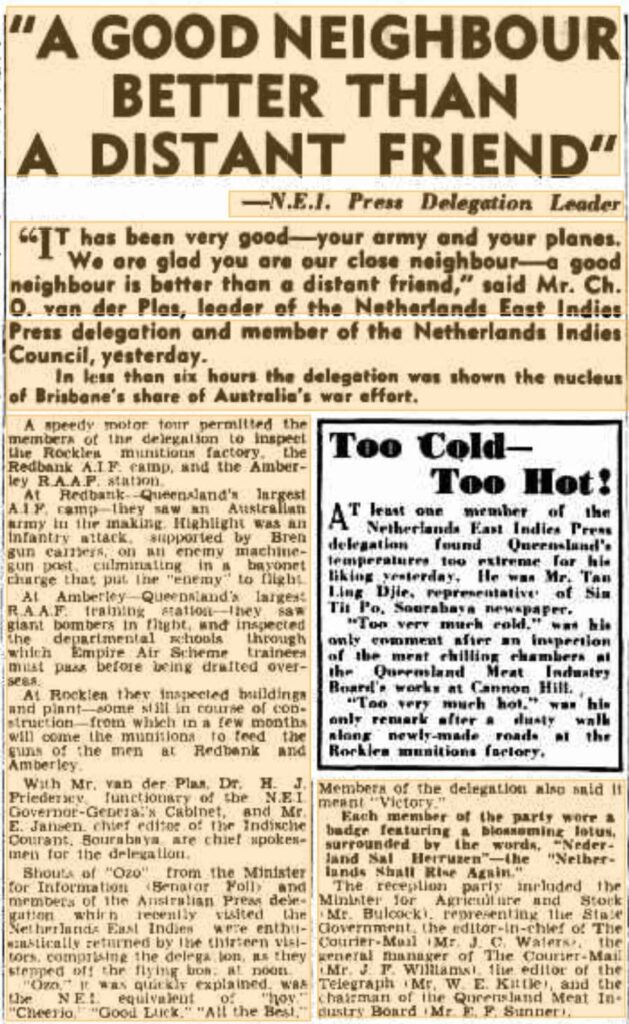
At Redbank, the visitors watched Australian soldiers conduct a simulated infantry attack supported by Bren guns. The demonstration concluded with a bayonet charge intended to show the intensity of Australian training.
At Amberley, they observed bomber training and inspected the facilities provided for aircrew associated with the Empire Air Training Scheme. At Rocklea, they inspected the developing munitions complex and buildings intended to expand the production of weapons and ammunition.
The Courier-Mail report reproduced above described these three locations as important elements of Brisbane’s contribution to Australia’s war effort.
This combination reflected the wider Australian–NEI relationship developing during 1941. The NEI needed weapons, ammunition and industrial supplies. Australia needed the NEI to remain a defensive barrier against Japanese expansion and was interested in its oil, rubber and other strategic resources.
“A good neighbour”
After the Brisbane inspections, Van der Plas expressed his appreciation of what the delegation had seen. His comments were reported under the headline:
“A good neighbour better than a distant friend.”
He praised the Australian Army and aircraft and emphasised the importance of geographical proximity. The statement encapsulated the principal message behind the entire visit: Australia and the NEI could no longer afford to regard one another as remote extensions of European empires.
The phrase also carried an implicit criticism of the earlier relationship. Australia and the NEI had always been neighbours, but they had not consistently dealt with each other as such. Decisions affecting them were frequently made in London or The Hague, while political and public awareness remained limited.
The pressures of war were now forcing direct contact.
Dinner at Lennon’s Hotel
The dinner at Lennon’s Hotel brought the NEI visitors together with Brisbane newspaper representatives and senior guests. Those present included members of the delegation, Queensland government representatives, Australian military officers and leading figures from Brisbane’s press.
The photographs show Van der Plas (with beard, in the middle) seated among Australian hosts beneath the Netherlands emblem. The motto Nederland Zal Herrijzen reflected Dutch confidence that the Netherlands would eventually be liberated from German occupation.
The setting projected solidarity and optimism. Australia was presented as a friendly and increasingly capable neighbour, while the NEI appeared secure enough to send a high-profile delegation abroad.
In retrospect, the photographs also capture the vulnerability of that moment. While the Netherlands would indeed rise again after its liberation, Dutch colonial authority in Indonesia would never be restored in its pre-war form.
Across Australia
After Brisbane, members of the delegation continued their inspection of Australian defence and industrial facilities.
At RAAF Base Richmond in New South Wales, they watched a simulated air engagement involving Wirraway and Hudson aircraft. They also inspected naval workshops and other military establishments around Sydney.
In Canberra, the delegation met Commonwealth officials and observed the national government responsible for coordinating the Australian war effort. It then continued to Melbourne, where members spent several days inspecting industries and defence establishments.
In South Australia, they visited the Finsbury munitions works. Four members travelled to Tasmania, where they inspected local industries and discussed Tasmania’s contribution to wartime production.
The national itinerary reinforced the Commonwealth Government’s intended message: Australia was mobilising its people, factories, military bases and natural resources for a prolonged war.
Public diplomacy on the eve of invasion
The press tour was one part of a much larger sequence of contacts. Australian military missions had visited Batavia; liaison officers had been exchanged; plans were being developed for the defence of Ambon and Timor; Harry Foll and Australian journalists had toured the NEI; and an NEI Economic Mission would visit Australia in November.
This concentration of activity indicates how rapidly the two neighbours were trying to overcome their earlier distance. Military planning, trade discussions and press diplomacy were all proceeding simultaneously.
Yet the missions also reveal how late this engagement came. The press delegation’s Brisbane dinner was held on 6 October 1941. Japan attacked Allied territories in the Pacific two months later. Singapore fell on 15 February 1942, and the Dutch surrendered on Java in March.
The delegation toured Australia as representatives of a functioning colonial administration seeking cooperation with a neighbouring country. Within months, many NEI officials, military personnel, aviators, seafarers and civilians would arrive in Australia as evacuees from Japanese-occupied territory.
An emerging relationship transformed by war
The NEI Press Delegation did not create the Australian–NEI relationship, but it made the emerging partnership publicly visible. Its members travelled throughout Australia, met their Australian counterparts and observed the industries and military establishments on which future cooperation might depend.
The mission is also a reminder that the pre-war relationship involved more than Dutch and Australian government officials. Indonesian and Chinese-Indonesian journalists participated, bringing with them political experiences and perspectives that would become increasingly important during and after the war.
The dinner at Lennon’s Hotel consequently represents a pivotal moment: after the German occupation of the Netherlands but before the Japanese occupation of the NEI; after Australia had begun looking north but before the Pacific War made that northern relationship a matter of survival.
The fourth article in this series examines the NEI Economic Mission of November 1941 and the efforts to develop closer trade in armaments, industrial products and strategic raw materials during the final weeks before war.
Sources
Jack M. Ford, Allies in a Bind: Australia and the Netherlands East Indies in the Second World War, University of Queensland.
The Courier-Mail, “A Good Neighbour Better Than a Distant Friend”, 7 October 1941, p. 4, see above.
The Courier-Mail, “Crowded Day Here for N.E.I. Visitors”, October 1941, available through Trove.
Townsville Daily Bulletin, “N.E.I. Press Delegation: To Study Australia’s War Effort”, 4 October 1941, available through Trove.
The Sydney Morning Herald, “N.E.I. Pressmen Visit Naval Workshops”, October 1941, available through Trove.
The Argus, “N.E.I. Mission in Canberra” and “In Melbourne Today”, 11 October 1941, p. 3, available through Trove.
The Mercury, reporting on the Netherlands East Indies Press Delegation in Tasmania, 17 October 1941, available through Trove.
State Library of Queensland, photographic collection, “Netherlands East Indies Press Delegation, 1941” (see above)
Australian War Memorial, Harry Foll and Australian journalists’ fact-finding tour of the NEI and Malaya, August 1941.
Herman Theodore Bussemaker, “Australian-Dutch defence cooperation, 1940–1941”, Australian War Memorial.
Four part series
This four-part series examines how Australia and the Netherlands East Indies moved from limited contact towards direct diplomatic, military, public and economic cooperation immediately before the Pacific War.
- From distant neighbours to regional partners: Australia and the Netherlands East Indies before the Pacific War
An introduction to the previously limited relationship and the growing connections through diplomacy, trade, aviation and shared strategic concerns. - Australia looks north: Australian missions to the Netherlands East Indies in 1941
Australian ministers, military officers and journalists travelled to the NEI as both neighbours developed direct defence planning and greater public awareness of their shared interests. - Australia and the Netherlands East Indies on the eve of war: the 1941 Press Delegation
Led by Charles van der Plas, the diverse NEI delegation toured Australian military establishments and industries only two months before Japan entered the war. - Trade, resources and the final mission before war: the NEI Economic Mission to Australia, 1941
The November mission sought increased Australian supplies and permanent purchasing arrangements, but its plans were overtaken within weeks by the outbreak of the Pacific War and the invasion of the NEI.
Related DACC series
A three-part series examining constitutional authority in London and the development of the Netherlands East Indies administration in wartime Australia.
This six-part series continues the story by examining how the displaced Netherlands East Indies administration was reconstructed in Australia, how it worked with Australia and the Allied command, and how wartime cooperation was affected by the political transformation of Indonesia after 1945.
Dutch–Australian wartime cooperation
This six-part thematic series explores particular political, administrative and practical issues within the wartime relationship, including neutrality, tensions between London and the Indies administration, constitutional reform, Indonesian voices, wartime purchasing and the development of Dutch–Australian diplomatic relations.