When we think about the Netherlands East Indies (NEI) Government-in-Exile during the Second World War, our attention naturally turns to Camp Columbia, the Dutch administration at Wacolin Brisbane and the military activities at Archerfield. These have become well-known chapters in the history of the Dutch presence in Australia.
Yet one question is rarely asked.
Who kept the Dutch aircraft flying?
Without a reliable transport service, the Government-in-Exile could not function. Personnel, equipment, mail, medical supplies and senior officials all depended on aircraft operating from Archerfield. Those aircraft, however, also depended on an extensive maintenance organisation that has received little historical attention.
One important part of that story was the Qantas-operated Engine Overhaul Workshop at Moorooka, located between Dinmore Street and Hamilton Road.
Building a transport lifeline
After the fall of Java in early 1942, the Dutch military and civil administration was re-established in Australia. Brisbane became one of its principal centres.
To support the growing activities of the Government-in-Exile, the Netherlands East Indies Transport Section was established at Archerfield in January 1943. As its responsibilities expanded, it developed into two transport organisations: No. 19 (NEI) Squadron RAAF and 1 NEI Transport Squadron. Together they formed the logistical backbone of Dutch operations in Australia and the South-West Pacific.
Their aircraft transported personnel between military headquarters, supplied Dutch units in northern Australia and New Guinea, supported the administration at Camp Columbia, and maintained communications across a vast theatre of operations.
Keeping this growing fleet operational required much more than skilled pilots. Every aircraft engine had a limited operational life before inspection and overhaul became mandatory.
Australian engineering support
To meet the enormous wartime demand for aircraft maintenance, the Commonwealth Government established several specialised engine overhaul facilities in Brisbane. One of these was the Engine Overhaul Workshop at Moorooka, built in 1943 by the Department of Aircraft Production and operated by Qantas Empire Airways.
Recent research undertaken by DACC board member and Engagement Officer at the Anzac Square Memorial Galleries Ethan Devereux-Phillip has revealed an important Dutch connection. The workshop was primarily staffed by Qantas employees who carried out engine overhaul work for the Netherlands East Indies Government-in-Exile.
Even more significantly, engine overhauls for both No. 19 (NEI) Squadron and 1 NEI Transport Squadron, operating from Archerfield, were allocated to the Moorooka workshop.
This provides a fascinating example of Australian industry directly supporting the Dutch war effort. While Dutch aircrews operated the aircraft, Australian engineers and technicians ensured that the engines remained airworthy.
Jean White: connecting Archerfield and Moorooka
The close relationship between Archerfield and Moorooka is illustrated by the wartime career of Jean White.
She first worked with the Dutch transport organisation at Archerfield, maintaining the flight records for No. 19 Squadron. These records were critical because they determined when engines required inspection and overhaul. Accuracy was essential.
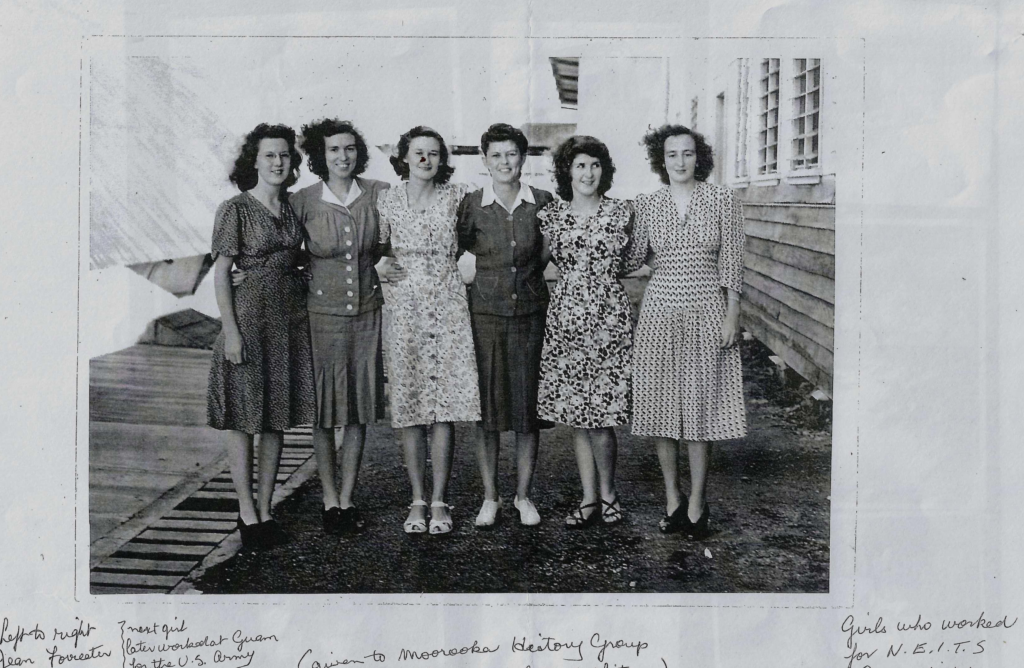
Later, Jean White transferred to the Qantas Engine Overhaul Workshop at Moorooka, where she maintained engineering and parts records. Her career provides a remarkable personal link between the Dutch operational headquarters at Archerfield and the Australian engineering facilities that supported it.
Through her work we can glimpse how closely the operational and technical sides of the Dutch transport organisation were connected.
An Australian contribution to the Dutch war effort
The wartime partnership between Australia and the Netherlands extended well beyond military headquarters and combat operations.
Australian governments provided facilities, Australian industry built workshops, and Australian engineers maintained aircraft that enabled the Dutch Government-in-Exile to continue operating from Australia.
The Moorooka workshop became an important part of that support network. At its peak, around 500 men and women worked across the three engine overhaul workshops established in the area. Although the neighbouring Australian National Airways workshops largely serviced American aircraft, the Qantas-operated facility continued supporting Dutch forces after the war, even as American overhaul work ceased. As per the articles below, by 1946/47 the majority of work at the Workshop was on Dutch planes.
Only when Dutch civilian and military air headquarters returned to Batavia in 1947 did work at the workshop finally begin to decline.
Remembering the hidden infrastructure
Histories of the Dutch presence in Australia naturally celebrate the pilots who flew dangerous missions, the administrators who rebuilt the Government-in-Exile, and the soldiers preparing for the liberation of the Netherlands East Indies.
Equally important, however, were the Australian engineers, mechanics, record keepers and workshop staff whose work remained largely invisible. Without them, aircraft would have been grounded and the Dutch transport network could not have operated.
The story of the Qantas Engine Overhaul Workshop at Moorooka reminds us that Allied cooperation was built not only in conference rooms and military headquarters, but also in engineering workshops where skilled Australians quietly helped keep the NEI Government-in-Exile flying.
Further research
This article draws together recent research that has highlighted the Dutch role of the Moorooka workshop. Future examination of National Archives files may reveal individual aircraft, engine overhaul records and engineering reports that will allow this important chapter of Dutch-Australian wartime cooperation to be documented in even greater detail.