When Germany invaded the Netherlands in May 1940, Queen Wilhelmina and the Dutch Government escaped to London, where they continued as the internationally recognised government of the Kingdom of the Netherlands. Constitutionally, the situation appeared straightforward: the Queen remained Head of State, Prime Minister Pieter Sjoerds Gerbrandy led the government, and political authority rested with the government in exile in London.
The Japanese invasion of Southeast Asia in late 1941 and early 1942 dramatically changed that picture.
With the fall of the Netherlands East Indies (NEI), thousands of Dutch military personnel, civil servants and refugees made their way to Australia. As Dr Jack Ford demonstrates in Allies in a Bind, maintaining a functioning Dutch administration while rebuilding military forces across several continents became an enormous challenge. The wartime alliance between the Netherlands and Australia was shaped not only by close cooperation, but also by distance, competing priorities and overlapping centres of authority.
To understand this period, it is useful to recognise that two parallel stories unfolded simultaneously. One concerned the conduct of the war against Japan. The other concerned the political future of the Netherlands East Indies after the war.
Fighting the war
Military cooperation between the Dutch, Australians and Americans quickly became highly practical. Operational necessity often outweighed political considerations.
Following the loss of the Netherlands East Indies, the Dutch faced severe shortages of aircraft, ships, equipment, spare parts and, perhaps most importantly, trained personnel. Many experienced aircrew, ground staff, technicians and specialist officers had been killed, captured or dispersed throughout the region. Rebuilding an effective fighting force from Australia could only succeed with extensive Allied assistance.
The combined RAAF–NEI squadrons, including No. 18 (NEI) Squadron and No. 120 (NEI) Squadron, were therefore not simply examples of international cooperation—they were born out of necessity. While the Dutch understandably wished to preserve their own identity through Dutch commanders, uniforms, insignia and traditions, they depended heavily on Australian infrastructure, maintenance facilities, logistics, training and ground crews. Without Australian support these squadrons could not have operated effectively.
The same applied across much of the Dutch military effort in Australia. Naval operations, transport, communications and logistics increasingly relied on close cooperation with Australian and American forces operating under General Douglas MacArthur’s South West Pacific Area (SWPA) command. Operational decisions were driven by the immediate demands of the war rather than by constitutional arrangements in London.
Intelligence operations demonstrated an even greater level of integration. As explored in the DACC article Dutch, Australian and Indonesian Agents: The NEI Section of Australia’s Secret War, many missions brought together Dutch, Australian and Indonesian personnel working as mixed teams. Their common objective was defeating Japan.
This cooperation was not always without its challenges. Dutch military organisation reflected a more formal and hierarchical tradition, while Australian forces often adopted a more pragmatic and informal approach. Cultural differences occasionally created misunderstandings, and the Dutch preference to keep military operations as distinctly Dutch as possible was not always compatible with the realities of wartime operations.
The limitations imposed by shortages of personnel and resources also affected some intelligence missions. A number of operations suffered from inadequate preparation, insufficient local knowledge or the simple reality that the Dutch lacked enough experienced personnel to undertake an expanding range of increasingly complex tasks. These were not failures of commitment, but the inevitable consequences of rebuilding a national military after losing an entire colony almost overnight.
Planning for peace
If military cooperation was largely driven by practical necessity, the political situation was considerably more complex.
From the moment the Netherlands East Indies fell to Japan, the overriding objective of the Dutch Government in London was to preserve Dutch sovereignty and prepare for the restoration of Dutch authority once the war ended. Constitutional authority remained firmly with the government in exile, which sought to ensure that the future of the Netherlands East Indies would ultimately be determined in London.
Australia’s interests, however, were evolving. As the principal base from which Dutch military forces and civil administration were rebuilt, Australia inevitably became more than simply a wartime host. The Curtin Government, and particularly Dr H. V. Evatt, increasingly regarded Southeast Asia as central to Australia’s post-war security and believed Australia should have a voice in shaping the future of the region.
Between London and Canberra stood Lieutenant-Governor-General Hubertus van Mook.
Working from Australia, Van Mook was responsible for rebuilding the Netherlands East Indies Commission under extraordinarily difficult circumstances. He remained committed to restoring Dutch authority but also recognised that the pre-war colonial system could not simply be recreated. His support for constitutional reform and greater participation by the peoples of the Netherlands East Indies was more progressive than the views of many senior figures in London, whose immediate priority was to re-establish Dutch control after the war.
Distance, wartime communications and rapidly changing military circumstances inevitably produced misunderstandings. Decisions often had to be made in Australia before instructions arrived from London, while messages crossing half the world sometimes failed to reflect events on the ground.
Brisbane becomes a centre of government
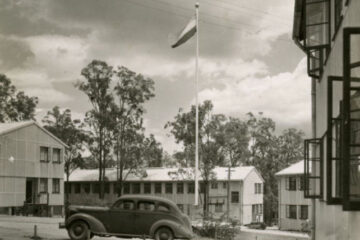
An important milestone came in 1944 with the formal establishment of the Netherlands East Indies Government-in-Exile at Camp Columbia in Brisbane.
While constitutional authority remained with the Dutch Government in London, Brisbane now became the official political and administrative centre from which the Netherlands East Indies Government-in-Exile prepared for the liberation and future administration of the colony. Australia had already become the operational centre of the Dutch war effort in the Pacific; it was now assuming a much greater political role as well.
This inevitably altered the balance within the Kingdom.
London remained determined to retain ultimate constitutional authority, while recognising that many operational and administrative decisions had to be made in Australia. It was also conscious that concentrating too much political and military authority there could potentially reduce London’s direct influence. Concerns that Admiral Conrad Helfrich might relocate from Ceylon to Australia, where Van Mook and the Netherlands East Indies administration were already based, reflected these sensitivities.
At the same time, military operations increasingly proceeded through MacArthur’s headquarters with relatively little day-to-day political involvement from London. The Dutch, Australians and Americans had a common military objective, even while governments were beginning to think about the very different political landscape that would emerge once Japan had been defeated.
An alliance shaped by necessity
The wartime Dutch–Australian partnership was therefore far more than a simple alliance between two governments.
Military cooperation was characterised by pragmatism, necessity and a shared determination to defeat Japan. Political cooperation was more complex, balancing constitutional authority in London, the growing responsibilities of the Netherlands East Indies Government-in-Exile in Brisbane, and Australia’s increasing interest in the post-war future of Southeast Asia.
The alliance succeeded because all parties recognised the overriding priority of winning the war. Yet beneath that common purpose lay differing visions for the future of the Netherlands East Indies and the wider region. Understanding how these military and political relationships developed side by side is essential to understanding the remarkable—and sometimes complicated—Dutch–Australian partnership that Dr Jack Ford explores in Allies in a Bind.
The next article examines the establishment of the Netherlands East Indies Government-in-Exile at Camp Columbia and explains how Brisbane became one of the most important centres of Dutch government outside Europe during the Second World War
Editorial Note
This article forms part of a six-part series based on the research of Dr Jack Ford, as presented in his book Allies in a Bind. Dr Ford has kindly given the Dutch Australian Cultural Centre (DACC) permission to use the chapters of his book as the basis for this series. The articles provide an accessible overview of his research rather than a comprehensive academic study.
A revised edition of Allies in a Bind is currently being prepared for republication, with the support of the Dutch Australian Cultural Centre (DACC). Once published, this series will be reviewed and updated with references to the revised edition and, where appropriate, additional supporting source material.
Readers are encouraged to begin with the introductory article in the series, which explains the historical context, scope and purpose of these articles.
DACC series based on Dr Jack Ford’s Allies in a Bind
The Challenge of Government in Exile – How War Forged an Enduring Dutch–Australian Partnership
London, Brisbane and Canberra- The Competing Centres of Power within the Dutch Wartime Alliance
Preparing to Return to the Netherlands East Indies – Building a Government-in-Exile from Australia
The Road Back to the Netherlands East Indies – How Allied Strategy Shaped the Dutch War Effort
From Liberation to Revolution – The Dutch and their Allies Caught Off Guard
Related DACC series
Australia and the Netherlands East Indies on the eve of war
This four-part series examines how Australia and the Netherlands East Indies moved from limited contact towards direct diplomatic, military, public and economic cooperation immediately before the Pacific War.
A three-part series examining constitutional authority in London and the development of the Netherlands East Indies administration in wartime Australia.
Dutch–Australian wartime cooperation
This six-part thematic series explores particular political, administrative and practical issues within the wartime relationship, including neutrality, tensions between London and the Indies administration, constitutional reform, Indonesian voices, wartime purchasing and the development of Dutch–Australian diplomatic relations.