By 1943, the tide of the Pacific War had begun to turn. Allied victories in New Guinea and the Solomon Islands gave increasing confidence that Japan would eventually be defeated. For the Dutch Government, however, military success created an entirely new challenge. Defeating Japan was only the first step. The equally important question was: who would govern the Netherlands East Indies once Allied forces began to liberate the islands?
Preparing for liberation required much more than military planning. A functioning civil administration had to be ready to move into liberated territories immediately behind the advancing Allied forces. Courts would need to reopen, police forces re-established, ports and communications restored, and essential public services restarted. All of this had to be organised while the Netherlands East Indies remained under Japanese occupation.
As Dr Jack Ford explains in Allies in a Bind, these changing wartime realities transformed both the scale and the purpose of the Dutch presence in Australia.
From Commission to Government
When the Netherlands East Indies Commission was established in Australia in 1942, its primary role was coordination. It acted as the link between the Dutch Government, the Australian Government and the Allied command, overseeing Dutch military, political and administrative activities during a period when survival remained the immediate priority.
By 1944, however, the situation had fundamentally changed.
General Douglas MacArthur’s advance through New Guinea brought the liberation of Dutch territory within sight. Planning could no longer be limited to coordinating the war effort. The Dutch now had to prepare for the restoration of government itself.
The Commission had effectively reached the limits of what it could achieve. Preparing for liberation required departments responsible for finance, justice, education, public works, communications, health, economic affairs and civil administration. It also required clear executive authority to make decisions, allocate resources and prepare policies for territories that had yet to be liberated.
The decision to establish the Netherlands East Indies Government-in-Exile in September 1944 therefore reflected much more than a constitutional change. It recognised that the Dutch now needed a functioning government capable of preparing for the restoration of civil authority as Allied forces advanced.
Several practical factors also influenced the timing. MacArthur’s campaign in Dutch New Guinea accelerated the need for such an organisation, while earlier shortages of staff, accommodation and the heavy operational commitments of Lieutenant-Governor-General Hubertus van Mook had delayed its establishment.
Why Brisbane?
Military developments also made Brisbane the natural location for this expanding government.
As Allied operations moved north, MacArthur progressively relocated his headquarters towards the front, eventually moving to Hollandia in Dutch New Guinea. His departure left the extensive headquarters facilities at Camp Columbia available for other Allied purposes.
At the same time, Brisbane had become the centre of Dutch military activity in Australia. It was considerably closer to New Guinea and the Netherlands East Indies than Melbourne, communications with forward operational areas were more direct, and Australian military support infrastructure was already well established.
The move to Camp Columbia therefore reflected practical wartime needs rather than political symbolism. It provided the space and facilities needed to bring together the growing departments of the Government-in-Exile as preparations for liberation intensified.
Building a government from Australia
The task ahead was immense.
The Dutch were effectively constructing the machinery of government while still in exile. Every aspect of civil administration had to be planned long before officials could return to the Netherlands East Indies.
Yet these ambitions had to be achieved with remarkably limited resources.
Although the southern Netherlands was being liberated during 1944, much of the country remained under German occupation and could contribute little in terms of personnel or material support. Experienced officials were recruited from Dutch diplomatic missions, colonial administrations and other parts of the Kingdom, including the Netherlands Caribbean, but their numbers remained limited.
Australia therefore became indispensable.
Local civilian staff were employed throughout the administration, while Australian personnel provided technical expertise, communications, transport and logistical support. Australian engineers and ground crews also maintained Dutch aircraft and equipment operating from Queensland bases, including Archerfield.
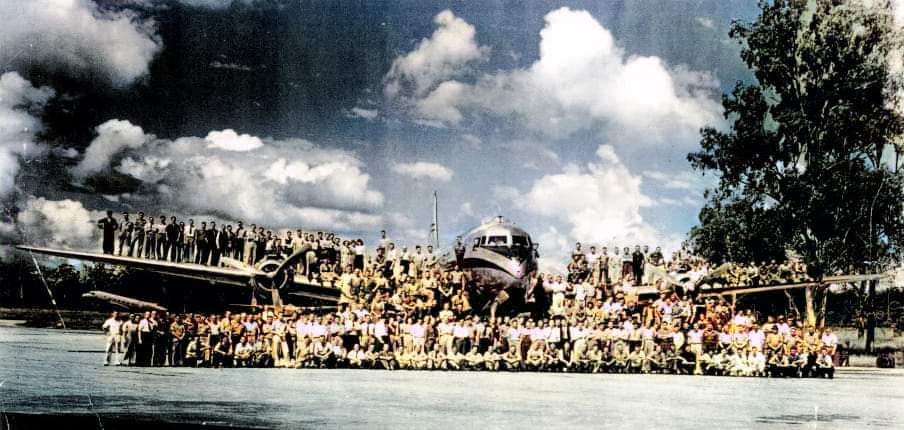
The Government-in-Exile remained unmistakably Dutch in its political authority and purpose. Its practical capacity, however, increasingly depended upon Australian assistance and Allied cooperation.
From planning to implementation
Creating a government was only the first step. It also needed an organisation capable of implementing its plans in liberated territory.
That role fell to the Netherlands Indies Civil Administration (NICA).
Working under the authority of the Government-in-Exile, NICA was organised to accompany Allied military forces into areas as they were liberated. Its responsibilities included restoring civil administration, re-establishing local government, reopening public services, organising food distribution and relief, rebuilding police and judicial systems, and preparing the transition from military to civilian administration.
In many respects, NICA became the Government-in-Exile in action. It transformed planning undertaken in Brisbane into practical administration on the ground as Dutch territory was gradually recovered.
Its creation also demonstrated how closely political planning and military operations had become intertwined. As Allied forces advanced, Dutch civil administration would advance with them.
Different priorities, shared objectives
The establishment of the Government-in-Exile reflected the differing priorities of the Allied partners.
For the Dutch Government in London, preserving sovereignty and preparing for the restoration of lawful government remained paramount.
For van Mook and his deputy van der Plas, working from Australia, faced the practical challenge of building an administration capable of governing again after liberation. While committed to restoring Dutch authority, he also recognised that constitutional reforms would be necessary after the war.
Australia’s role had also evolved. Having become the principal base for Dutch military and administrative activities in the Pacific, Canberra increasingly regarded developments in the Netherlands East Indies as matters of direct strategic interest.
For MacArthur, the priority remained operational. Civil administrations needed to be ready to assume responsibility immediately behind advancing Allied forces, allowing military operations to continue without delay.
Balancing these different priorities required close cooperation throughout the Allied partnership.
Preparing for an uncertain future
By late 1944, the Dutch had built an impressive administrative organisation in Brisbane. Plans had been developed, departments established and NICA prepared to accompany the Allied advance.
Much, however, remained uncertain.
Most Dutch planners assumed that the restoration of Dutch administration would naturally follow Japan’s defeat. While reforms were anticipated, the profound political changes taking place throughout the archipelago during the Japanese occupation were not yet fully appreciated within many Dutch planning circles. Indonesian nationalism had gained new strength and confidence under wartime conditions, creating realities that would fundamentally reshape the post-war environment.
Those challenges still lay ahead.
For the moment, the Government-in-Exile remained focused on preparing for the return to the Netherlands East Indies—a task that represented one of the most ambitious administrative undertakings attempted by any government operating in exile during the Second World War.
Editorial Note
This article forms part of a six-part series based on the research of Dr Jack Ford, as presented in his book Allies in a Bind. Dr Ford has kindly given the Dutch Australian Cultural Centre (DACC) permission to use the chapters of his book as the basis for this series. The articles provide an accessible overview of his research rather than a comprehensive academic study.
A revised edition of Allies in a Bind is currently being prepared for republication, with the support of the Dutch Australian Cultural Centre (DACC). Once published, this series will be reviewed and updated with references to the revised edition and, where appropriate, additional supporting source material.
Readers are encouraged to begin with the introductory article in the series, which explains the historical context, scope and purpose of these articles.
DACC series based on Dr Jack Ford’s Allies in a Bind
The Challenge of Government in Exile – How War Forged an Enduring Dutch–Australian Partnership
London, Brisbane and Canberra- The Competing Centres of Power within the Dutch Wartime Alliance
Preparing to Return to the Netherlands East Indies – Building a Government-in-Exile from Australia
The Road Back to the Netherlands East Indies – How Allied Strategy Shaped the Dutch War Effort
From Liberation to Revolution – The Dutch and their Allies Caught Off Guard
Other series
Australia and the Netherlands East Indies on the eve of war
This four-part series examines how Australia and the Netherlands East Indies moved from limited contact towards direct diplomatic, military, public and economic cooperation immediately before the Pacific War.
A three-part series examining constitutional authority in London and the development of the Netherlands East Indies administration in wartime Australia.
Dutch–Australian wartime cooperation
This six-part thematic series explores particular political, administrative and practical issues within the wartime relationship, including neutrality, tensions between London and the Indies administration, constitutional reform, Indonesian voices, wartime purchasing and the development of Dutch–Australian diplomatic relations.