For more than three years, the Netherlands East Indies (NEI) Government-in-Exile had worked from Australia towards a single objective: the restoration of Dutch authority in the Netherlands East Indies following Japan’s defeat.
Government departments had been established in Brisbane. The Netherlands Indies Civil Administration (NICA) had recruited and trained administrators to accompany Allied forces into liberated territory. Dutch military units had fought alongside American and Australian forces, while the Netherlands Forces Intelligence Service (NEFIS) had become a trusted intelligence partner within General Douglas MacArthur’s South West Pacific command.
By August 1945, years of planning appeared ready to bear fruit.
Then Japan surrendered.
Ironically, the Allied victory that the Dutch Government-in-Exile had worked towards since 1942 created an entirely new political reality—one that neither the Dutch nor their Allies had fully anticipated.
Preparing for a new Kingdom
The Dutch Government-in-Exile was not simply planning to restore the pre-war colonial administration.
Even before the Japanese invasion, the Visman Commission had begun examining the future constitutional relationship between the Netherlands and its overseas territories. Queen Wilhelmina’s famous 1942 radio address from London called for a new partnership within the Kingdom after the war, while Lieutenant Governor-General Hubertus van Mook advocated greater autonomy for the Netherlands East Indies within a restructured constitutional framework.
The Dutch envisaged a Kingdom in which the Netherlands, the Netherlands East Indies, Suriname and the Caribbean territories would enjoy much greater self-government while remaining united under the Dutch Crown. In many respects, the concept resembled the evolving British Commonwealth—a partnership of autonomous countries rather than a centrally governed colonial empire.
For the Netherlands Government-in-Exile, this represented a significant departure from the pre-war colonial system. It acknowledged that change was inevitable, while seeking to preserve the unity of the Kingdom.
The original Visman Commission report is attached below to this article for readers interested in exploring these wartime constitutional proposals in greater detail.
A different vision emerges
The Japanese occupation, however, had transformed Indonesia in ways few Allied planners fully appreciated.
Indonesian nationalism had long pre-dated the war, but the occupation accelerated its development. Seeking local support for their own war effort, the Japanese increasingly relied on Indonesian leaders such as Sukarno and Mohammad Hatta, expanded Indonesian participation in civil administration and created organisations such as PETA (Pembela Tanah Air), providing military training and organisational experience to thousands of young Indonesians.
These measures were intended to strengthen Japan’s wartime position rather than create an independent Indonesia. Nevertheless, they fostered political confidence, administrative experience and military organisation that profoundly changed the balance of power within the archipelago.
While the Dutch were preparing to reform the Kingdom under continued Dutch sovereignty, many Indonesian nationalists had come to believe that the time had arrived for full independence.
Victory—and a humanitarian emergency
When Japan accepted the Allied terms of surrender on 15 August 1945, the immediate priorities of the Allied authorities were humanitarian rather than political.
Across the Netherlands East Indies, approximately 100,000 Dutch civilian internees—many of them women and children—and tens of thousands of Allied prisoners of war remained in Japanese camps. Years of internment had left many suffering from severe malnutrition, disease and exhaustion.
British-led RAPWI (Recovery of Allied Prisoners of War and Internees) teams were established to locate, liberate and care for prisoners and civilian internees until they could be evacuated. At the same time, the Netherlands authorities, working closely with Australia, expanded the Netherlands Indies Welfare Organisation for Evacuees (NIWOE) to receive evacuees arriving in Australia.
Brisbane once again became an important centre for the Dutch war effort. Ships and aircraft transported liberated civilians, wounded military personnel and vulnerable refugees to Australia, where hospitals and rehabilitation centres provided medical treatment, recuperation and temporary accommodation before many eventually returned to the Netherlands or the Netherlands East Indies.Other cities across Australia also hosted refugees and returning POWs.
For thousands of former internees, Australia represented not the end of the journey, but the first place of safety after years of imprisonment.
A political vacuum
The humanitarian crisis unfolded against an increasingly unstable political background.
Although Japan had surrendered, Allied occupation forces had not yet arrived in sufficient strength across much of the archipelago. Japanese troops had been ordered to maintain order until relieved by Allied forces, while NICA teams were preparing to resume civil administration in areas as they were progressively liberated.
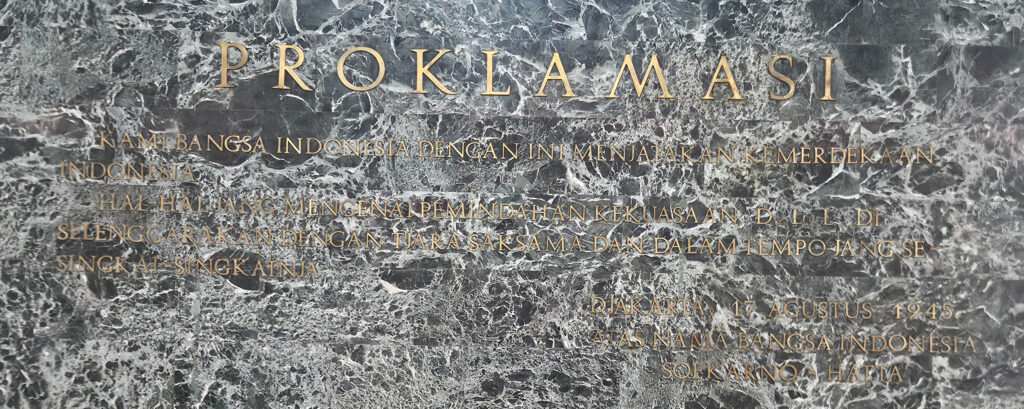
Before these plans could be fully implemented, Sukarno and Mohammad Hatta proclaimed the independent Republic of Indonesia on 17 August 1945.
This Proklamasi fundamentally challenged the assumptions on which Allied planning had been based.
Legally, the Netherlands remained the internationally recognised sovereign authority over the Netherlands East Indies. Britain, Australia and the United States initially continued to recognise that position and expected Dutch civil administration to resume after the Japanese surrender.
On the ground, however, events moved far more rapidly than diplomatic planning.
In the weeks that followed, armed youth groups—the pemuda—seized weapons and asserted Republican authority in many areas. Violence erupted against Europeans, Eurasians, Chinese and Indonesians regarded as collaborators. This chaotic and often brutal period became known as the Bersiap.
For British forces under Admiral Lord Louis Mountbatten’s South East Asia Command, the mission expanded dramatically. They were now required not only to accept the Japanese surrender and liberate prisoners, but also to restore public order, protect civilians and facilitate the return of Allied civil administrations in an increasingly volatile political environment.
An uncertain future
The Dutch had spent more than three years preparing for liberation.
They had anticipated constitutional reform within a restructured Kingdom.
They had not anticipated that victory would coincide with a declaration of independence and the collapse of public order across large parts of the archipelago.
Nor had their Allies.
At the moment of Japan’s surrender, Britain, Australia and the United States still broadly supported the restoration of Dutch administration under internationally recognised sovereignty. None had yet fundamentally questioned the Dutch constitutional proposals. Their immediate concern was humanitarian relief, military security and the orderly implementation of Japan’s surrender.
Those priorities would soon collide with the rapidly changing political realities in Indonesia.
The defeat of Japan ended the Pacific War, but it did not bring peace to the Netherlands East Indies. Instead, it marked the beginning of a new and complex political struggle that would reshape relations between the Netherlands, Australia and the emerging Republic of Indonesia. That transformation—and the gradual divergence of Allied policies—forms the subject of the final article in this series.
Editorial Note
This article forms part of a six-part series based on the research of Dr Jack Ford, as presented in his book Allies in a Bind. Dr Ford has kindly given the Dutch Australian Cultural Centre (DACC) permission to use the chapters of his book as the basis for this series. The articles provide an accessible overview of his research rather than a comprehensive academic study.
A revised edition of Allies in a Bind is currently being prepared for republication, with the support of the Dutch Australian Cultural Centre (DACC). Once published, this series will be reviewed and updated with references to the revised edition and, where appropriate, additional supporting source material.
Readers are encouraged to begin with the introductory article in the series, which explains the historical context, scope and purpose of these articles.
DACC series based on Dr Jack Ford’s Allies in a Bind
The Challenge of Government in Exile – How War Forged an Enduring Dutch–Australian Partnership
London, Brisbane and Canberra- The Competing Centres of Power within the Dutch Wartime Alliance
Preparing to Return to the Netherlands East Indies – Building a Government-in-Exile from Australia
The Road Back to the Netherlands East Indies – How Allied Strategy Shaped the Dutch War Effort
From Liberation to Revolution – The Dutch and their Allies Caught Off Guard
Other series
Australia and the Netherlands East Indies on the eve of war
This four-part series examines how Australia and the Netherlands East Indies moved from limited contact towards direct diplomatic, military, public and economic cooperation immediately before the Pacific War.
A three-part series examining constitutional authority in London and the development of the Netherlands East Indies administration in wartime Australia.
Dutch–Australian wartime cooperation
This six-part thematic series explores particular political, administrative and practical issues within the wartime relationship, including neutrality, tensions between London and the Indies administration, constitutional reform, Indonesian voices, wartime purchasing and the development of Dutch–Australian diplomatic relations.