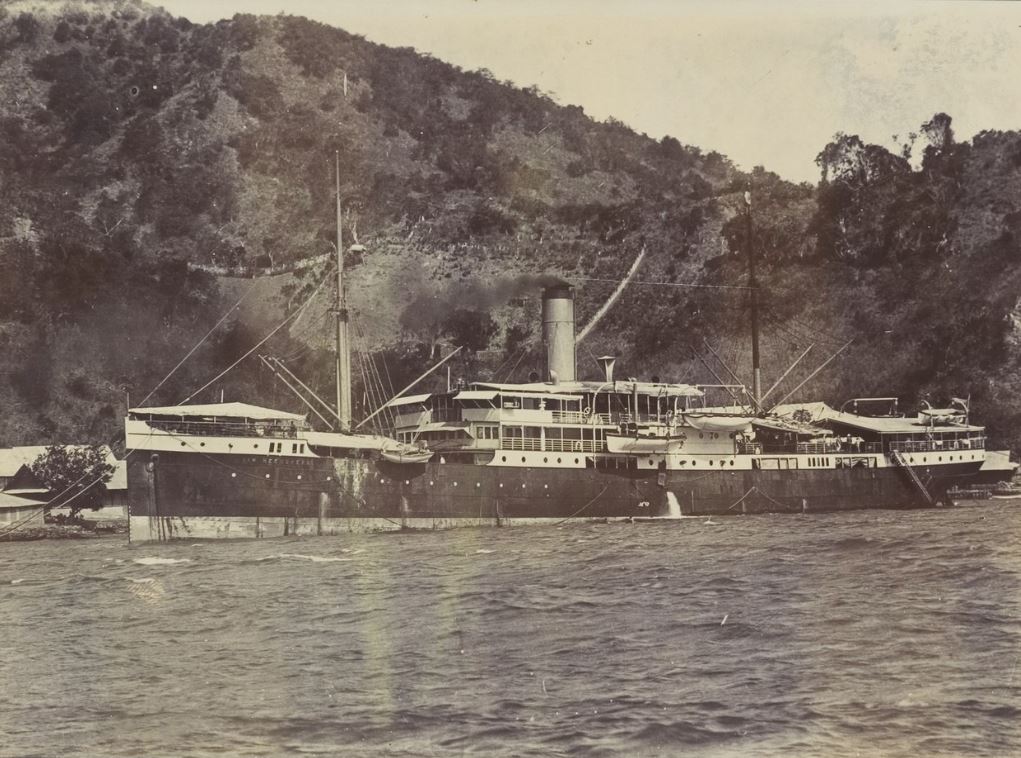
The KPM steamship Van Heemskerk served as a military transport throughout the critical first year of the Allied campaign in New Guinea. After escaping the Japanese conquest of the Netherlands East Indies, she carried Australian and American troops, military equipment, fuel and ammunition from Australian ports to the fighting front.
Van Heemskerk survived repeated Japanese air attacks, including a damaging raid at Merauke in December 1942. She was finally destroyed at Milne Bay on 14 April 1943 while carrying supplies for the Allied campaign.
Her wartime history illustrates both the strategic importance of the Koninklijke Paketvaart-Maatschappij fleet and the dangers faced by its Dutch officers and predominantly Indonesian crews.
An experienced inter-island vessel
Van Heemskerk was built for the KPM by the Nederlandsche Scheepsbouw-Maatschappij in Amsterdam. Launched on 31 August 1909 and completed later that year, she was a passenger and cargo steamship of 2,996 gross tons.[1]
The ship was approximately 95 metres long and was powered by a triple-expansion steam engine. She had accommodation for first- and second-class passengers as well as a much larger number of deck or steerage passengers, reflecting the diverse traffic carried by KPM vessels throughout the Netherlands East Indies.[2]
Van Heemskerk had already experienced wartime service during the First World War. In 1918 she was temporarily placed under the control of the British Shipping Controller and managed by the British India Steam Navigation Company. She returned to the KPM in 1919.[3]
By 1941, Van Heemskerk was more than thirty years old. Nevertheless, her size, cargo capacity and suitability for service in small tropical ports made her extremely valuable when war reached the Netherlands East Indies.
From the Netherlands East Indies to Australia
Van Heemskerk survived the Japanese invasion and reached Australia with other ships from the KPM fleet. The vessels remained Dutch-owned, sailed under the Dutch flag and retained their Dutch officers and predominantly Indonesian crews. Operationally, however, they were placed at the disposal of the Allied command.
The surviving KPM ships represented far more than the remaining assets of a commercial company. They were among the few vessels immediately available in Australian waters that could carry troops and supplies into the relatively undeveloped ports of New Guinea.
Van Heemskerk consequently became part of the transport fleet supporting General Douglas MacArthur’s Southwest Pacific Area command.
Convoy ZK8
Van Heemskerk’s first major assignment from Australia was participation in Convoy ZK8. The convoy left Sydney on 18 May 1942 carrying 4,735 members of the Australian 14th Brigade and supporting units to Port Moresby.[4]
The Australian troops and their equipment were carried aboard four KPM vessels: Bantam, Bontekoe, Van Heemskerk and Van Heutsz.
The convoy was initially escorted by the Dutch light cruiser Tromp and the Australian destroyer Arunta. On 23 May, escort responsibility passed to the Australian warships Swan, Goulburn and Cessnock. The ships reached Port Moresby without loss.[5]
The successful voyage helped reinforce Port Moresby at a time when an attack on the town appeared imminent. It also demonstrated that the KPM vessels could be incorporated into the Allied convoy system and used to move substantial military forces from Australia to New Guinea.
Defending Merauke
Later in 1942, Van Heemskerk was used to supply Merauke on the southern coast of Dutch New Guinea. Merauke was the principal Netherlands East Indies settlement in New Guinea that remained outside Japanese occupation.
Dutch forces were determined to hold the town. Its initial garrison included a KNIL heavy-weapons company and three Royal Netherlands Navy minesweepers. Small vessels maintained a supply service from Darwin, while Van Heemskerk was employed to deliver larger cargoes.[6]
On 27 December 1942, Japanese aircraft attacked Merauke. Van Heemskerk was severely damaged and members of her crew were killed or wounded. Sources differ slightly over whether the ship was attacked on both 26 and 27 December, but the principal damaging raid occurred on 27 December.[7]
Despite the seriousness of the damage, Van Heemskerk was saved. She was taken to Brisbane, repaired and returned to operational service. Her recovery was important because the Allies had very few ships suitable for the New Guinea coastal supply routes.
Operation Accountant
In February 1943, Van Heemskerk joined Bontekoe and Karsik in Operation Accountant. During five convoy voyages between 21 February and 4 March, the three Dutch ships transported approximately 3,200 men of the United States 162nd Infantry Regiment from Port Moresby to Oro Bay.[8]
The movement took place in stages between 21 February and 4 March 1943. It brought an additional American regiment into the New Guinea theatre following the conclusion of the Buna–Gona campaign and in preparation for further Allied operations along the northern coast.[9]
Van Heemskerk’s participation demonstrates how quickly she returned to service after being damaged at Merauke. Within weeks of undergoing repairs in Brisbane, the ship was again carrying troops into a forward operational area.
Convoy TN67
Van Heemskerk’s final voyage began when she left Townsville on 6 April 1943 as part of Convoy TN67. The convoy also included the KPM ships Bontekoe and Balikpapan and was escorted by the Australian destroyer Stuart.[10]
Van Heemskerk and Balikpapan were intended to proceed towards the New Guinea supply area. Because Port Moresby was under heavy Japanese air attack, the two ships were redirected to Milne Bay. They were escorted there by the Australian corvette HMAS Kapunda and arrived on 14 April.[11]
Van Heemskerk carried troops as well as a dangerous cargo that included fuel and ammunition. The troops were disembarked, but there was insufficient time to unload the remaining cargo before Japanese aircraft appeared over Milne Bay.
The Japanese attack on Milne Bay
The raid formed part of Operation I-Go, a major Japanese air offensive directed against Allied shipping, airfields and bases in New Guinea and the Solomon Islands.
Van Heemskerk, Balikpapan, Van Outhoorn and the British ship Gorgon were in Milne Bay when nine Japanese dive-bombers attacked. The KPM ships were particularly vulnerable while unloading because they could not immediately put to sea.[12]
To strengthen Van Heemskerk’s defences, a group of approximately twenty United States soldiers remained aboard. Jeeps mounting .50-calibre machine guns were positioned over the cargo hatches to provide improvised anti-aircraft protection.[13]
The defenders survived several low-level attacks before a bomb struck a hold containing ammunition and fuel. The resulting fire spread rapidly. Efforts were made to control it, but the ammunition cargo made it impossible to save the vessel.
At approximately 5 pm, Van Heemskerk exploded and sank in Milne Bay.[14]
Two American soldiers were killed. Seven other American soldiers and ten members of Van Heemskerk’s crew were wounded.[15] Some secondary accounts give different overall casualty totals, apparently combining deaths and injuries from the December 1942 attack at Merauke with those suffered at Milne Bay.
Van Outhoorn was also seriously damaged by near misses during the raid. Eight of her crew were killed and twelve crew members and six American soldiers were wounded. Balikpapan survived and was credited with helping shoot down Japanese aircraft.[16]
The last KPM ship lost during Operation Lilliput
Van Heemskerk was the third and last Dutch merchant ship lost during Operation Lilliput. ’s Jacob had been sunk near Oro Bay on 8 March 1943, followed by Bantam on 28 March. Together, these losses removed valuable ships from an already limited pool of suitable transports.
Operation Lilliput nevertheless continued. Of its 40 planned convoy stages, 39 were completed. The destruction of Van Heemskerk caused the only cancellation.[17]
The loss also reinforced KPM concerns about inadequate protection and salvage facilities in the forward ports. Dutch representatives had already complained about the lack of firefighting equipment, pumps, tugboats and dependable air cover. The destruction of three Dutch ships within less than a month demonstrated that these concerns were justified.[18]
The contribution of the crew
The history of Van Heemskerk cannot be understood solely through her cargoes and convoy movements. The ship remained operational because her Dutch officers and Indonesian seafarers continued to serve under exceptionally dangerous conditions.
They took the ageing vessel from the Netherlands East Indies to Australia, carried Australian troops to Port Moresby, supplied the Dutch position at Merauke and transported American reinforcements to Oro Bay. After surviving a serious air attack and undergoing repairs in Brisbane, they returned to the New Guinea supply route.
Van Heemskerk’s destruction at Milne Bay brought this service to an end. Her story nevertheless demonstrates how the surviving KPM fleet became an integral part of the Allied war effort and how closely Dutch, Indonesian, Australian and American personnel worked together during the New Guinea campaign.
Return to the Dutch Merchant Fleet and the Allied War Effort in Australia – Portal.
Endnotes
[1] Lloyd’s Register of Shipping, entry for Van Heemskerk; Nederlandsche Scheepsbouw-Maatschappij construction records. The vessel was launched on 31 August 1909 and completed on 29 October 1909.
[2] Lloyd’s Register of Shipping; Mercantile Navy List. Van Heemskerk was powered by a single triple-expansion engine and had a service speed of approximately 10½ knots.
[3] Mercantile Navy List, 1919, p. 582. Van Heemskerk was returned to the KPM in February 1919.
[4] G. Hermon Gill, Royal Australian Navy 1942–1945, Australia in the War of 1939–1945, Series 2, vol. II (Canberra: Australian War Memorial, 1968), account of Convoy ZK8, May 1942.
[5] Gill, Royal Australian Navy 1942–1945; Royal Australian Navy operational records for HMA Ships Arunta, Swan, Goulburn and Cessnock.
[6] Jonathan Ford, “The Netherlands Merchant Navy in the Pacific War,” Journal of Australian Naval History, vol. 6, no. 1 (2009), discussion of the defence and supply of Merauke.
[7] Jack Ford, “The Netherlands Merchant Navy in the Pacific War.” Contemporary records identify 27 December 1942 as the date of the principal damaging raid on Van Heemskerk at Merauke.
[8] James R. Masterson, U.S. Army Transportation in the Southwest Pacific Area, 1941–1947 (Washington: Transportation Unit, Historical Division, Special Staff, United States Army, 1949), account of troop movements to Oro Bay; Ford, “The Netherlands Merchant Navy in the Pacific War.”
[9] United States Army records for the movement of the 162nd Infantry Regiment; Masterson, U.S. Army Transportation in the Southwest Pacific Area.
[10] Gill, Royal Australian Navy 1942–1945, p. 281.
[11] Gill, Royal Australian Navy 1942–1945, p. 281; HMAS Kapunda operational history.
[12] G. Hermon Gill, Royal Australian Navy 1942–1945, pp. 281–283. Contemporary Australian naval records place the destruction of Van Heemskerk at Milne Bay on 14 April 1943.
[13] Samuel Eliot Morison, Breaking the Bismarcks Barrier, 22 July 1942–1 May 1944, History of United States Naval Operations in World War II, vol. VI (Boston: Little, Brown and Company, 1950), pp. 126–127.
[14] Gill, Royal Australian Navy 1942–1945, p. 281.
[15] Ford, “The Netherlands Merchant Navy in the Pacific War”; Gill, Royal Australian Navy 1942–1945, p. 281.
[16] Ford, “The Netherlands Merchant Navy in the Pacific War”; Gill, Royal Australian Navy 1942–1945, pp. 281–283.
[17] Gill, Royal Australian Navy 1942–1945, p. 269. Operation Lilliput comprised 39 completed convoy movements conducted in 40 planned stages.
[18] Ford, “The Netherlands Merchant Navy in the Pacific War,” p. 88.