The remarkable story behind Opposite the Lion’s Den
During the German occupation of the Netherlands in the Second World War, Daniel Johannes Huygens and his wife Lydia made an extraordinary decision. They opened their home to Jewish friends threatened with arrest and deportation, transforming the upper floor of their house into a secret refuge.
What made their actions particularly dangerous was the location of their home. On the ground floor they operated a hairdressing salon frequented by German personnel and Dutch Nazi sympathisers. Directly across the street stood the headquarters of the SS.
For almost three years, the couple lived with the constant possibility that their activities would be discovered. Their story is one of personal courage, friendship and the willingness of ordinary citizens to defy a brutal occupying regime.
In 1950, Daniel migrated to Australia, followed approximately six months later by Lydia and their two daughters. Their experiences were eventually recorded in Daniel’s autobiography, Opposite the Lion’s Den: A Story of Hiding Dutch Jews, published in Sydney in 1996.
Their lives form an important part of Dutch-Australian history, connecting the Dutch resistance, the rescue of Jewish people during the Holocaust, post-war migration and the preservation of wartime memories in Australia.
Life in the Netherlands before the war
Daniel Johannes Huygens was born in Utrecht in 1908. Before the Second World War, he and Lydia established their lives in the Netherlands, where they operated a hairdressing business.
Their salon was more than a workplace. It brought them into regular contact with people from different backgrounds and provided opportunities for conversation about the increasingly troubling political developments in Germany and Europe.
Daniel had organised a discussion group concerned with the dangers posed by Nazi Germany.
When German forces invaded the Netherlands on 10 May 1940, the country was rapidly occupied. The Dutch armed forces surrendered in the European Netherlands on 15 May, and the occupation authorities progressively introduced measures that excluded Jewish citizens from public life.
Jewish people were dismissed from professions, subjected to registration and restrictions, and increasingly isolated from the wider population. By 1942, the deportation of Jews from the Netherlands to Nazi concentration and extermination camps had begun.
For Jewish families, finding somewhere to hide became a matter of survival. For Dutch citizens willing to shelter them, the consequences of discovery could include arrest, imprisonment and death.
It was against this background that Daniel and Lydia Huygens became involved in rescuing Jewish friends.
A hiding place opposite the SS headquarters
In 1942, the Huygens family began sheltering Jewish people in their home.
The upper storey was adapted to provide a hiding place, while the hairdressing business continued operating downstairs. The arrangement created a striking contrast between the ordinary commercial activities visible to customers and the secret rescue operation taking place above them.
The danger was heightened by the presence of the SS headquarters opposite the house.
German personnel and Dutch fascists were among the salon’s customers. People associated with the occupation authorities could therefore enter the premises without necessarily realising that Jewish people were concealed nearby.
The title of Daniel’s later autobiography, Opposite the Lion’s Den, captures the extraordinary circumstances under which the family lived.
The house offered refuge, but its location also made the risks unusually immediate. An unexpected visit, a suspicious noise, a search or an indiscreet remark could have exposed everyone involved.
Maintaining the appearance of an ordinary household and business became essential to the safety of those sheltering there.
The Jewish people sheltered by the Huygens family
The Hijman family were regular customers of the Huygens family’s hairdressing salon. Their relationship with Daniel appears to have developed through discussions he organised about the growing threat posed by Nazi Germany. As the persecution of Jewish people intensified under German occupation, the daughter of the Hijman family became one of the first people to find refuge in the Huygens home.
Daniel and Lydia subsequently extended their protection to other Jewish acquaintances, including Miep Degen, her sister Beppie, and Beppie’s husband Barend.
According to the publisher’s description of Daniel’s autobiography, Opposite the Lion’s Den, the couple sheltered five Jewish friends. They also provided temporary refuge to Jewish children who were subsequently moved to other safe houses. Their rescue activities therefore appear to have extended beyond the five people accommodated in the upstairs hiding place.
For those in hiding, daily life meant confinement, uncertainty and complete dependence on the courage and discretion of their hosts. The constant threat of discovery restricted their movements and required them to remain out of sight and hearing whenever customers or visitors entered the premises.
For Daniel and Lydia, protecting their guests involved obtaining additional food and supplies, carefully managing movements within the house and maintaining the appearance of an ordinary household and business. The presence of German personnel and Dutch Nazi sympathisers among their customers made these precautions particularly important.
Their actions formed part of the wider civilian resistance in the Netherlands, where individuals, families and underground networks helped Jewish people escape deportation by providing shelter, food, false identity documents and assistance in moving between hiding places.
What distinguished the Huygens family’s circumstances was the extraordinary proximity of the danger. While they continued operating their hairdressing salon, Jewish people were concealed upstairs, directly opposite the local SS headquarters. For almost three years, the family maintained this precarious arrangement, risking their own safety to protect the lives of others.
Daily life under constant threat
One of the most significant aspects of the Huygens story is that their rescue work continued over an extended period.
The publisher describes the autobiography as an account of almost three years of hardship and danger.
Unlike a single act of assistance, sheltering people for months or years required continuing commitment. Every day presented practical challenges and the possibility of discovery.
Food had to be obtained in an increasingly difficult wartime economy. The presence of additional people had to be concealed from visitors and neighbours. The hidden guests had to remain quiet whenever customers or potentially hostile visitors were present.
Accounts of the family’s experiences also mention police searches during which quick thinking helped prevent discovery.
Such incidents underline the vulnerability of everyone in the house. The people being sheltered faced deportation if discovered, while their rescuers risked severe punishment.
The Huygens family’s resistance was not carried out on a battlefield. It took place in a domestic setting, through the daily decisions involved in protecting people whom the Nazi authorities sought to arrest.
This form of resistance required courage, persistence and a profound sense of responsibility towards others.
Liberation and the end of the occupation
The German occupation of the Netherlands ended in stages during 1944 and 1945, culminating in the liberation of the remaining occupied areas in May 1945.
For the Huygens family and those they had sheltered, liberation meant the end of years of immediate danger.
However, the wider consequences of the Holocaust were devastating.
More than 100,000 Jews from the Netherlands were murdered during the Holocaust. The destruction of families and communities left lasting scars on Dutch society.
Against this background, the survival of people protected by families such as the Huygens was especially significant.
Their story illustrates how individual acts of resistance could save lives even within an environment dominated by persecution, fear and state violence.
It also demonstrates that resistance was not confined to organised underground movements. Ordinary citizens, acting through personal relationships and moral conviction, could make a decisive difference.
Migration to Australia in 1950 – a new beginning
Five years after the end of the Second World War, Daniel and Lydia Huygens decided to explore the possibility of building a new life in Australia.
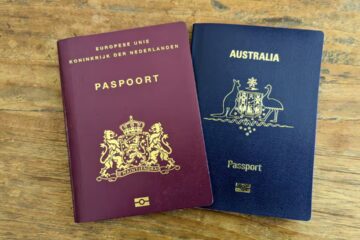
In 1950, Daniel travelled alone to Australia aboard the Dutch passenger ship Sibajak to investigate the opportunities available for himself and his family. Rather than immediately uprooting the entire household, he first wanted to establish whether Australia offered suitable prospects for their future.
Having decided to settle in Australia, Daniel was joined approximately six months later by Lydia and their two daughters, who travelled aboard the Dutch passenger liner Johan van Oldenbarnevelt.
Their migration took place during a period of substantial Dutch emigration to Australia. Following the devastation and economic difficulties of the Second World War, many Dutch families sought new opportunities overseas, and Australia became one of their principal destinations.
The Huygens family eventually settled in Sydney, where they began rebuilding their lives far from the country in which they had experienced the German occupation and had helped save Jewish lives.
Their journey illustrates an important aspect of post-war Dutch migration: the decision to emigrate was often carefully considered, with one family member travelling ahead to investigate employment, accommodation and prospects before the remainder of the family followed.
Recognition by Yad Vashem in 1989
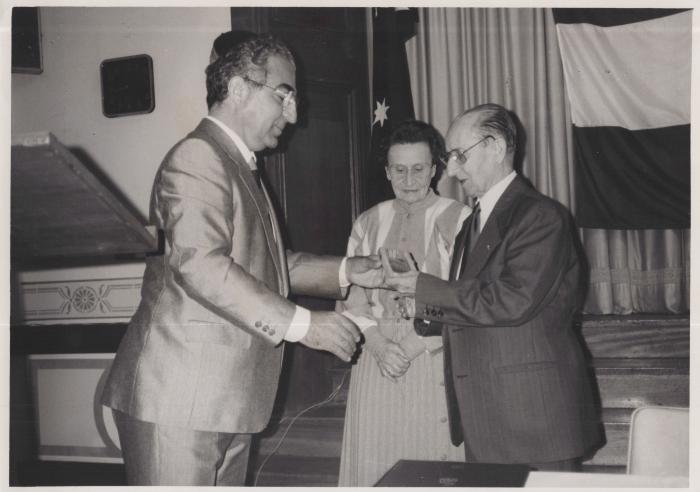
Decades after their wartime activities, Daniel and Lydia Huygens received formal recognition for their efforts to rescue Jewish people.
On 27 October 1989, their recognition as Righteous Among the Nations was commemorated at an award ceremony.
The title Righteous Among the Nations is awarded by Yad Vashem, Israel’s Holocaust remembrance authority, to non-Jewish individuals who risked their lives or freedom to rescue Jewish people during the Holocaust without seeking financial reward.
The recognition acknowledges people who demonstrated exceptional humanity during a period of systematic persecution and mass murder.
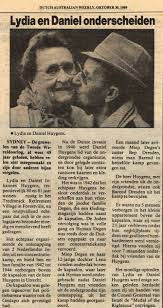
This recognition placed Daniel and Lydia among the Dutch rescuers whose wartime actions have been formally commemorated by Israel.
Opposite the Lion’s Den – preserving the story in a book
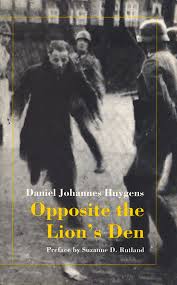
Daniel Huygens recorded his experiences in an autobiography titled Opposite the Lion’s Den: A Story of Hiding Dutch Jews.
The book was published in Sydney by Brandl & Schlesinger in 1996, the year after Daniel’s death.
Australian historian Suzanne D. Rutland contributed a preface, placing the family’s experiences within the broader history of the Holocaust and the persecution of Dutch Jews.
The autobiography describes the day-to-day challenges faced by the family while sheltering Jewish friends over almost three years.
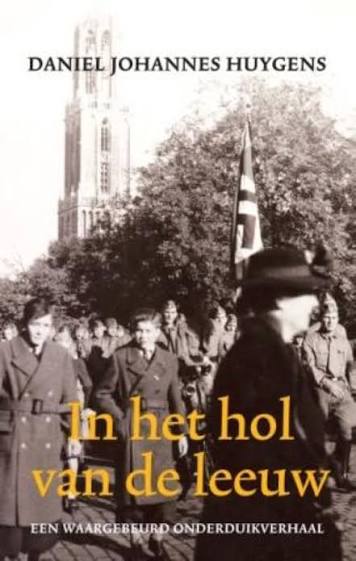
Its importance lies not only in recording a remarkable rescue operation, but also in documenting the domestic realities of resistance.
Accounts of the Second World War often concentrate on military operations, political leaders and organised resistance movements. Personal memoirs such as this reveal another dimension: the experiences of families who risked their safety to protect people in immediate danger.
The book was positively received in Australia. The Canberra Times compared its significance with that of Anne Frank’s diary, describing it as a companion testimony to the period.
The book remains available through the Sydney Jewish Museum’s bookshop, helping make the family’s story accessible to subsequent generations.
The Sydney Jewish Museum and the preservation of Holocaust memory
The Sydney Jewish Museum, established in 1992, plays an important role in documenting the Holocaust and the experiences of survivors and rescuers who subsequently settled in Australia.
Its collections include personal testimonies, photographs, documents and objects that preserve the experiences of people affected by Nazi persecution.
The museum also recognises the actions of non-Jewish individuals who helped rescue Jewish people during the war.
The Huygens family’s story has a connection with the museum through the continuing availability of Daniel’s autobiography in its bookshop.
Family information also indicates that the story was associated with an exhibition at the Sydney Jewish Museum. The title, date, content and precise nature of this exhibition have not yet been established.
The Huygens family’s place in Dutch-Australian history
Daniel and Lydia Huygens represent a distinctive part of the Dutch-Australian experience.
Their lives connect three important historical developments: the Nazi occupation of the Netherlands, the post-war migration of Dutch families to Australia, and the preservation of European wartime experiences within Australian society.
Their story also illustrates how the personal histories of migrants can contribute to the historical memory of both their country of origin and their adopted homeland.
For the Dutch Australian Cultural Centre, recording such experiences is an important part of preserving the broader history of the Dutch community in Australia.
The Huygens family’s contribution extends beyond their own migration story. Their actions during the war saved lives, and Daniel’s autobiography helped ensure that their experiences would not be forgotten.
Through their recognition by Yad Vashem, the publication of Opposite the Lion’s Den, and the preservation of related material in Australia, their courage continues to be remembered.
Daniel Johannes Huygens died in Sydney in 1995.
His legacy, shared with Lydia and their family, remains a reminder that even under the most dangerous circumstances, individuals could choose compassion over indifference and take extraordinary risks to protect others.
Sources and further reading
- DACC – Righteous Among the Nations. Includes the Dutch Australian Weekly article of 30 October 1989.
- Brandl & Schlesinger – Opposite the Lion’s Den. Publisher’s description and author biography.
- Sydney Jewish Museum – Opposite the Lion’s Den. Book information and availability.
- Open Library – Bibliographic record. Publication and catalogue details.
- Yad Vashem – Righteous Among the Nations. Background on the award and recognition criteria.