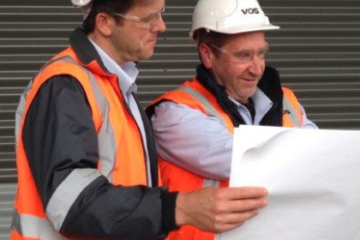
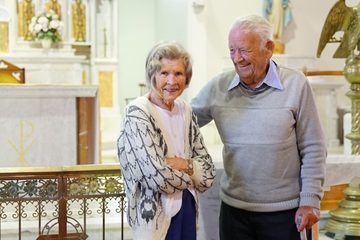
In June and July 1950, two specially organised KLM flights carried Dutch dredging workers and members of their families to Australia. The passengers were associated with the establishment and early operations of Australian Dredging and General Works Pty Ltd, although the precise connection of several individuals with the company remains under investigation.
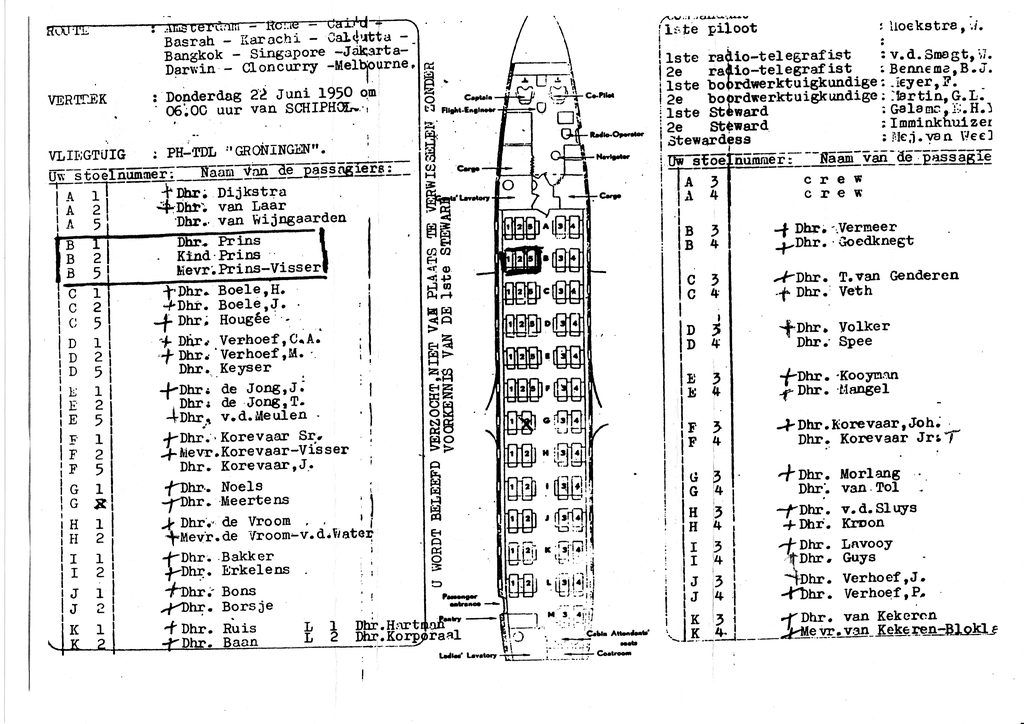
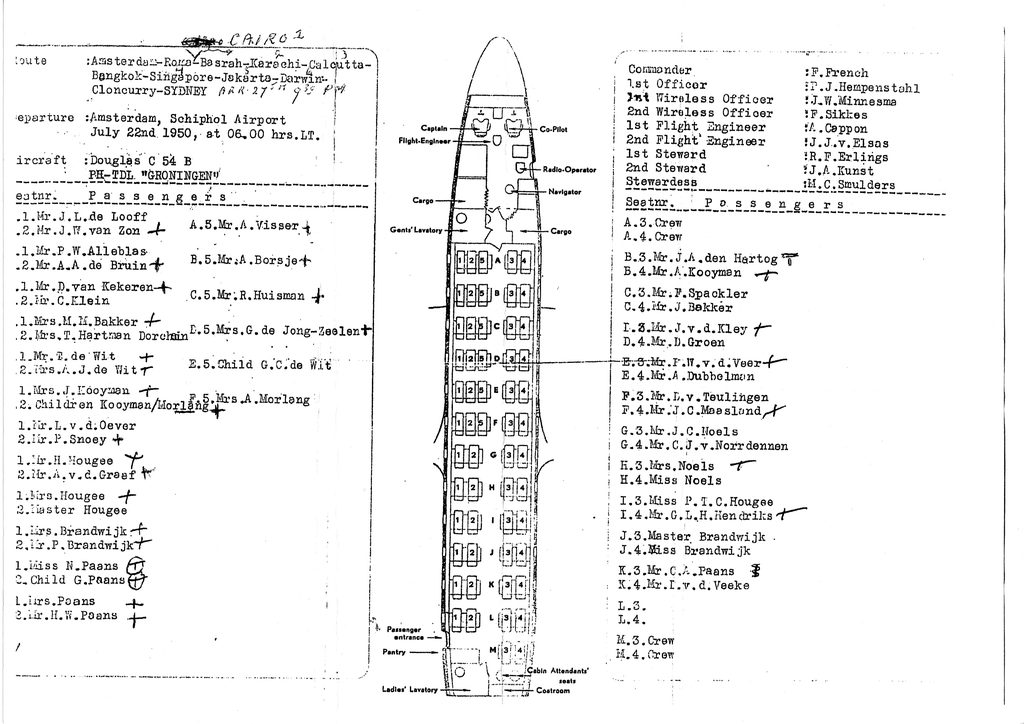
The first flight departed Amsterdam on 22 June 1950 and travelled to Melbourne. The second departed on 22 July and continued to Sydney. Each surviving seating plan records 50 allocated passenger places.
The passengers included skilled dredging workers, engineers, maritime personnel, wives and children. Some remained permanently in Australia, others returned to the Netherlands, and several continued working on dredging projects elsewhere.
This alphabetical register brings together the names recorded on the seating plans and the biographical information recovered so far. Names are alphabetised by the principal part of the surname. The spelling and initials are based on the latest transcription of the seating plans and should not be treated as a definitive official passenger manifest.
Where a separate DACC article has been published, the passenger’s name links to that story. Entries without a link remain subjects for further research.
The two KLM flights
Flight of 22 June 1950
The first group travelled aboard the KLM Douglas C-54B Skymaster Groningen, registration PH-TDL. The seating plan records 45 men, four women and one child. The aircraft travelled from Amsterdam through Europe, the Middle East, Asia and northern Australia before reaching Melbourne.
Flight of 22 July 1950
The second flight carried additional workers and a considerably larger number of women and children. The surviving plan records 50 allocated passenger places, although the actual number of people may have been slightly higher because some children were recorded together or may have shared seats.
Alphabetical passenger register
A
- Petrus Wilhelmus “Peter” Alleblas — Travelled on 22 July in seat B1 and subsequently established his life in Australia.
B
- Dirk Baan — Tugboat captain who travelled on 22 June in seat K2.
- Jelte Bakker — Recorded on the 22 June flight in seat I1. Read the family story of Jelte Lubertus Bakker and Lizelotte Staudinger.
- Mrs M.N. Bakker — Travelled on 22 July in seat D1. Her precise identity and relationship to other Bakker passengers require confirmation.
- Hendrik and Johannis Boele — The two brothers travelled on 22 June in seats C1 and C2.
- Mattheus “Theo” Bons — Travelled on 22 June in seat J1 and later established his family life in Australia.
- Adrianus “Adrian” Borsje — Travelled on 22 July in seat B5 and later lived in Geelong.
- Mr Borsje — A passenger with the same surname also occupied seat J2 on 22 June. His full identity and relationship to Adrianus remain to be confirmed.
- Pieter and Arina Brandwijk and their children — The family occupied seats J1 to J4 on the 22 July flight and later returned to the Netherlands.
- Arie de Bruin — Travelled on 22 July in seat B2. His direct employment connection with the dredging project remains under investigation.
D
- Mr J. Dekker — Travelled on 22 July in seat C4. Further information is sought.
- Mr Dijkstra — Travelled on 22 June in seat A1. His full name and later history remain unknown.
- Abraham Dubbelman — Travelled on 22 July in seat E4, became an Australian citizen and later lived in South Australia.
E
- Anne Pieter Erkelens — Travelled on 22 June in seat I2 and eventually returned to the Netherlands.
G
- Teunis van Genderen — Travelled on 22 June in seat C3.
- Gerrit Goedknegt — Travelled on 22 June in seat B4 and worked as a dredging engineer in Australia.
- Adriaan van de Graaf — Travelled on 22 July in seat H2 and remained in Australia.
- Dirk Groen — Travelled on 22 July in seat D4 and worked for Australian Dredging and General Works.
- Jacob Teunis Guijs, later Guys — Recorded as “Mr Guys” in seat I4 on the 22 June flight.
H
- Mr Hartman — Travelled on 22 June in seat L1.
- Mrs T. Hartman-Dorchein — Travelled on 22 July in seat D2. Her relationship to the June passenger is likely but still requires confirmation.
- Jacob Adrianus den Hartog — Travelled on 22 July in seat B3.
- Mr C.L.H. Hendriks — The latest transcription records this passenger in seat I4 on 22 July. DACC research has identified Petrus Franciscus Martinus Hendriks as the passenger, but the difference in initials still requires resolution.
- Arie Hougee and his family — Mr and Mrs Hougee, Hester Hougee and Miss P.T.C. Hougee occupied seats H1 and I1–I3 on 22 July.
- Rokus Huisman — Travelled on 22 July in seat C5 and later remained in Victoria. Further information about his Australian life is sought.
J
- Joost and Teunis de Jong — The brothers travelled on 22 June in seats E1 and E2.
- Geertrui de Jong-Zeelen — Followed on the 22 July flight and occupied seat D5, reuniting with her husband in Australia.
K
- Arie van Kekeren and Maria Blokland — Travelled together on 22 June in seats K3 and K4 and later returned to the Netherlands.
- Dirk van Kekeren — Travelled on 22 July in seat C1 and later returned to Sliedrecht.
- Johannes Pieter Keyser — Occupied seat C5 on 22 June. Read his personal story.
- Second Mr Keyser — Another passenger with the surname Keyser occupied seat D5 on 22 June. His identity and relationship to Johannes Pieter require further investigation.
- Mr J. van der Kley — Travelled on 22 July in seat D3. Further information is sought.
- Mr C. Klein — Travelled on 22 July in seat C2. Further information is sought.
- Kooyman family — A Mr Kooyman travelled on 22 June in seat E3. A. Kooyman, Mrs J. Kooyman and a child recorded as “Kooyman-Morlang” travelled on 22 July. Their precise relationships and subsequent lives require further research.
- The Korevaar family — Five family members occupied seats F1 to F5 on 22 June. Their migration became the foundation of the later Korevaar marine businesses in Australia.
- Henk Korporaal — Travelled on 22 June in seat L2, later worked in Melbourne and Sydney and settled permanently in Australia. His daughter Glenda Korporaal has written about his migration experience.
- Mr Kroon — Travelled on 22 June in seat H4. His identity has not been established and he should not be assumed to be the Henk Kroon who arrived in Australia by ship later in 1950.
L
- Mr Van Laar — Travelled on 22 June in seat A2. His full name and later history remain unknown.
- Jan Lavooy — Travelled on 22 June in seat I3 and established a new life in Australia.
- Mr J.L. de Looff — Travelled on 22 July in seat A1. Further information is sought.
M
- Jan Cornelis Maasland — Travelled on 22 July in seat F4.
- Oep Mangel — Travelled on 22 June in seat E4 and later lived in Williamstown.
- Bernardus Johannes Meertens — Travelled on 22 June in seat G2 and was later joined by Dana Anna Geervliet.
- Gerrit van der Meulen — Travelled on 22 June in seat E5, returned temporarily to the Netherlands and later migrated again with his family.
- Karel Frederik Lodewijk Morlang and his family — Karel travelled on 22 June in seat G3. Mrs A. Morlang and a child recorded as “Kooyman-Morlang” followed on 22 July.
N
- Adrianus “Janus” Noels — A Mr Noels travelled on 22 June in seat G1. J.G. Noels, Mrs Noels and Miss Noels travelled on 22 July in seats G3, H3 and H4. The precise relationships between these passengers should be recorded carefully.
- Cornelis Jan van Noordennen — Travelled on 22 July in seat G4 and later became a Melbourne shopkeeper.
O
- Mr L. van den Oever — Travelled on 22 July in seat G1. Further information is sought.
P
- Hermanus Wouter “Manus” Paans and his family — H.W. Paans, Mrs Paans, C.A. Paans, Miss N. Paans and a child travelled on 22 July. Their seats were K1–K3 and L1–L2.
- Hendrik and Niesje Prins-Visser and their son Ruud — Travelled together on 22 June in seats B1, B2 and B5.
R
- Kuindert “Kuin” Ruis — Travelled on 22 June in seat K1 and was later joined by members of his family.
S
- Egbert Adriaan van der Sluijs — Recorded as “V. de Sluys” in seat H3 on 22 June. Read his personal story.
- Pieter “Peter” Snoey — Travelled on 22 July in seat G2.
- Frederik “Fred” Spackler — Travelled on 22 July in seat C3.
- Rias Nicolaas Spee — Travelled on 22 June in seat D4.
T
- Dick van Teulingen — Travelled on 22 July in seat F3, worked in the dredging industry and settled permanently in Victoria.
- Herman van Tol — Travelled on 22 June in seat G4.
V
- Pieter Willem van der Veer — The seating transcription records “F.H. van der Veer” in seat E3 on 22 July, while archival research identifies Pieter Willem van der Veer as the passenger. The discrepancy should remain noted.
- Dirk van der Veeke — Travelled on 22 July in seat K4.
- Cornelis Adrianus and Marinus Verhoef — Travelled on 22 June in seats D1 and D2.
- Pieter and Jan Verhoef — Travelled on the same flight in seats J4 and J3.
- Abraham “Abram” Vermeer — Travelled on 22 June in seat B3.
- Govert Veth — Travelled on 22 June in seat C4 and later settled in Perth.
- Adrianus Visser — Travelled on 22 July in seat A5.
- Jan Volker — Travelled on 22 June in seat D3 and was associated with the technical supervision of the project.
- Mr and Mrs De Vroom-van de Water — Travelled on 22 June in seats H1 and H2. Their subsequent lives in Australia remain to be documented.
W
- Pieter van Wijngaarden — Travelled on 22 June in seat A5.
- De Wit family — T. de Wit, Mrs A.J. de Wit and their child G.C. de Wit occupied seats E1, E2 and E5 on 22 July. Further biographical information is sought.
Z
- Jan Willem van Zon — Travelled on 22 July in seat A2. His wife later followed him to Australia.
An evolving research register
This register remains a work in progress. Several initials, spellings and family relationships have not yet been conclusively verified. Presence on a seating plan also does not necessarily establish that every passenger was employed by the dredging company.
The DACC welcomes corrections and additional information, including:
- complete names and dates;
- occupations and company positions;
- family relationships;
- places of residence in Australia;
- information about those who returned to the Netherlands;
- photographs, documents and personal recollections; and
- contact with descendants of the passengers.
Research collaboration and acknowledgement
This register has been developed through collaboration between the Dutch Australian Cultural Centre and researchers Kees van der Sluijs and Fred Stuij of the Historische Vereniging Sliedrecht.
Fred Stuij has undertaken extensive genealogical research into the passengers and their families. Further genealogical information is available through Alblasserwaard Genealogy.
The DACC is publishing the resulting passenger register, personal histories and supporting material to make this shared Dutch-Australian history publicly accessible and to encourage further contributions from families and researchers.
The original seating plans were preserved by Dick van Teulingen and supplied to the DACC by Glenda Korporaal.
Related DACC articles
- From Sliedrecht to Williamstown: Dutch dredging workers and their families in post-war Australia
- Dutch dredging in Australia – Research Portal
- Contemporary newspaper reports on the Sliedrecht–Williamstown dredging migration, 1950–1954
Family reflection
- Glenda Korporaal – “Reflections of a migrant’s daughter”
A personal reflection on Glenda’s father, Henk Korporaal, Dick van Teulingen and the experience of growing up as the daughter of a Dutch migrant.