This is the second article in the DACC Research Series The Netherlands Government-in-Exile, Australia and the Netherlands East Indies during the Second World War. The series explores the political, constitutional and administrative relationship between the Netherlands Government-in-Exile, Australia and the Netherlands East Indies during the Second World War.
Introduction
When German forces invaded the Netherlands on 10 May 1940, they did far more than occupy a European nation. Within five days the Dutch Army had surrendered, Queen Wilhelmina and members of her government had escaped to Britain, and the Kingdom of the Netherlands entered one of the most extraordinary constitutional periods in its history.
Although the Netherlands itself was occupied, the Kingdom continued to exist. From London, Queen Wilhelmina and the Netherlands Government-in-Exile retained full constitutional authority and remained internationally recognised by the Allied powers. That authority extended not only over the occupied Netherlands but also over Suriname, Curaçao and the Netherlands East Indies (NEI), then the largest and economically most important overseas territory of the Kingdom.
For the next five years the Dutch Government faced an unprecedented challenge. It had to govern a kingdom whose constituent parts were scattered across the globe, while preparing simultaneously for the liberation of Europe and the recovery of its Asian territories.
Understanding how that government functioned—and how its relationship with Australia evolved—is fundamental to understanding the Dutch wartime presence in Australia.
Historical perspective
This series examines the wartime relationship between the Netherlands, Australia and the Netherlands East Indies as contemporaries experienced it. Decisions taken in London, Canberra, Batavia, Washington and later Brisbane are considered in the context of the information available at the time, rather than through the benefit of hindsight.
The Kingdom survives
Unlike Belgium, Norway and several other occupied countries, the Dutch Government managed to preserve complete constitutional continuity.
Queen Wilhelmina’s decision to leave the Netherlands before the country’s surrender proved decisive. From London she remained Head of State, while successive governments under Prime Minister Pieter Sjoerds Gerbrandy continued to exercise the constitutional powers of government. Allied nations recognised the Government-in-Exile as the legitimate government of the Kingdom of the Netherlands throughout the war.
This constitutional continuity became one of the Netherlands’ greatest political assets. Although much of the Kingdom’s territory was occupied by Germany or Japan, the state itself never ceased to exist in international law.
For Allied governments this was more than a legal technicality. The Netherlands Government-in-Exile could conclude treaties, direct Dutch armed forces overseas, administer territories that remained outside enemy occupation and represent Dutch interests within the growing Allied coalition.
The Netherlands East Indies: the Kingdom’s greatest overseas possession
The Netherlands East Indies occupied a unique position within the Kingdom.
Stretching across the 5000 km long Indonesian archipelago, the colony was not only geographically vast but also economically indispensable. Before the war, income derived from trade, shipping, oil, rubber, tin, sugar and other commodities made the Indies one of the principal pillars of the Dutch economy. Dutch companies such as Royal Dutch Shell had become international enterprises largely because of their activities in the Indies.
For the Government-in-Exile, preserving sovereignty over the Netherlands East Indies was therefore about far more than colonial prestige. It involved the future economic recovery of the Kingdom itself.
At the same time, ministers in London recognised that the Netherlands East Indies possessed strategic importance far beyond Dutch interests alone. Located astride major sea routes linking the Indian and Pacific Oceans, the archipelago became central to Allied planning once Japan entered the war.
Gerbrandy’s leadership
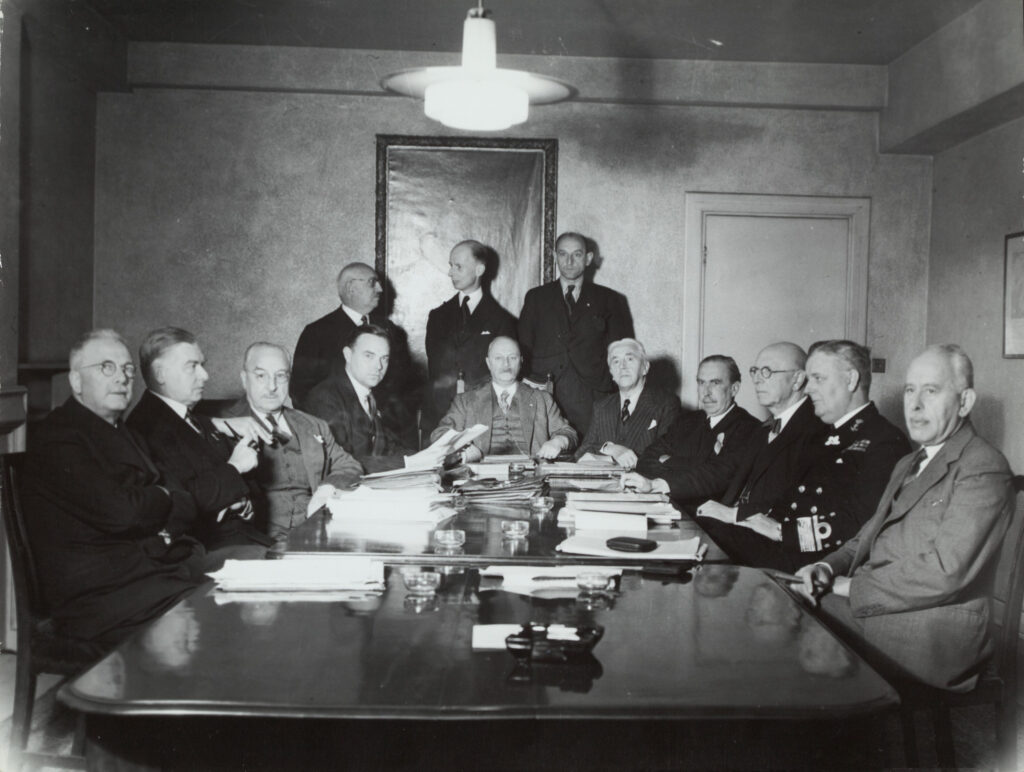
Prime Minister Pieter Gerbrandy brought determination and resilience to government during these difficult years.
A lawyer by training and deeply influenced by his Calvinist beliefs, Gerbrandy regarded the preservation of the Kingdom’s constitutional integrity as one of his foremost responsibilities. Throughout the war he worked tirelessly to maintain Allied recognition of the Dutch Government, support resistance activities in occupied Europe and prepare for eventual liberation.
Yet Gerbrandy’s experience inevitably shaped his outlook.
His political career had been firmly rooted in the Netherlands. Unlike many senior officials responsible for the Netherlands East Indies, he had little direct experience of governing the colony or of the rapidly changing political circumstances emerging in Southeast Asia.
This difference in experience did not weaken his constitutional authority. It did, however, influence how he viewed the future of the Kingdom.
Queen Wilhelmina’s influence
If Gerbrandy provided political leadership, Queen Wilhelmina became the moral authority of the Dutch nation.
Her radio broadcasts from London inspired both occupied Netherlands and Dutch communities throughout the world. She also exercised considerably more influence over policy than many constitutional monarchs, maintaining close contact with ministers and frequently expressing strong views on the future direction of the Kingdom.
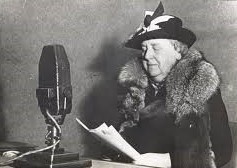
One of her most significant wartime statements came on 6 December 1942.
Broadcast from London to the peoples of the Kingdom, her speech recognised that the relationship between the Netherlands and its overseas territories would require reform after the war. While firmly rejecting the idea of abandoning the Kingdom, she envisaged a new constitutional partnership in which the various parts of the Kingdom would enjoy greater equality while remaining united under the Crown.
The speech represented a remarkable acknowledgement that the pre-war colonial order could not simply be restored unchanged.
It should also be understood within the wider international climate created by the Atlantic Charter of August 1941. Although originally framed as a statement of Allied war aims by Winston Churchill and Franklin D. Roosevelt, the Charter’s language concerning self-government and the right of peoples to determine their own future resonated throughout the colonial world. While Churchill insisted that these principles did not apply to the British Empire, many colonial peoples interpreted them very differently.
Wilhelmina recognised that the Netherlands would need to respond to these changing international expectations.
London and the Indies: different perspectives
The Netherlands Government-in-Exile viewed developments primarily through the experience of occupied Europe.
Senior administrators from the Netherlands East Indies approached the same questions from an entirely different perspective.
Lieutenant Governor-General Dr Hubertus van Mook, Dr Charles Olke van der Plas and many of their colleagues had spent most of their professional lives in the Indies. Some came from long-established Indisch families whose roots in the archipelago extended back several generations. Although fully committed to the continuation of the Kingdom, they regarded the Netherlands East Indies as their home rather than simply as a distant colony administered from Europe.
Their experience gave them a deeper appreciation of the political and social changes taking place within Indonesian society.
This did not make them Indonesian nationalists. They remained loyal representatives of the Dutch Crown and believed that Dutch authority should be restored after the war. Nevertheless, they increasingly recognised that constitutional reform would be necessary if the Kingdom was to adapt successfully to post-war realities.
Thus, while London concentrated on preserving the constitutional integrity of the Kingdom, senior Indies administrators increasingly focused on how Dutch authority might realistically be re-established in a society that had already begun to change profoundly.
These differing perspectives would become increasingly important as the war progressed.
Australia changes the equation
The Japanese conquest of the Netherlands East Indies in early 1942 transformed these constitutional questions into practical ones.
Although the Netherlands Government-in-Exile retained full constitutional authority, the administration responsible for planning the future of the Netherlands East Indies could no longer operate from Batavia.
Australia became its new base.
At precisely the same moment, Australia itself was undergoing a strategic revolution. The fall of Singapore destroyed long-standing confidence in British military protection. Prime Minister John Curtin increasingly turned towards the United States, while Dr H. V. Evatt sought a more independent Australian voice in international affairs. The arrival of General Douglas MacArthur in Australia in March 1942 confirmed Australia’s new role as the principal Allied base in the South West Pacific.
Dutch policymakers immediately recognised the significance of these developments.
Traditionally, the Netherlands had regarded Britain as its principal European ally. Wartime realities now required Dutch officials to work increasingly within an Allied command structure centred on Australia and the United States.
As a result, constitutional authority remained firmly vested in the Netherlands Government-in-Exile in London, while an increasing number of practical decisions concerning the Netherlands East Indies were developed in Australia by Lieutenant Governor-General Van Mook and the Netherlands East Indies Commission for Australia and New Zealand.
This distinction between constitutional authority and operational reality became one of the defining characteristics of the Dutch wartime experience in the Pacific.
It also explains why Australia occupies such a central place in this series.
Conclusion
The Netherlands Government-in-Exile successfully preserved the constitutional continuity of the Kingdom throughout the Second World War. Under Queen Wilhelmina and Prime Minister Gerbrandy it remained the internationally recognised authority over all parts of the Kingdom, including the Netherlands East Indies.
Yet constitutional authority alone could not solve the practical problems created by Japan’s conquest of Southeast Asia.
As the war moved into the Pacific, the centre of day-to-day planning for the future of the Netherlands East Indies increasingly shifted to Australia. There, a generation of experienced Indies administrators led by Van Mook and Van der Plas would begin to shape policies that sometimes reflected a different understanding of post-war realities from that held in London.
Their story is the subject of the next article in this series.
Sources
Ford, Jack, Allies in a Bind: Australia and the Netherlands East Indies in the Second World War (University of Queensland doctoral thesis; published edition, 1997). Page references will be added after verification against the published edition and updated where necessary following publication of the forthcoming revised edition currently being prepared by the Dutch Australian Cultural Centre in consultation with Dr Jack Ford’s family.
Additional sources include Australian, Dutch and Indonesian archival material and published scholarship.
DACC Research Series
The Netherlands Government-in-Exile, Australia and the Netherlands East Indies during the Second World War
This three-part series examines the constitutional and political foundations of the Dutch administration in exile: the authority retained by the Netherlands Government-in-Exile in London and the different perspective that developed among Netherlands East Indies administrators working from Australia.
- A Kingdom divided by war: Australia, the Netherlands Government-in-Exile and the Netherlands East Indies
- The Netherlands Government-in-Exile: Gerbrandy, Queen Wilhelmina and constitutional authority
- Van Mook, Van der Plas and the Indisch vision for the post-war Netherlands East Indies
Related DACC series
Australia and the Netherlands East Indies on the eve of war
This four-part series examines how Australia and the Netherlands East Indies moved from limited contact towards direct diplomatic, military, public and economic cooperation immediately before the Pacific War.
The Challenge of Government in Exile: Wartime Cooperation and an Enduring Dutch–Australian Partnership
This six-part series continues the story by examining how the displaced Netherlands East Indies administration was reconstructed in Australia, how it worked with Australia and the Allied command, and how wartime cooperation was affected by the political transformation of Indonesia after 1945.
Dutch–Australian wartime cooperation
This six-part thematic series explores particular political, administrative and practical issues within the wartime relationship, including neutrality, tensions between London and the Indies administration, constitutional reform, Indonesian voices, wartime purchasing and the development of Dutch–Australian diplomatic relations.