Dutch migrants help shape a growing coastal community
In the years following the Second World War, thousands of Dutch migrants arrived in Australia in search of new opportunities. Many brought skills in engineering, construction, manufacturing and agriculture, while others came with their families hoping to establish a better future after the upheavals of wartime Europe.
Victoria’s Geelong region became an important destination for these newcomers. Its expanding industries offered employment, while nearby coastal settlements such as Torquay provided opportunities for families to build homes and establish themselves in Australian society.
Among the Dutch families who settled in Torquay during the post-war years were the Koopman, Van den Hurk, Van den Dungen and Van ‘t Hag families. Their experiences, documented through family interviews and local recollections, provide an insight into the Dutch contribution to the town’s development.
Another Dutch migrant who eventually made Torquay his home was Dirk (Dick) van Teulingen, whose remarkable life connected wartime Europe, Dutch engineering expertise and post-war Australia.
Together, these stories illustrate how migration, employment, housing, education, sport and family relationships helped transform a small seaside town into a more diverse community.
Why Dutch migrants came to the Geelong region
The post-war expansion of Geelong’s industrial economy created substantial opportunities for skilled European migrants.
One of the most significant projects was the construction of the Shell oil refinery, which involved the Dutch engineering company Werkspoor. The project commenced in 1952, and the refinery opened in March 1954.
Werkspoor’s involvement brought Dutch engineering expertise to the region. Contemporary reports referred to plans to recruit several hundred Dutch specialists for the project, which involved workers from numerous countries.
The refinery was part of a wider period of industrial development in Geelong, creating employment opportunities in engineering, construction, manufacturing and associated trades.
For Dutch migrants, Geelong offered the prospect of employment and an established regional centre with shops, schools, services and developing migrant networks.
Torquay, approximately 21 kilometres away by road, offered a different environment. During the early 1950s, the seaside settlement was expanding, with new residential subdivisions and houses appearing as the town developed beyond its traditional holiday character.
Although Geelong’s industrial expansion attracted substantial numbers of Dutch migrants, not all settled in Torquay. Anna Koopman recalled that many Dutch families worked in Corio and therefore lived closer to their workplaces.
Not all Dutch families who settled in the region were directly connected with major industrial employers. Some established themselves through skilled trades, small businesses and other local employment. The experiences of the early Dutch families in Torquay illustrate this wider pattern of settlement.
The Dutch Australian Cultural Centre has documented this wider history in its articles on the Dutch in Geelong, Werkspoor Australia and the history of Shell in Australia.
Building a home in Torquay – the remarkable story of the Koopman family
Among the earliest Dutch families to settle in Torquay were Cornelis (Cor) and Anna Koopman, who married in the Netherlands in 1943, during the German occupation. According to their youngest son, Peter, Cornelis had been involved in the Dutch resistance during the Second World War, at considerable personal risk.
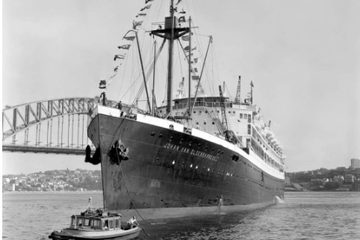
In June 1951, the couple arrived in Australia aboard the Sibajak with their three young children, Catharina, Cees and Marianne.
Their migration story is particularly unusual because they brought a prefabricated house with them from the Netherlands.
Cornelis had constructed the house in the backyard of their home in Bergen, specifically intending to dismantle it and transport it to Australia. He carefully packed the components for shipment, together with a Wolseley motor car. According to the earlier family account, the house’s windows and doors were packed inside the vehicle.
After arriving in Melbourne, the family initially settled in Yarragon, Victoria, where they experienced considerable hardship. They lived in a caravan during a bitterly cold winter while waiting for their belongings to be released from customs.
Once the house became available, Cornelis assembled it, although the family initially had to manage without proper windows and doors because their car remained in customs.
Cornelis found employment as a motor mechanic, but changing employment circumstances encouraged the family to look elsewhere.
In 1952, they decided to move to Torquay, which they had previously visited. Their house was dismantled again and transported by truck across Victoria. Despite mechanical problems and several flat tyres during the journey, it eventually arrived safely.
Cornelis rebuilt the house in Beales Street, a few blocks from the beach, with assistance from two local builders who arranged the necessary permits.
At the time, there were only three houses in the street, surrounded by paddocks. The house initially contained a kitchen, living room, two bedrooms and an outside toilet. A bathroom and additional bedroom were added later.
The Koopmans soon became part of Torquay’s developing community.
In 1952, they built a small second house on their property, allowing them to rent their main house to summer visitors. Their accommodation also provided a temporary home for newly arrived Dutch families, friends and relatives.
Cornelis worked in several occupations, including mechanical repairs, refrigeration, cartage, the Geelong Harbour Trust and the Country Roads Board. He also operated a sand, loam and gravel business.
He contributed to the local community through practical assistance to neighbours and involvement in the construction of St Therese’s Catholic Church.
Anna played an equally important role in establishing the family’s new life. She grew the family’s vegetables, worked part-time as a cleaner and managed the household. The couple maintained friendships with other Dutch migrants throughout the region.
Reflecting on his childhood, Peter recalled:
“Those early years were marked by austerity, hard work and determination to succeed. While there were few luxuries as I was growing up, we had everything we needed, thanks to our parents’ extraordinary resourcefulness and drive.”
The couple eventually had four children: Catharina, Cees, Marianne and Peter, who was born in Geelong in 1959.
Catharina became a teacher and later worked in educational administration. Cees pursued a technical career, including employment with Alcoa. Marianne worked in banking, business and real estate in Torquay.
Their youngest son, Peter, became an internationally recognised developmental geneticist at the University of Queensland. His research contributed to a landmark discovery concerning the genetic mechanisms of sex determination in mammals.
His achievements are documented in the separate DACC article Peter Koopman – From a Dutch Migrant Family in Torquay to a Pioneer of Genetic Research.
Cornelis died on 13 August 1999, aged 86, and Anna died in 2010, aged 95.
Remarkably, the house Cornelis constructed in the Netherlands in 1951 still stands in Torquay. Peter continues to look after the property, including the roses planted and lovingly maintained by his mother.
The family’s experiences were originally recorded in an interview conducted by fellow Dutch migrant Josie Wepster and published in The Turn of the Tide in 1999. The account was republished in History Matters, the magazine of Torquay Museum Without Walls, in September 2026.
Additional information and personal recollections have been provided by Peter Koopman, adding valuable firsthand family perspectives to this remarkable Dutch-Australian migration story.
Growing up Dutch in an Australian seaside town
For the children of Dutch migrants, adapting to life in Torquay involved learning a new language, attending Australian schools and forming friendships outside their own migrant communities.
A published collection of memories of Torquay State School provides an important glimpse into this period.
Former teacher Pat Briody (Garner), who began teaching at the school in 1950, recalled the presence of displaced children, including Dutch and Polish pupils. Some had experienced the disruptions and hardships of war, while others faced the challenge of adjusting to a new country and education system.
These school memories provide a wider context for the experiences of Dutch migrant children in Torquay. Education helped them learn English, form friendships and become part of the local community, while family life often continued to reflect the language and traditions of their Dutch heritage.
Dutch skills and local businesses – the Van den Dungen family
Skilled tradespeople were important to Torquay’s post-war development as new homes were built and the town’s infrastructure expanded.
Among the Dutch families remembered locally was the Van den Dungen family. According to recollections shared with Torquay Museum Without Walls, a family member worked as a plumber and built a home in Boston Road. The plumbing trade reportedly continued into the next generation.
Although further details about the family and its business remain to be established, the recollection illustrates how Dutch migrants contributed practical skills to the development of their new communities.
Sport and professional life – the Van den Hurk family
The Van den Hurk family is another Dutch family remembered in Torquay’s post-war history.
According to local recollections, brothers Ron and Eric Van den Hurk were talented footballers who participated in junior competitions and later became associated with football in Geelong. It has not yet been established whether they played soccer or Australian rules football, or which clubs they represented.
Another family member, Anton, also remembered as Burt, reportedly pursued a medical career and practised in Torquay.
These recollections suggest that members of the family became involved in local sporting and professional life, although further research is needed to establish the details.
Dutch migrants also established several soccer clubs in Geelong during the 1950s, including Shell, Olympia and DSG. Their wider sporting history is documented in the DACC article Clogball: Remembering the 38 Dutch Football Clubs of Australia.
Ron Van ‘t Hag – from Torquay to the Geelong Football Club
Ron Van ‘t Hag, born in Almelo in the Netherlands in 1940, arrived in Australia with his parents as a young teenager. The family settled in the Torquay area, where Ron became involved in Australian rules football.
He developed his skills through local football and went on to play two senior matches for the Geelong Football Club in the Victorian Football League (VFL) in 1959, wearing number 21.
According to local recollections, Ron later married Marianne Bendle, whose family had longstanding connections with nearby Jan Juc.
His story illustrates how sport helped young Dutch migrants become part of Australian community life. While other Dutch migrants in Geelong established soccer clubs, Ron made his mark playing Australian rules football.
Read the full story: Ron Van ‘t Hag – from Almelo to the Geelong Football Club.
Dick van Teulingen – from Dutch dredging to a life in Torquay
Dirk (Dick) van Teulingen (1925–2026) represents another aspect of Dutch migration to the Geelong–Torquay region.
Born in Barsingerhorn in the Netherlands on 8 July 1925, Dick experienced the German occupation during the Second World War. In late 1944, he was rounded up and taken to Germany, where he endured imprisonment and forced labour.
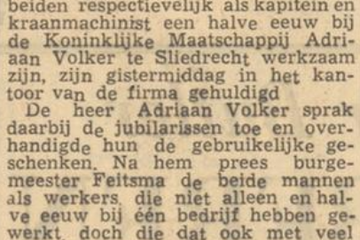
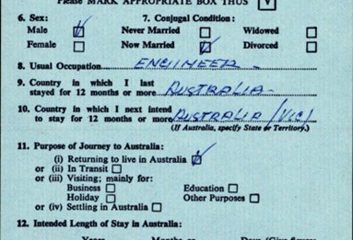
After the war, he worked in the Dutch shipbuilding and dredging industry. In 1950, he travelled to Australia as part of the recruitment of Dutch workers for major dredging projects.
Dick subsequently built a new life in Australia, married Linda and eventually settled in Torquay, where he became a keen supporter of the Geelong Cats. He died in 2026, aged 100.
His remarkable journey is documented in Dick van Teulingen (1925–2026): War, Dredging and a New Life in Australia.
The broader migration history of Dutch dredging workers is explored in From Sliedrecht to Williamstown – Dutch dredging workers and their families in post-war Australia.
A Dutch community connected across Geelong and Torquay
The stories of these families illustrate the different paths taken by Dutch migrants who settled in the Geelong–Torquay region.
For Cornelis and Anna Koopman, migration involved transporting and rebuilding their own home, establishing a livelihood and raising a family in a small coastal community. The Van den Dungen family contributed through skilled trades, while the Van den Hurk family’s recollections point to involvement in local sport and professional life.
Ron Van ‘t Hag’s progression from Torquay football to the VFL demonstrates how a young Dutch migrant became part of Australia’s sporting culture. Dick van Teulingen’s journey from wartime Europe and Dutch dredging to a new life in Torquay reflects another important strand of post-war migration.
Although these families followed different paths, their experiences collectively demonstrate how Dutch migrants became part of the social and economic fabric of regional Australia.
Their stories also remind us that the history of Dutch migration extends well beyond the major industrial centres and organised migrant communities. It can also be found in the homes, schools, businesses, sporting clubs and personal relationships of smaller towns such as Torquay.
Preserving Torquay’s Dutch-Australian heritage
Much of the history of Dutch settlement in Torquay survives through family memories, photographs, school records and local historical collections.
The Dutch Australian Cultural Centre gratefully acknowledges Cheryl Baulch and Torquay Museum Without Walls for their assistance in identifying these families and sharing historical material. The published account of Cornelis and Anna Koopman has been particularly valuable in documenting the experiences of the town’s early Dutch residents.
We welcome further information, photographs and family recollections relating to the Koopman, Van den Hurk, Van den Dungen and Van ‘t Hag families, as well as other Dutch migrants who settled in Torquay and Jan Juc. Additional material will help preserve this important part of the region’s history for future generations.
Sources and further reading
Local history and family recollections
- Josie Wepster, “A House from Across the Sea: How Cornelis and Anna Koopman Carried a Dutch Home to Post-War Australia,” History Matters, Torquay Museum Without Walls, Issue 41, September 2026, pp. 10–14. Originally published in The Turn of the Tide (1999), Torquay (Spring Creek) Community House.
- Torquay Museum Without Walls
- Torquay and District Historical Society – Family Histories
- Memories, Memories, Memories – Torquay State School history
Related Dutch Australian Cultural Centre articles
- The Dutch in Geelong
- Werkspoor Australia
- The history of Shell in Australia – since 1901
- Clogball: Remembering the 38 Dutch Football Clubs of Australia
- Dick van Teulingen (1925–2026): War, Dredging and a New Life in Australia
- From Sliedrecht to Williamstown – Dutch dredging workers in post-war Australia
- Ron Van ‘t Hag – from Almelo to the Geelong Football Club
- MS Sibajak: From Netherlands East Indies mail ship to Dutch emigration ship
This article is part of an ongoing effort to document Dutch migration and settlement in regional Australia. Some family details are based on oral recollections and remain subject to further verification.